Subscribe to the OES Update
|
State Focus
Michigan had higher-than-average employment concentrations of architecture and engineering
occupations and production occupations, and lower-than-average concentrations of
office and administrative support occupations and construction and extraction occupations

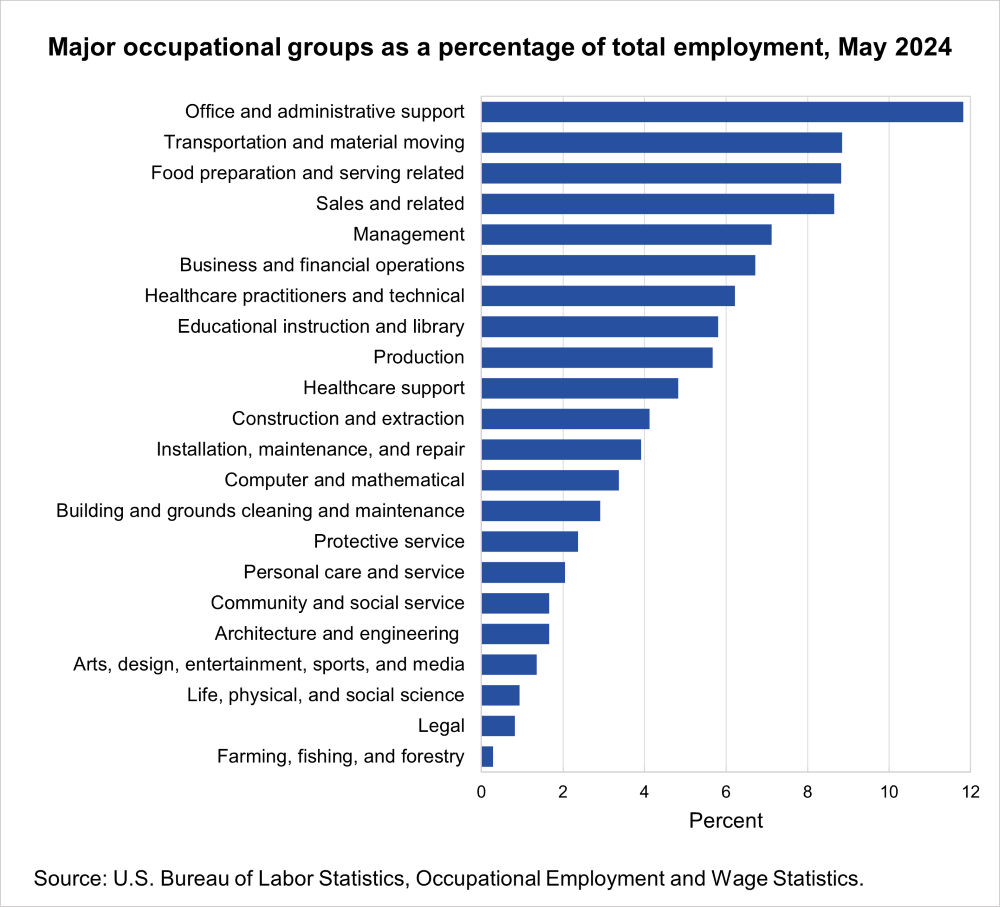
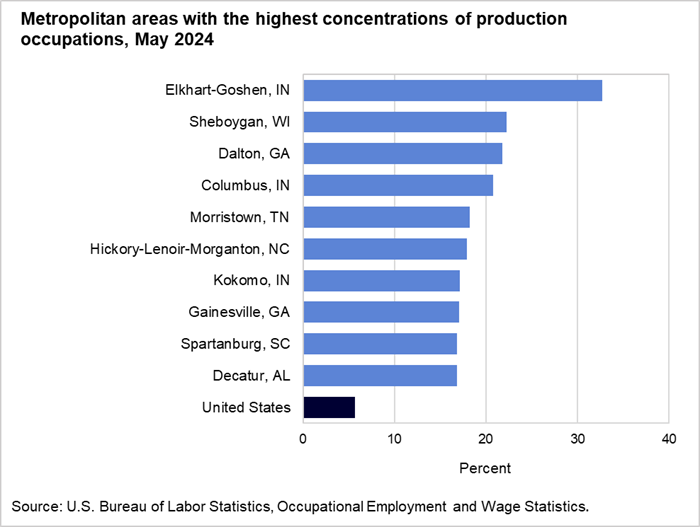
- Production occupations made up 10.4 percent of Michigan's employment but only 7.3 percent of total U.S. employment.
- Office and administrative support occupations made up 17.2 percent of U.S. employment and 15.7 percent of Michigan employment.
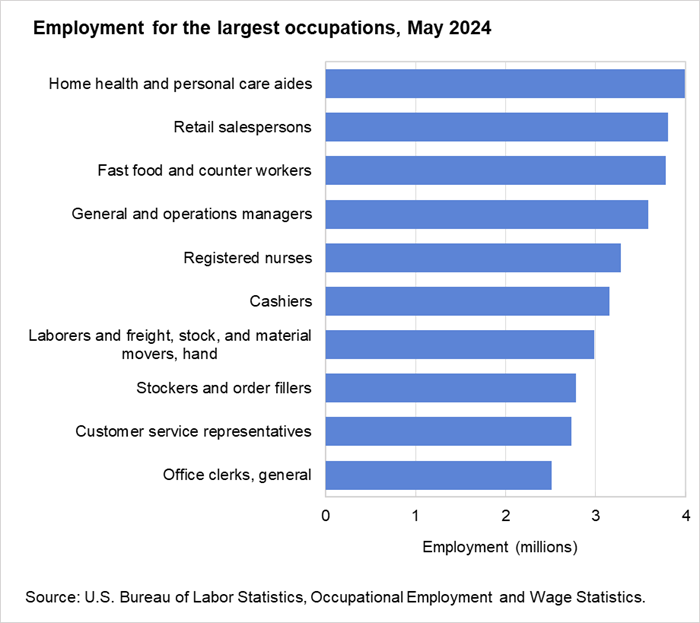
- The largest production occupation in Michigan was team assemblers, with employment of 45,690. The mean hourly wage for this occupation was $13.66 in Michigan and $13.28 in the United States.
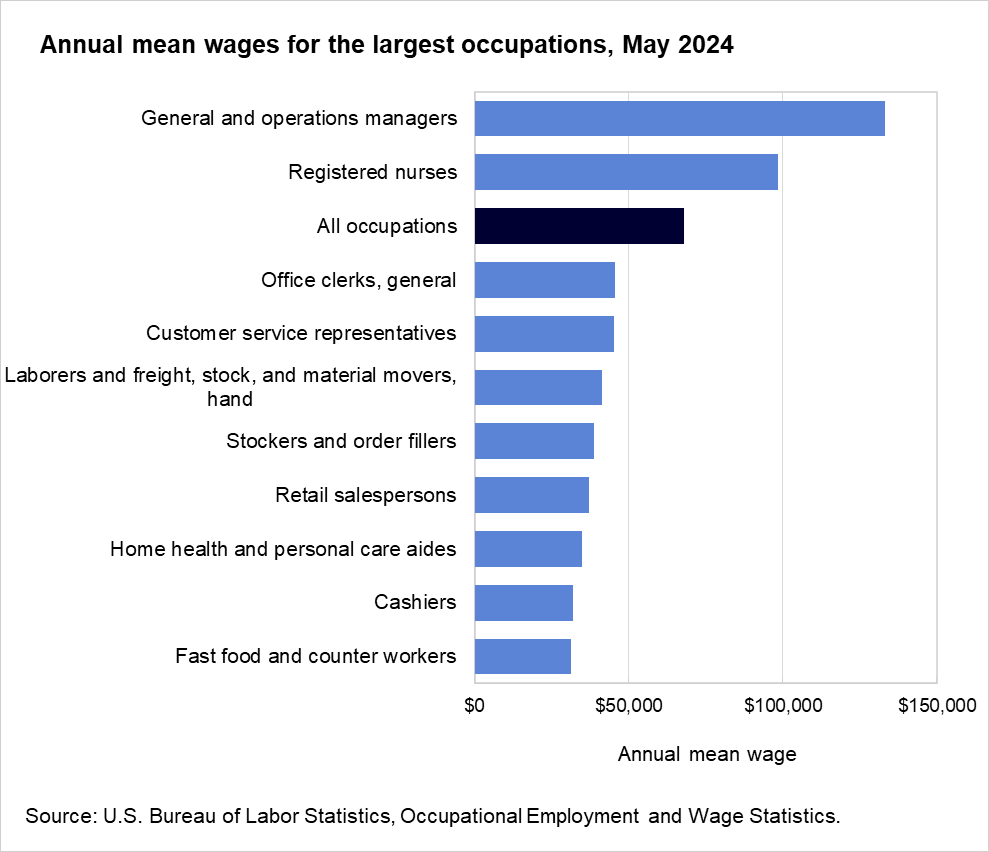
- General office clerks had a mean hourly wage of $13.08 in Michigan, slightly above the U.S. mean hourly wage of $12.90. The lowest paid 25 percent of general office clerks in Michigan earned $9.68 or less, while the highest paid 25 percent earned $15.27 or more.
Structural metal fabricators and fitters had a median hourly wage of $15.58, about the same as the U.S. median wage

- The State with the smallest wage range for structural metal fabricators and fitters was Maine, with a difference between the 90th and 10th percentiles of only $5.90. New York had the widest wage range for this occupation, with a difference of $21.71 between the 90th- and 10th-percentile wages.
- New York and Arizona had similar 10th percentile wages, but New York's 90th-percentile wage was $12.24 higher than Arizona's for this occupation.
- Minnesota had the third-highest median wage of all States for this occupation, $18.18.
States with different rates of layoffs had varying occupational
compositions

- States with high concentrations of employment in computer and mathematical science; business and financial operations; and education, training, and library occupations tended to have low rates of separations due to layoffs. Other occupations in which mass layoffs did not cause many separations also were generally analytical and administrative in nature.
- States with high concentrations of employment in food preparation and serving related, building and grounds cleaning and maintenance, and transportation and material moving occupations tended to have high overall separations rates due to layoffs. Occupations in these groups involved physical labor or were related to personal service and sales, with the exception of some architecture and engineering occupations.
- The rate of mass-layoff-induced separation in each State represents the State's private nonfarm, nonseasonal, and nonvacation separations in 2008 as a percentage of total private, nonfarm employment among establishments with more than 50 employees in the State in March 2008. Separations data are from the BLS Mass Layoff Statistics
program, and total State employment data are from the Quarterly Census of Employment and Wages.
Delaware and California had average wages above the national average in part
because they had above-average wages for their occupations, and in part because
more of their employment was in higher paying occupations

- A State's overall average wage is influenced by two factors—the wages of occupations in the State, and the way in which employment is distributed among higher and lower paying occupations.
- The chart shows the difference between the average wage in the Nation and the average wage in the State (represented by the purple bar), how much of that difference is due to different occupational wages (represented by the orange bar), and how much is due to greater employment concentrations in higher or lower paying occupations as compared with the Nation's occupational composition (represented by the blue bar).
- South Dakota and North Carolina had average wages below the national average because they had below-average occupational wages and more employment concentrated in lower paying occupations.
Real average wages declined in Nevada and Indiana because of shifts in employment towards lower paying occupations as well as declines in the average wages of individual occupations

- A change in a State's real average wage can be divided into two factors: changes in the average wages of workers in specific occupations and changes in the occupational structure of employment—that is, whether on the whole employment is moving from higher to lower paying occupations or from lower to higher paying occupations.
- Each purple bar in the chart shows the change in the real average wage of the State in question. The light blue bar shows the amount of the change in the average wage that is due to changes in the wages of individual occupations, whereas the pink bar shows the amount of the change in the average wage that is due to shifts in employment towards higher or lower paying occupations.
- Real average wages in Colorado and Wyoming rose because of increases in the average wages of occupations and shifts in employment towards higher paying occupations.
- Ohio had a decrease in its real average wage of over $0.20, despite an average increase in occupational wages of almost $0.20, because employment in this State shifted towards lower paying occupations—a pattern also seen in Arizona.
- Wage increases in Illinois and Virginia caused increases in the average wage despite a shift towards lower paying occupations in both States.
- Shifts towards higher paying occupations in New York and Minnesota accounted for the increase in the average wage in each of those States.
- A shift towards higher paying occupations in Georgia and Kentucky slowed the declines in the average wages in these States; in each state, the decrease in the average wage was due to declines in the wages of individual occupations.
States with higher concentrations of employment in computer and mathematical occupations generally had high wages for these occupations

- Virginia, Massachusetts, Maryland, Colorado, and Washington had the highest concentrations of computer and mathematical occupations, with 4 to 5 percent of their employment in these occupations.
- Wyoming, Louisiana, Mississippi, West Virginia, and Nevada each had about 1 percent of total employment in these occupations.
- Virginia had a high level of employment in the following computer and mathematical occupations: computer systems analysts (employment of 33,590); computer software engineers, applications (employment of 31,830); computer software engineers, systems software (26,060); and computer support specialists (18,750).
- The largest computer and mathematical occupations in Wyoming were computer support specialists (employment of 460), computer system analysts (350), network and computer system administrators (300), and computer specialists, all other (280).

- The States with the highest average wages for computer and mathematical occupations were Massachusetts ($86,760), Virginia ($85,650), California ($83,790), New Jersey ($83,120), and Maryland ($82,740).
- The States with the lowest average wages for these occupations were North Dakota ($49,460), Wyoming ($53,270), South Dakota ($53,430), Mississippi ($54,030), and Louisiana ($54,690).
- States with high concentrations of employment in computer and mathematical occupations tended to have more of this employment concentrated in the higher paying computer occupations, including computer systems analysts; computer software engineers, applications; and computer software engineers, systems software. Computer support specialists, the lowest paid of the computer occupations, made up a higher percentage of computer and mathematical employment in States with lower concentrations of employment in the computer and mathematical occupational group.
Previous: Industry focus | Next: Area focus
Last Modified Date: April 2, 2010
|