An official website of the United States government
 United States Department of Labor
An official website of the United States government
United States Department of Labor

The .gov means it's official.
Federal government websites often end in .gov or .mil. Before sharing sensitive information,
make sure you're on a federal government site.

The site is secure.
The
https:// ensures that you are connecting to the official website and that any
information you provide is encrypted and transmitted securely.
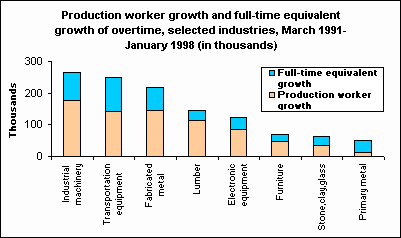
Historically, both employment and factory overtime have increased as the economy emerged from recessions. In the most recent recovery, employers appeared to rely about as heavily on overtime as on hiring or recalling employees.
[Chart data—TXT]
From March 1991 to January 1998, the number of production workers in manufacturing increased by 601,000. Over the same period, the full-time equivalent of the aggregate overtime hours growth in manufacturing was 571,000 jobs.
The largest number of such hypothetical full-time equivalent jobs was found in transportation equipment manufacturing; industrial machinery, and fabricated metals establishments also accounted for many. Other durable goods industries with relatively large full-time equivalents included electronics and primary metals.
These data are a product of the Current Employment Statistics program. To find out more, see "Analyzing the recent upward surge in overtime hours," by Ron L. Hetrick, Monthly Labor Review, February 2000. Full-time equivalents are computed by taking the total number of overtime hours and dividing it by 40, the number of hours in a standard workweek.
Bureau of Labor Statistics, U.S. Department of Labor, The Economics Daily, Overtime contributes to factory recovery at https://www.bls.gov/opub/ted/2000/mar/wk3/art05.htm (visited April 19, 2024).