An official website of the United States government
 United States Department of Labor
An official website of the United States government
United States Department of Labor

The .gov means it's official.
Federal government websites often end in .gov or .mil. Before sharing sensitive information,
make sure you're on a federal government site.

The site is secure.
The
https:// ensures that you are connecting to the official website and that any
information you provide is encrypted and transmitted securely.
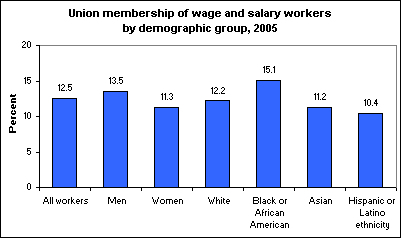
In 2005, 12.5 percent of wage and salary workers were union members, unchanged from 2004. The union membership rate has declined from a high of 20.1 percent in 1983, the first year for which comparable union data are available.
In 2005, the union membership rate was higher for men (13.5 percent) than for women (11.3 percent). The gap between their rates has narrowed considerably since 1983, when the rate for men was 10 percentage points higher than the rate for women. This narrowing occurred because the union membership rate for men declined more rapidly than the rate for women over the period.
Blacks were more likely to be union members (15.1 percent) than were whites (12.2 percent), Asians (11.2 percent), or Hispanics (10.4 percent).
These 2005 data on union membership are from the Current Population Survey. Unionization data are for wage and salary workers. Find out more in "Union Members in 2005" (PDF) (TXT), news release USDL 06-99.
Bureau of Labor Statistics, U.S. Department of Labor, The Economics Daily, Union membership in 2005 at https://www.bls.gov/opub/ted/2006/jan/wk4/art01.htm (visited April 19, 2024).