An official website of the United States government
 United States Department of Labor
An official website of the United States government
United States Department of Labor

The .gov means it's official.
Federal government websites often end in .gov or .mil. Before sharing sensitive information,
make sure you're on a federal government site.

The site is secure.
The
https:// ensures that you are connecting to the official website and that any
information you provide is encrypted and transmitted securely.
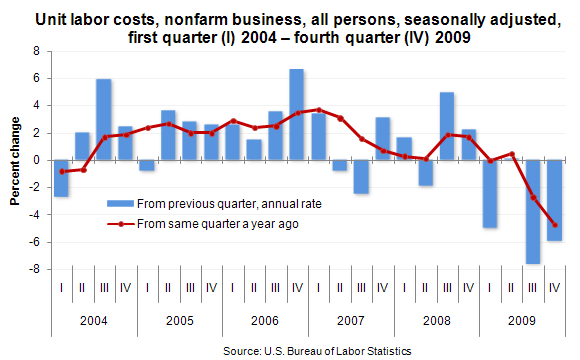
Unit labor costs in nonfarm businesses decreased 4.7 percent from the same quarter a year ago, the largest four-quarter decline since the series began in 1948.
From the previous quarter, at an annual rate, unit labor costs in nonfarm businesses fell 5.9 percent in the fourth quarter of 2009, the result of productivity increasing faster than hourly compensation.
The annual average index of unit labor costs declined 1.7 percent from 2008 to 2009, the largest decline in that series.
The U.S. Bureau of Labor Statistics defines unit labor costs as the ratio of hourly compensation to labor productivity; increases in hourly compensation tend to increase unit labor costs and increases in output per hour tend to reduce them.
These data, from the Productivity and Costs program, are seasonally adjusted and are subject to revision. To learn more about productivity, output, hours and related measures, see "Productivity and Costs: Fourth Quarter and Annual Averages 2009, Revised" (HTML) (PDF), news release USDL-10-0255.
Bureau of Labor Statistics, U.S. Department of Labor, The Economics Daily, Unit labor costs in the fourth quarter of 2009 at https://www.bls.gov/opub/ted/2010/ted_20100308.htm (visited April 19, 2024).