An official website of the United States government
 United States Department of Labor
An official website of the United States government
United States Department of Labor

The .gov means it's official.
Federal government websites often end in .gov or .mil. Before sharing sensitive information,
make sure you're on a federal government site.

The site is secure.
The
https:// ensures that you are connecting to the official website and that any
information you provide is encrypted and transmitted securely.


The Producer Price Index (PPI) program measures the average change over time in the selling prices received by domestic producers for their output. The prices included in the PPI are from the first commercial transaction for many products and some services.
PPI for final demand components, 1-month percent change, April 2026
Commodity
1-month percent change
Goods
2.0%
Foods
0.2%
Fresh fruits and melons
1.0%
Fresh and dry vegetables
13.5%
Meats
-1.7%
Processed poultry
1.0%
Dairy products(1)
1.9%
Soft drinks(1)
-0.6%
Energy
7.8%
Residential electric power
0.5%
Residential natural gas
-0.9%
Gasoline
15.6%
Jet fuel(1)
36.4%
Home heating oil and distillates
1.9%
No. 2 diesel fuel
12.6%
Goods less foods and energy
0.7%
Industrial chemicals
4.4%
Pharmaceutical preparations(1)
0.1%
Passenger cars
0.3%
Trucks, 14,000 lbs. and under
0.3%
Aircraft and aircraft equipment
0.2%
Cigarettes, including nontobacco(1)
1.8%
Services
1.2%
Trade services
2.7%
Machinery and equipment and parts and supplies wholesaling(1)
3.5%
Food and alcohol retailing
-1.5%
Health and beauty retailing, including optical goods(1)
6.9%
Apparel, jewelry, footwear, and accessories retailing
2.5%
Automobiles and automobile parts retailing
0.1%
Fuels and lubricants retailing
26.6%
Transportation and warehousing services
5.0%
Rail transportation of freight and mail(1)
0.0%
Truck transportation of freight(1)
8.1%
Water transportation of freight(1)
2.6%
Air transportation of freight(1)
3.6%
Courier, messenger, and U.S. postal service
2.8%
Airline passenger services
1.0%
Less trade, transportation, and warehousing
0.1%
Loan services (partial)
1.7%
Securities brokerage, dealing, investment advice, and related services(1)
0.3%
Portfolio management(1)
-2.4%
Outpatient care (partial)
0.2%
Inpatient care
0.2%
Traveler accommodation services
-0.4%
Footnotes
(1) Not seasonally adjusted.
Note: All data are subject to revision up to 4 months after originally published.

Total
+2.0%(p) in Apr 2026

Foods
+0.2%(p) in Apr 2026
Energy
+7.8%(p) in Apr 2026
Core goods
+0.7%(p) in Apr 2026
Total
+1.2%(p) in Apr 2026
Transportation and warehousing
+5.0%(p) in Apr 2026
Trade
+2.7%(p) in Apr 2026
Other
+0.1%(p) in Apr 2026
Construction
-0.1%(p) in Apr 2026
Processed goods
+2.7%(p) in Apr 2026
Unprocessed goods
+4.1%(p) in Apr 2026
Services
+1.1%(p) in Apr 2026
Stage 4 intermediate demand
+0.9%(p) in Apr 2026
Stage 3 intermediate demand
+2.3%(p) in Apr 2026
Stage 2 intermediate demand
+2.8%(p) in Apr 2026
Stage 1 intermediate demand
+2.1%(p) in Apr 2026
Motor vehicles
+0.3%(p) in Apr 2026
Pharmaceutical preparations
+0.1%(p) in Apr 2026
Gasoline
+15.6%(p) in Apr 2026
Meats
-1.7%(p) in Apr 2026
Industrial chemicals
+4.4%(p) in Apr 2026
Lumber
+7.2%(p) in Apr 2026
Steel mill products
+3.8%(p) in Apr 2026
Diesel fuel
+12.6%(p) in Apr 2026
Prepared animal feeds
+1.8%(p) in Apr 2026
Crude petroleum
+11.3%(p) in Apr 2026
Grains
-4.5%(p) in Apr 2026
Carbon steel scrap
+4.3%(p) in Apr 2026
Outpatient healthcare
+0.2%(p) in Apr 2026
Inpatient healthcare services
+0.2%(p) in Apr 2026
Food and alcohol retailing
-1.5%(p) in Apr 2026
Apparel and jewelry retailing
+2.5%(p) in Apr 2026
Airline passenger services
+1.0%(p) in Apr 2026
Securities brokerage, dealing, investment, and related services
+0.3%(p) in Apr 2026
Business loans (partial)
+2.0%(p) in Apr 2026
Legal services
+0.9%(p) in Apr 2026
Truck transportation of freight
+8.1%(p) in Apr 2026
Machinery and equipment wholesaling
+3.5%(p) in Apr 2026
 Historical Data
 News Release
SA - Seasonally Adjusted
NSA - Not Seasonally Adjusted
p - preliminary
News Release
SA - Seasonally Adjusted
NSA - Not Seasonally Adjusted
p - preliminary
05/13/2026
The Producer Price Index for final demand increased 1.4 percent in April. Prices for final
demand services advanced 1.2 percent, and the index for final demand goods moved up 2.0
percent. Prices for final demand rose 6.0 percent for the 12 months ended in April.
HTML
|
PDF
|
RSS
|
Charts
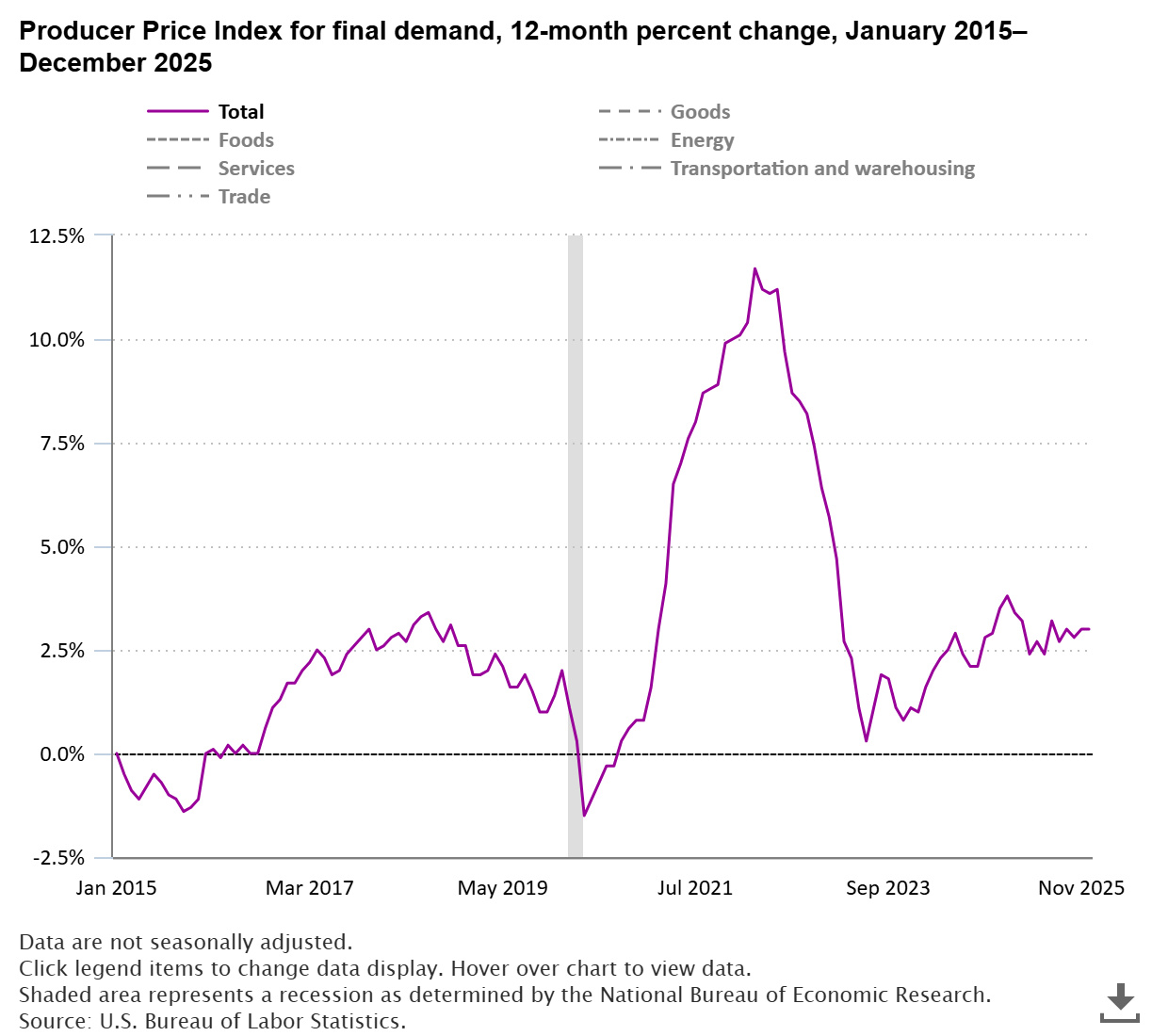
The Producer Price Index for final demand increased 3.0 percent in 2025 after rising 3.5 percent in 2024. Producer prices for goods rose 2.5 percent in 2025, while prices for services increased 3.2 percent. read more »

This Beyond the Numbers article will examine the price movement of steel in three phases: March 2020–August 2020, when the pandemic shock set in and steel prices fell; September 2020–December 2021, when the economy began to rebuild and steel prices surged; and January 2022–May 2023, when economic activity expanded but steel prices generally moved lower. read more »

This Spotlight on Statistics reviews historical establishment, employment, and wage trends for the amusement and theme parks industry. Additionally, productivity, consumer expenditures for entertainment fees and admissions, and producer prices for select amusement and theme parks products are reviewed. read more »

This article introduces Producer Price Index (PPI) research series calculated with a geometric-mean (geomean) formula and explains the formula’s methodological advantages. The article also compares official and geomean PPIs to illustrate how formula choice affects index values. read more »