
An official website of the United States government
 United States Department of Labor
An official website of the United States government
United States Department of Labor

The .gov means it's official.
Federal government websites often end in .gov or .mil. Before sharing sensitive information,
make sure you're on a federal government site.

The site is secure.
The
https:// ensures that you are connecting to the official website and that any
information you provide is encrypted and transmitted securely.


In May 2008, the Internal Revenue Service (IRS) started mailing Economic Stimulus Payments (also called tax rebates) to an estimated 130 million income tax filers.1 In order to examine the impact of these payments, special questions were included in the Interview component of the Consumer Expenditure Survey from June 2008 through March 2009 to collect information on the amount of payment received, form in which it was received (electronic funds transfer or check), and how it was used (mostly for spending, saving, or paying off debt). This report contains the first analysis of these data.
Those who were eligible for the payments received up to:
These payments decreased with income once the threshold value ($75,000 for individuals, and $150,000 for married couples filing jointly) was passed. However, the exact level of income at which payments were entirely phased out depended both on income and number of qualifying children for eligible filers.2
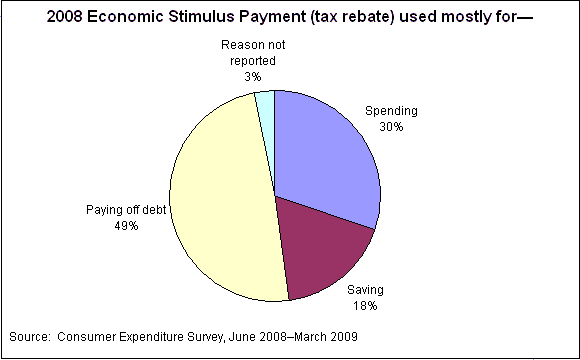
Nearly half (49 percent) of recipients reported using the rebate mostly to pay off debt. Most other recipients reported either mostly spending the rebate (30 percent), or mostly saving the rebate (18 percent). The small remainder of those asked (3 percent) did not report this information (Chart). Although there is some variation, this pattern also generally holds true across income groups (Table 1).
Consumer units with at least one parent and qualifying child were about two to two-and-one-half times more likely to use the rebate to pay off debt than they were to spend it. However, single parents were much less likely to save the rebate than husband and wife families with children. Comparable consumer units without children (husband and wife only or single person 18 or older) were similar to each other in their propensities to allocate these funds: Less than one-third spent the rebate; less than one-fourth saved it; and most of the rest (well under one-half of the total) used it to pay off debt (Table 2).
Interestingly, in general, there was little difference in the average amount of the rebate received for those who mostly spent ($926) or saved ($936) it (Table 3). However, those who used it mostly to pay off debt had substantially larger rebates on average ($995) than the others.
The amount of the stimulus payment reported varied as expected with demographic characteristics (Table 2). For example, consumer units with qualifying children received more on average ($1,432 for married couples, and $872 for single parents) than their counterparts without children ($979 for married couples, and $508 for single persons 18 years or older). The average generally rises with income, from under $600 for those with less than $20,000 to a peak of $1,227 for those in the $70,000 and over range, consistent with the pattern for number of earners in the consumer unit (Table 1).
The most popular method of receiving the stimulus payment was clearly by check (Table 1):
However, the relationship varies with income (Table 1):
Most rebate reporters report receipt of one rebate (Table 4). However:
More than 27,500 interviews occurred during the collection period (June 2008 through March 2009). However, only half (about 13,800) were unique consumer units (see www.bls.gov/cex/csxfaqs.htm, question 3, for definition), because some were visited more than once. Of these, over 5,600 provided information on receipt of the payment, and over 5,300 provided information on use of the payment. (See tables for precise figures.)
For researcher use, the 2008 Public Use topcoded Microdata files (available October 2009) contain more detailed information on consumer units and their expenditures, income, and other demographics.
Standard tables for 2008, which include information on the rebate amounts, were released on October 6, 2009. They are available online at www.bls.gov/cex/tables.htm. For more information, contact the CE program by e-mail or call (202) 691-6900.
Data collection. In the usual course of the Interview Survey, an address is visited once per quarter for five consecutive quarters. For the Economic Stimulus Payments, the data regarding amount received and method of payment were collected the first time in which the consumer unit was interviewed between June 2008 and March 2009. In the next completed interview, respondents were asked how they mostly used the funds. When the first interview during the collection period was also the fifth interview for the consumer unit, both sets of questions were asked during the same interview. Nonetheless, there is not always information available regarding both receipt and use. For example, a respondent may provide receipt information in one interview, and then may not be available for any subsequent interview, or may not know or may refuse to provide information about the use of the rebate. In such cases, no information on use of the payment was obtained. In cases where receipt, but no value, of the payment was reported in the first eligible interview, a value based on other available information, such as family composition, was imputed during data processing.
Weighting. The data in this report have not been weighted to reflect the population.
1 “Facts about the Economic Stimulus Payments,” https://www.irs.gov/uac/facts-about-the-2008-stimulus-payments, FS-2008-15, February 2008, last reviewed or updated: 12 Dec 2008 (December 12, 2008), visited 8/24/09.
2 For more information regarding eligibility for and amounts due from these payments, see “Economic Stimulus Payment Q&As: Eligibility,” www.irs.gov/newsroom/article/0,,id=179181,00.html, initially updated July 16, 2008; last reviewed or updated: 12 Dec 2008 (December 12, 2008), visited 8/24/09.
| Item | All consumer units | Less than $10,000 | $10,000 to $19,999 | $20,000 to $29,999 | $30,000 to $39,999 | $40,000 to $49,999 | $50,000 to $69,999 | $70,000 and more |
|---|---|---|---|---|---|---|---|---|
Sample size | 13,803 | 1,232 | 1,788 | 1,678 | 1,400 | 1,258 | 2,033 | 4,414 |
Income before taxes (rounded to nearest $100) | $63,200 | $3,800 | $14,800 | $24,800 | $34,500 | $44,600 | $59,100 | $130,200 |
Average number in consumer unit: | ||||||||
Persons | 2.5 | 1.6 | 1.8 | 2.1 | 2.3 | 2.5 | 2.7 | 3.1 |
Children under 18 | 0.6 | 0.4 | 0.4 | 0.5 | 0.6 | 0.7 | 0.7 | 0.9 |
Earners | 1.3 | 0.5 | 0.6 | 0.8 | 1.1 | 1.3 | 1.6 | 1.9 |
Rebate information: | ||||||||
Average amount received (recipients only) | $958 | $599 | $571 | $709 | $821 | $932 | $1,056 | $1,227 |
Percent distribution: | ||||||||
Received at least one rebate | 40.9 | 20.7 | 34.5 | 42.4 | 43.1 | 47.3 | 48.0 | 43.0 |
Rebate reporters only | ||||||||
Receiving at least one rebate by: (1) | ||||||||
Check | 67.1 | 72.9 | 78.6 | 72.9 | 70.0 | 69.1 | 64.5 | 60.0 |
EFT | 44.5 | 32.2 | 25.9 | 33.6 | 35.2 | 43.0 | 50.9 | 56.4 |
No information available | 2.0 | 3.1 | 1.6 | 2.4 | 2.2 | 1.2 | 2.5 | 1.7 |
Asked how rebate was used: | 94.7 | 94.5 | 93.8 | 92.5 | 94.9 | 94.1 | 95.1 | 95.8 |
If asked how rebate was used: | ||||||||
Rebate was used mostly for: | ||||||||
Spending | 30.2 | 31.5 | 32.1 | 31.0 | 28.7 | 28.6 | 28.5 | 31.1 |
Saving | 17.6 | 15.8 | 16.6 | 19.6 | 16.1 | 15.9 | 15.6 | 19.5 |
Paying off debt | 49.1 | 49.4 | 49.2 | 45.9 | 51.0 | 53.6 | 52.2 | 46.6 |
No information reported | 3.0 | 3.3 | 2.1 | 3.5 | 4.2 | 2.0 | 3.7 | 2.8 |
Footnotes: | ||||||||
| Item | All consumer units | Husband and wife, at least one qualifying child | Single parent, at least one qualifying child | Husband and wife only | Single person, 18 years or older (1) | All other consumer units |
|---|---|---|---|---|---|---|
Sample size | 13,803 | 2,817 | 845 | 2,943 | 4,094 | 3,104 |
Income before taxes (rounded to nearest $100) | $63,200 | $94,300 | $35,600 | $75,900 | $32,400 | $71,000 |
Average number in consumer unit: | ||||||
Persons | 2.5 | 4.1 | 3.0 | 2.0 | 1.0 | 3.3 |
Children under 18 | 0.6 | 2.0 | 1.8 | 0.0 | 0.0 | 0.6 |
Earners | 1.3 | 1.8 | 1.0 | 1.2 | 0.6 | 1.9 |
Rebate information: | ||||||
Average amount received (recipients only) | $958 | $1,432 | $872 | $979 | $508 | $967 |
Percent distribution: | ||||||
Received at least one rebate | 40.9 | 45.1 | 36.4 | 46.3 | 33.5 | 43.2 |
Percent distribution: Rebate reporters only | ||||||
Received at least one rebate by: (2) | ||||||
Check | 67.1 | 53.6 | 67.9 | 69.1 | 62.9 | 81.9 |
EFT | 44.5 | 59.4 | 36.0 | 39.3 | 37.2 | 45.1 |
No information available | 2.0 | 1.7 | 1.9 | 1.8 | 2.3 | 2.2 |
Asked how rebate was used: | 94.7 | 94.2 | 90.6 | 96.8 | 93.4 | 95.4 |
If asked how rebate was used: | ||||||
Rebate was used mostly for: | ||||||
Spending | 30.2 | 28.7 | 26.9 | 31.9 | 31.9 | 29.0 |
Saving | 17.6 | 15.0 | 6.1 | 23.3 | 21.4 | 13.0 |
Paying off debt | 49.1 | 53.8 | 65.2 | 41.7 | 43.6 | 54.4 |
No information reported | 3.0 | 2.5 | 1.8 | 3.1 | 3.2 | 3.6 |
Footnotes: | ||||||
| Item | All Reporters Asked About Rebate Use | Rebate used mostly for spending | Rebate used mostly for saving | Rebate used mostly for paying off debt | Rebate use asked, but not reported |
|---|---|---|---|---|---|
Sample size | 5,353 | 1,618 | 944 | 2,628 | 163 |
Percent of total sample | 100.0 | 30.2 | 17.6 | 49.1 | 3.0 |
Income before taxes (rounded to nearest $100) | $62,700 | $64,000 | $65,900 | $60,300 | $70,000 |
Average number in consumer unit: | |||||
Persons | 2.6 | 2.5 | 2.3 | 2.8 | 2.5 |
Children under 18 | 0.7 | 0.6 | 0.4 | 0.8 | 0.5 |
Earners | 1.4 | 1.3 | 1.2 | 1.5 | 1.4 |
Rebate information: | |||||
Average amount received | $962 | $926 | $936 | $995 | $925 |
Percent distribution: | |||||
Received at least one rebate by: (1) | |||||
Check | 67.6 | 68.9 | 67.7 | 66.8 | 65.6 |
EFT | 44.3 | 42.8 | 41.8 | 46.7 | 35.6 |
No information available | 2.0 | 1.3 | 1.3 | 1.5 | 20.2 |
Footnotes: | |||||
| Item | All consumer units | No rebate reported | At least one rebate reported |
|---|---|---|---|
Sample size | 13,803 | 8,151 | 5,652 |
Income before taxes (rounded to nearest $100) | $63,200 | $64,000 | $62,100 |
Average number in consumer unit: | |||
Persons | 2.5 | 2.4 | 2.6 |
Children under 18 | 0.6 | 0.6 | 0.7 |
Earners | 1.3 | 1.2 | 1.4 |
Rebate information: | |||
Number reported | |||
Minimum | 0 | 0 | 1 |
Maximum | 6 | 0 | 6 |
Average | 0.5 | 0.0 | 1.1 |
Average amount received | $392 | $0 | $958 |
By those receiving one rebate | $910 | N/A | $910 |
By those receiving two or more rebates | $1,352 | N/A | $1,352 |
Percent distribution: | |||
Received one rebate | 36.5 | 0.0 | 89.0 |
Received two or more rebates | 4.5 | 0.0 | 11.0 |
Received at least one rebate by: (1) | |||
Check | 67.1 | 0.0 | 67.0 |
EFT | 44.5 | 0.0 | 44.5 |
No information available | 2.0 | 0.0 | 2.0 |
Asked how rebate was used: | 38.8 | 0.0 | 94.7 |
If asked how rebate was used: | |||
Rebate was used mostly for: | |||
Spending | 30.2 | 0.0 | 30.2 |
Saving | 17.6 | 0.0 | 17.6 |
Paying off debt | 49.1 | 0.0 | 49.1 |
No information reported | 3.0 | 0.0 | 3.0 |
Footnotes: | |||
Last Modified Date: April 9, 2018