An official website of the United States government
 United States Department of Labor
An official website of the United States government
United States Department of Labor

The .gov means it's official.
Federal government websites often end in .gov or .mil. Before sharing sensitive information,
make sure you're on a federal government site.

The site is secure.
The
https:// ensures that you are connecting to the official website and that any
information you provide is encrypted and transmitted securely.


The Office of Productivity and Technology (OPT) measures how efficiently the U.S. converts inputs into the outputs of goods and services. Measures of labor productivity compare the growth in output to the growth in hours worked and measures of total factor productivity (TFP), also known as multifactor productivity (MFP), compare growth in output to the growth in a combination of inputs that include labor, capital, energy, materials, and purchased services.
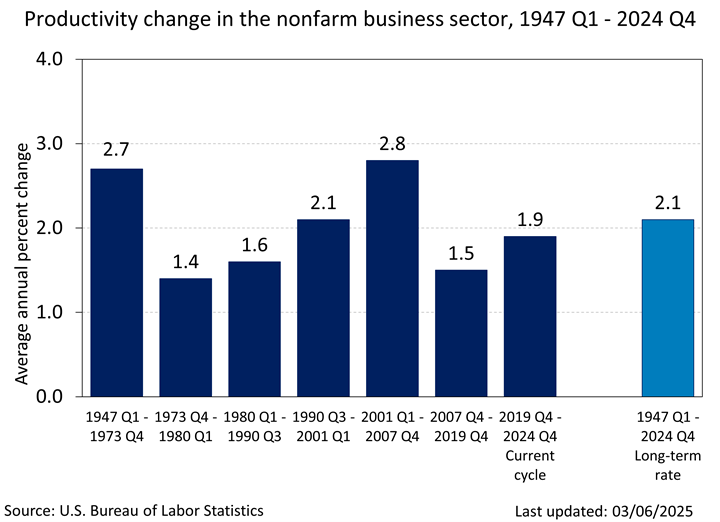
Click the graphic to enlarge chart: Long-term labor productivity in the nonfarm business sector since 1947.
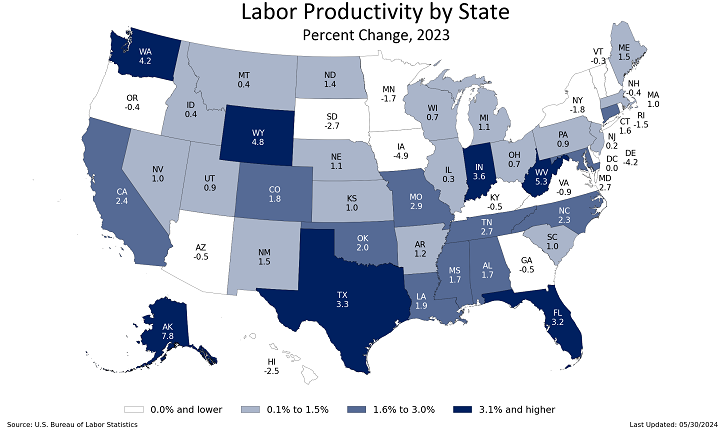
Click the graphic to enlarge chart: Labor Productivity by State, Percent Change.
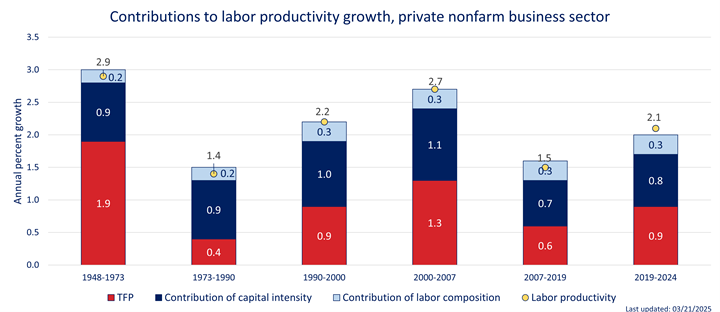
Click the graphic to enlarge chart: Contributions to Labor Productivity Growth, Private Nonfarm Business Sector, Selected Time Periods.
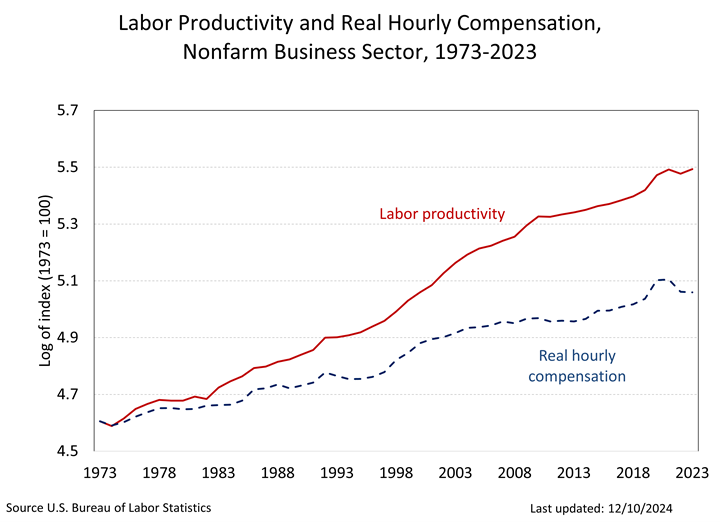
Click the graphic to enlarge chart: Labor Productivity and Real Hourly Compensation, Nonfarm Business Sector since 1973.
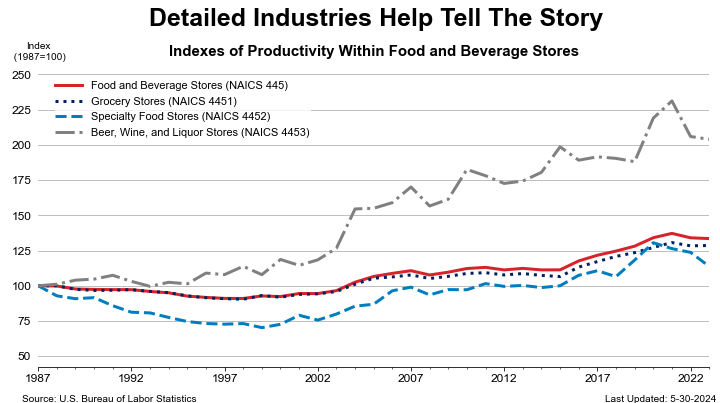
Click the graphic to enlarge chart: Detailed Industries Help Tell the Story, Indexes of Productivity Within Food and Beverage Stores.

Labor productivity (output per hour)
+1.4% in 2nd Qtr of 2026

Hourly compensation
+2.6%(r) in 2nd Qtr of 2026
Unit labor costs
+1.2%(r) in 2nd Qtr of 2026
Real value-added output
+1.7% in 2nd Qtr of 2026
Hours worked
+0.3% in 2nd Qtr of 2026
Labor productivity (output per hour)
+2.4%(r) in 2nd Qtr of 2026
Hourly compensation
+2.1%(r) in 2nd Qtr of 2026
Unit labor costs
-0.3%(r) in 2nd Qtr of 2026
Real sectoral output
+5.4%(r) in 2nd Qtr of 2026
Hours worked
+2.9%(r) in 2nd Qtr of 2026
 Historical Data
 News Release
09/03/2026
Productivity increased 1.4 percent in the nonfarm business sector in the second quarter of 2026;
unit labor costs increased 1.2 percent (seasonally adjusted annualized rates). In manufacturing,
productivity increased 2.4 percent and unit labor costs decreased 0.3 percent.
HTML
|
PDF
|
RSS
|
Charts
06/24/2026
Labor productivity increased in 39 of 80 covered four-digit NAICS manufacturing industries and in 2 of 5 mining industries in 2025. Output fell in 66 of 85 manufacturing and mining industries while hours worked fell in 52 industries. Seven industries increased both output and hours worked.
HTML
|
PDF
|
RSS
|
Charts
05/28/2026
Labor productivity increased in 42 states and the District of Columbia in 2025. Output increased in all 50
states and the District of Columbia and hours worked increased in 33 states.
HTML
|
PDF
|
RSS
|
Charts
08/26/2026
Labor productivity rose in 15 of 30 selected service-providing industries in 2025. Output and hours worked increased in 18 industries each. Unit labor costs went up in 24 of the 30 industries.
HTML
|
PDF
|
RSS
|
Charts
05/28/2026
Wholesale trade productivity increased 4.4 percent in 2025 with retail trade productivity up 2.9 percent. Output grew and hours worked fell in both sectors. Unit labor costs declined 0.4 percent in wholesale trade and dropped 0.7 percent in retail trade.
HTML
|
PDF
|
RSS
|
Charts
06/24/2026
Total factor productivity fell in 70 of 86 4-digit NAICS manufacturing industries in 2023, up from 65 industries that declined in 2022. Output fell in 64 industries while intermediate inputs grew in 56 industries and capital increased in 31 industries.
HTML
|
PDF
|
RSS
12/19/2025
In 2024, total factor productivity increased in 13 out of 21 major industries, led by the retail trade and the agriculture, forestry, fishing and hunting industries.
HTML
|
PDF
|
RSS
|
Charts
03/19/2026
Total factor productivity increased 0.8 percent in the private
nonfarm business sector in 2025 as output
increased 2.6 percent and combined inputs increased 1.7 percent.
HTML
|
PDF
|
RSS

The COVID-19 pandemic brought about dramatic changes in the work environment. Although 6.5 percent of workers in the private business sector worked primarily from home in 2019, the pandemic was the start of a massive experiment in full-time remote work for most workers and firms. People often ask: are workers more productive or less productive when working from home? read more »

Artificial intelligence (AI) is an emerging technological innovation in many aspects of production and across many industries. The U.S. Bureau of Labor Statistics (BLS) implicitly captures AI use through its capital measure of software used in production. This article uses data from the BLS productivity program to break down recent investment growth by asset category and, more specifically, to examine recent investment in the software category. read more »

Labor share—the fraction of economic output that accrues to workers as compensation in exchange for their labor—in the nonfarm business sector was 52.8 percent in the second quarter of 2026, the lowest level ever recorded. (As shown in the chart, these data begin in 1947.) read more »

This Spotlight on Statistics reviews historical establishment, employment, and wage trends for the amusement and theme parks industry. Additionally, productivity, consumer expenditures for entertainment fees and admissions, and producer prices for select amusement and theme parks products are reviewed. read more »