An official website of the United States government
 United States Department of Labor
An official website of the United States government
United States Department of Labor

The .gov means it's official.
Federal government websites often end in .gov or .mil. Before sharing sensitive information,
make sure you're on a federal government site.

The site is secure.
The
https:// ensures that you are connecting to the official website and that any
information you provide is encrypted and transmitted securely.
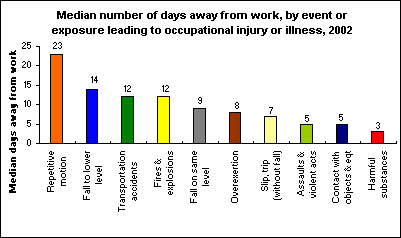
Repetitive motion, such as grasping tools, scanning groceries, and typing, resulted in the longest absences from work among the leading events and exposures in 2002—a median of 23 days.
The next longest median absence in 2002 (14 days) was due to falls to lower levels, followed by fires and explosions, and transportation accidents (12 days each). Falls on the same level had a median of 9 days.
Note: Effective January 1, 2002, the Occupational Safety and Health Administration (OSHA) revised its requirements for recording occupational injuries and illnesses. These revised recordkeeping requirements include new rules for counting that rely on calendar days instead of workdays. This change affects the calculation of median days away from work and thus makes the data non-comparable with prior years.
These data are from the BLS Injuries, Illnesses, and Fatalities program. Additional information is available from "Lost-worktime Injuries and Illnesses: Characteristics and Resulting Time Away From Work, 2002" (PDF) (TXT), news release USDL 04-460.
Related TED article:
Bureau of Labor Statistics, U.S. Department of Labor, The Economics Daily, Repetitive motion results in longest work absences at https://www.bls.gov/opub/ted/2004/mar/wk5/art02.htm (visited September 03, 2026).