|
|
Charting International Labor Comparisons
(2011 Edition)
Section 2: Labor market
On This Page
- Chart 2.1 - Labor force size, gender composition, and participation rates, selected countries, 2009
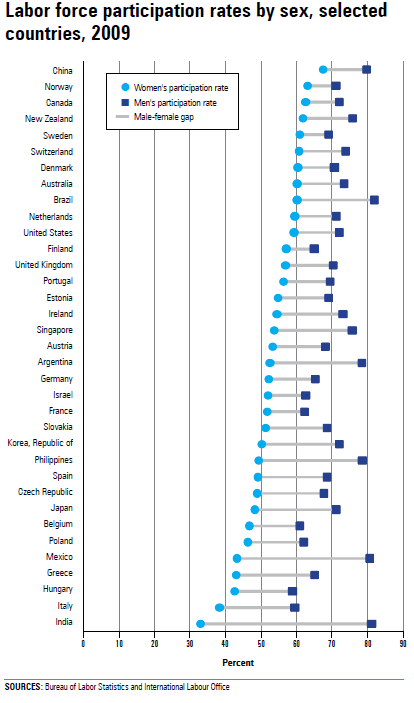
- Chart 2.2 - Labor force participation rates by sex, selected countries, 2009
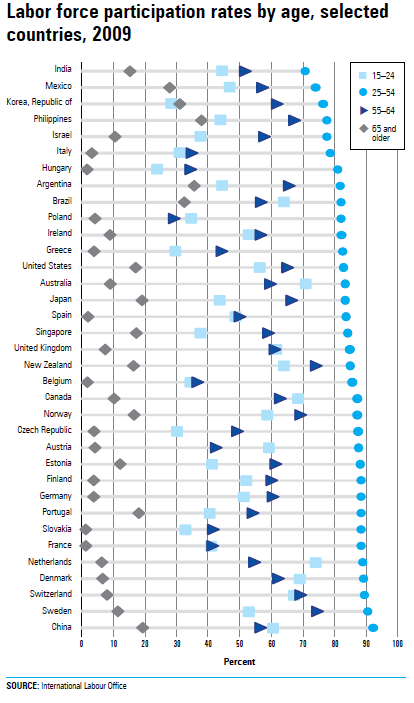
- Chart 2.3 - Labor force participation rates by age, selected countries, 2009
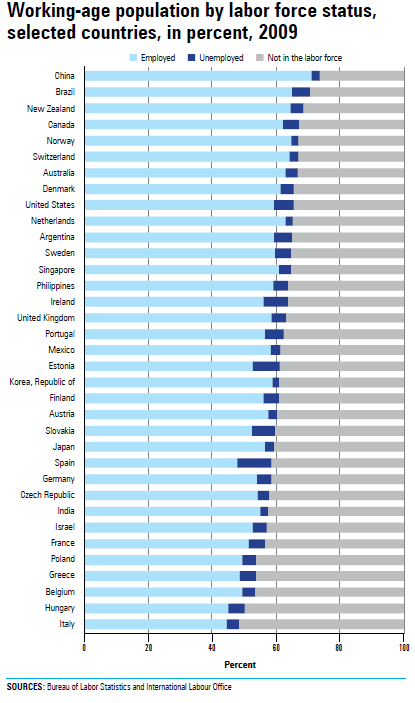
- Chart 2.4 - Working-age population by labor force status, selected countries, in percent, 2009
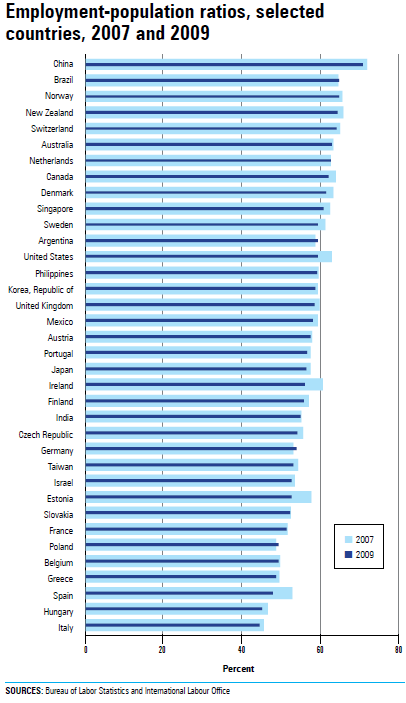
- Chart 2.5 - Employment-population ratios, selected countries, 2007 and 2009
- Chart 2.6 - Employment growth, selected countries, average annual rates, 2000–2007 and 2007–2009
- Chart 2.7 - Part-time employment rates by sex, selected countries, 2009
- Chart 2.8 - Share of employment by sector, selected countries, 2009
- Chart 2.9 - Unemployment rates, selected countries, 2000–2009
- Chart 2.10 - Unemployment rates by age, selected countries, 2009
- Chart 2.11 - Unemployment rates by education, selected countries, 2008
- Chart 2.12 - Various measures of labor underutilization, selected countries, 2009
- Chart 2.13 - UR6: A broad rate of labor underutilization, selected countries, 2007 and 2009
- Notes - Sources and definitions
Labor force statistics, such as employment
and unemployment, are key indicators
of the functioning of labor markets
both within and across countries.
Labor force levels and participation rates
provide information on the supply of labor
in an economy. Employment focuses on
the extent to which people are engaged
in productive labor market activities,
while measures of labor underutilization,
including unemployment, provide
information on an economy’s unused or
underused labor supply.
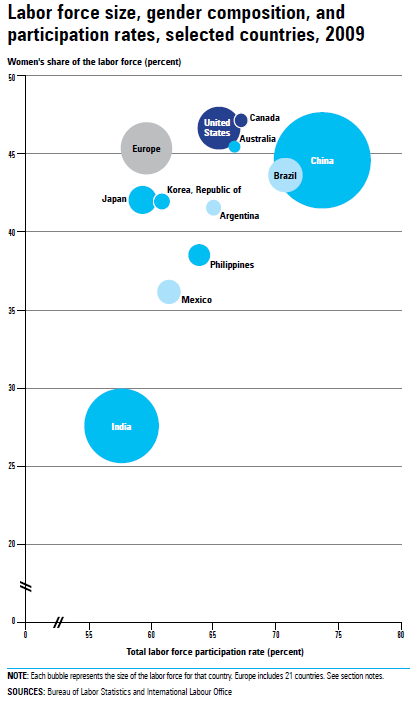
Chart 2.1
- China and India had the largest workforces, although China had the highest labor force participation rate, while India had the lowest.
- Women made up less than half of the labor force in all countries and Europe, with India having, by far, the lowest proportion of women in the labor market.
Back to Top
Chart 2.2
- Women’s participation rates in India and Mexico were among the lowest; these countries had the largest gender gaps.
- Labor force participation rates were higher for men than women in all countries, although the size of the gender gap varied considerably. The largest gaps were in Asian and Latin American countries.
- The highest participation rates for men were in large emerging economies: Brazil, India, Mexico and China. China also had the highest participation rate for women and, thus, a relatively low gender gap.
Back to Top
Chart 2.3
- Participation rates were highest for persons ages 25 to 54 in all countries and lowest for those ages 65 and older in all countries except the Republic of Korea.
- In Argentina and the Philippines, more than one-third of persons ages 65 and older were still in the labor force. In contrast, many European countries had rates below 5 percent for this age group.
- Participation rates among youth varied most across countries. The Netherlands and Australia had the highest participation rates (above 70 percent) while Hungary, the Republic of Korea, and Greece had the lowest rates (under 30 percent).
Back to Top
Chart 2.4
- The working-age population is composed of those in the labor force — the employed and the unemployed — and those not in the labor force.
- Italy was the only country with less than half of its working-age population engaged in the labor force.
- Although Spain had average labor force participation, this masks its relatively low employment rate and high unemployment. Estonia, Ireland, and Slovakia also had relatively low employment but high unemployment.
Back to Top
Chart 2.5
- Employment-population ratios decreased between 2007 and 2009 in 31 of the 36 countries, with the steepest declines in Estonia, Spain, Ireland, and the United States.
- In 2009, China and Brazil had the highest proportions of employed persons, while Hungary and Italy had the lowest.
Back to Top
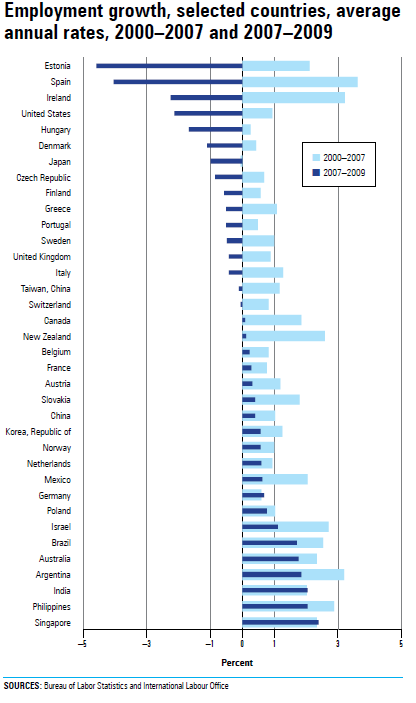
Chart 2.6
- Employment grew from 2000 to 2007 in all countries except for Japan but decreased in almost half of the countries from 2007 to 2009.
- Between 2007 and 2009, the sharpest declines in employment were in Estonia and Spain, followed by Ireland and the United States.
- The largest gains in employment between 2007 and 2009 were in three Asian countries: Singapore, the Philippines, and India. Singapore and India were 2 of 3 countries (Germany was the third) that had more employment growth during 2007–2009 than during 2000–2007.
Back to Top
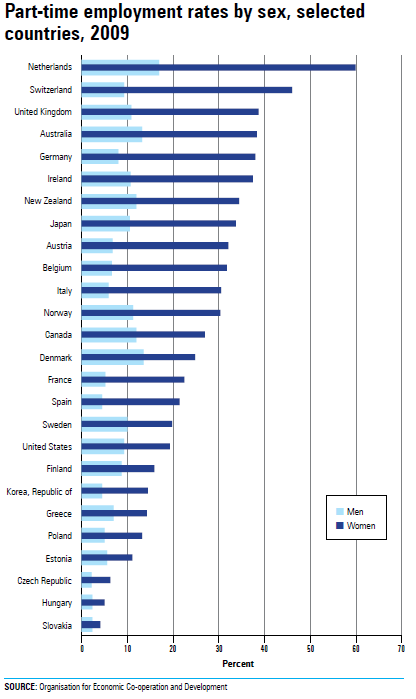
Chart 2.7
- The part-time employment rate for women was roughly 2 to 5 times higher than the men’s rate in most countries.
- The largest difference between men and women’s part-time employment rates was in the Netherlands, although it had the highest rate for both men (17.0 percent) and women (59.9 percent).
- Part-time employment was least common for both men and women in three Eastern European countries: Slovakia, Hungary, and the Czech Republic.
Back to Top
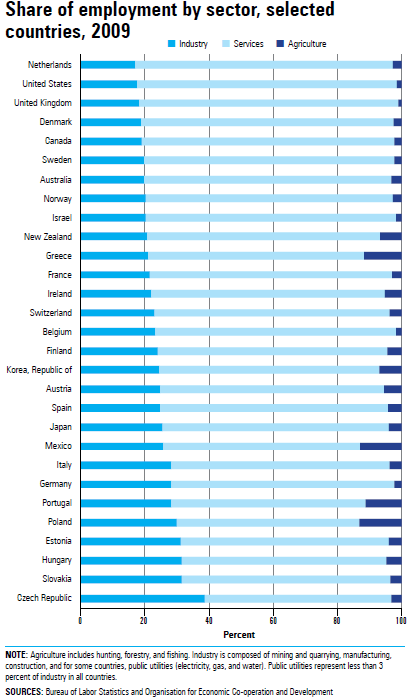
Chart 2.8
- More than half of employment was in the service sector in all countries.
- The Netherlands, the United States, and the United Kingdom had the largest shares of service employment (above 80 percent).
- The largest shares of industry employment (above 30 percent) were in five Eastern European countries.
- Poland, Mexico, Greece, and Portugal had the largest agricultural sectors.
Back to Top
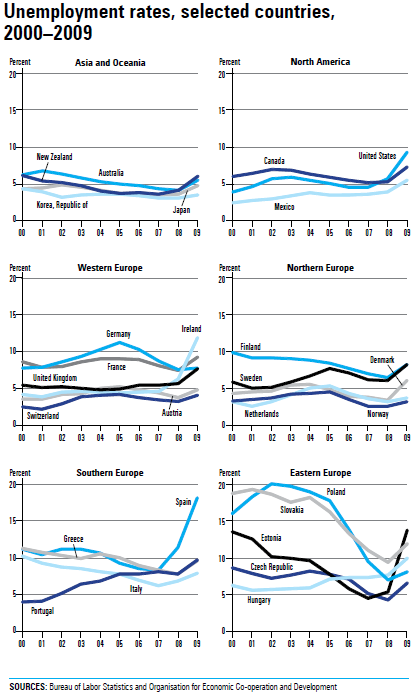
Chart 2.9
- In 2009, Spain had, by far, the highest unemployment rate, and Norway had the lowest.
- Unemployment rates were higher in 2009 than 2000 in a majority of countries, due in part to the effects of the global recession at the end of the decade. Unemployment rates increased in 11 countries between 2007 and 2008, and in all countries between 2008 and 2009.
- Poland recorded the highest unemployment rate of the period (20.0 percent in 2002), and Switzerland had the lowest (2.2 percent in 2001).
Back to Top
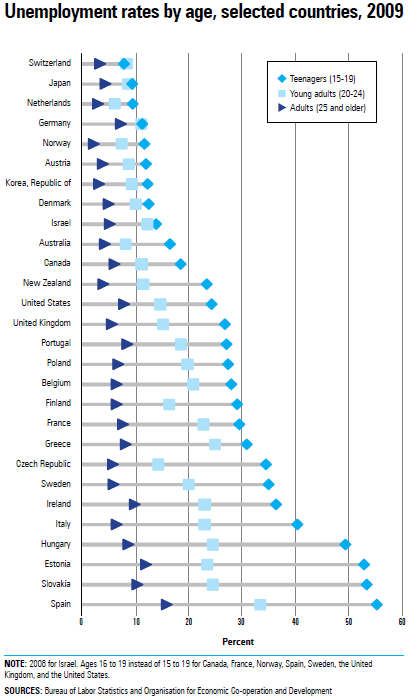
Chart 2.10
- Unemployment rates for teenagers and young adults are generally higher than those for adults, partly due to young people’s greater vulnerability to economic downturns and lack of experience.
- Slovakia had the largest difference between rates for teenagers and adults, and Germany had the smallest.
- Only Switzerland had a higher unemployment rate for young adults than for teenagers.
Back to Top
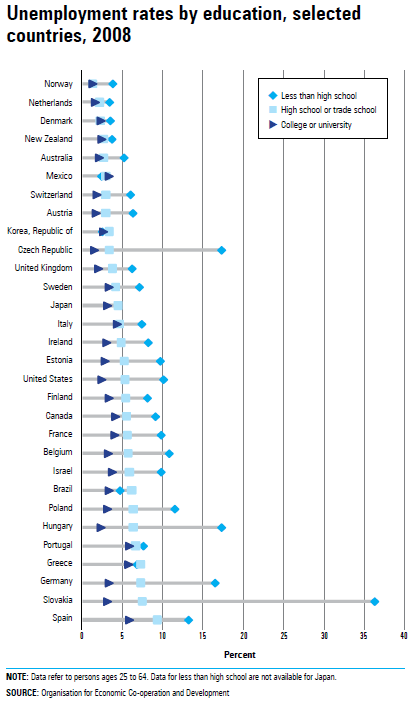
Chart 2.11
- In 23 out of 30 countries, college graduates had the lowest unemployment rates, followed by high school graduates; high school dropouts had the highest rates.
- College graduates had the highest unemployment rate only in Mexico.
- The unemployment rate gap between high school dropouts and high school graduates was generally larger than the gap between college graduates and high school graduates, reflecting the value of a high school education in seeking employment.
Back to Top
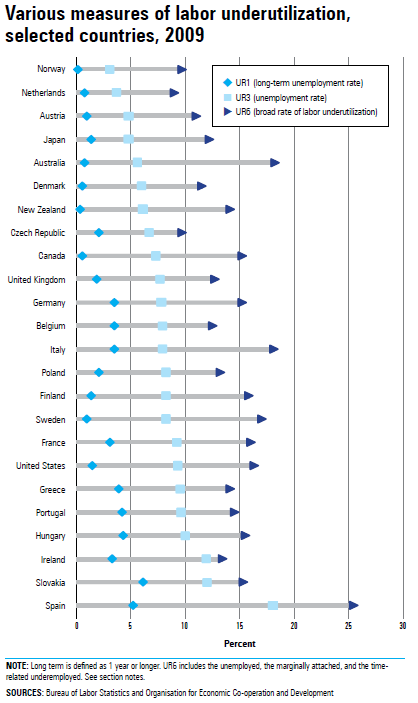
Chart 2.12
- Long-term unemployment (UR1) was most prevalent in Slovakia and Spain.
- UR1 is the most restrictive rate of labor underutilization and consists only of the subset of the unemployed who were unemployed for at least 1 year. UR3 is the official unemployment rate and the most widely recognized. The broadest rate, UR6, includes the unemployed, the marginally attached, and persons who are employed but who worked fewer hours than they would like (i.e., the time-related underemployed).
- Spain had the highest UR3 and UR6. Although Australia had the second highest UR6, its UR3 was relatively low.
Back to Top
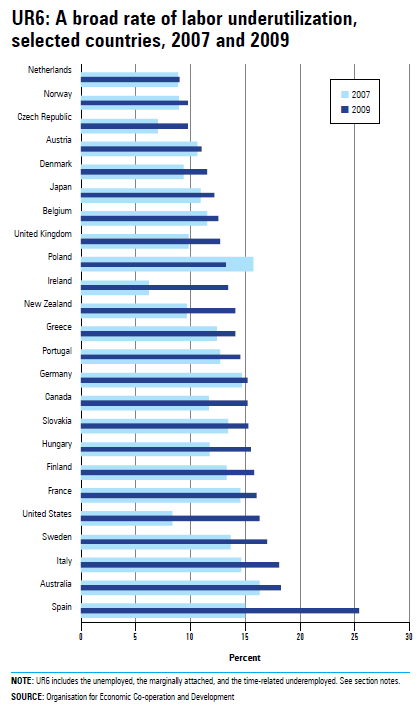
Chart 2.13
- During the global recession, UR6 increased between 2007 and 2009 in all countries, except for Poland. The largest increases were in Spain, the United States, and Ireland.
- UR6 is a broader measure of labor underutilization than the unemployment rate because it includes the marginally attached and those who are employed but who worked fewer hours than they would like (i.e., time-related underemployed).
This broader measure is popular during times of recession, when unemployment and other types of labor market difficulty are on the rise.
Back to Top
Notes
Sources
Data for 10 countries for most indicators are based
on the BLS report International Comparisons of
Annual Labor Force Statistics, Adjusted to U.S.
Concepts, 10 Countries, 1970-2010. To facilitate
international comparisons, foreign-country data are
adjusted to U.S. concepts. Data for the remaining
countries and some indicators in their entirety—
labor force participation rates by age, part-time
employment rates, unemployment rates by
education and measures of underutilization—are
based on data from the International Labour Office
(ILO) or the Organisation for Economic Co-operation
and Development (OECD).
Labor force participation rates, employment-population
ratios, and employment growth are
supplemented with data from the ILO database
Key
Indicators of the Labour Market (KILM). The KILM
harmonizes data using econometric models to
account for differences in national data and scope of
coverage, collection and tabulation methodologies,
and other country-specific factors, such as military
service requirements. Although some differences
remain between the KILM and ILC series, they do
not materially affect comparisons across countries.
Part-time employment rates, employment by
sector, unemployment rates, and measures of
underutilization are supplemented with data
from the OECD database OECD.Stat. The OECD
generally uses labor force surveys and captures
labor force statistics according to ILO guidelines,
which facilitate cross-country comparisons, because
these guidelines create a common conceptual
framework for countries. However, except for total
unemployment rates, the OECD does not adjust
data for differences that remain across countries in
coverage and definitions that can affect international
comparisons. See Labor Force Statistics in OECD
Countries: Sources, Coverage and Definitions. For
total unemployment rates, the OECD series used
is the “harmonized unemployment rates” (HURs),
which are adjusted to conform to the ILO guidelines
in countries where deviations occur. For a full
discussion of comparability issues, see the BLS
article, "International Unemployment Rates: How Comparable are they?"
Using multiple sources for an indicator to extend
country coverage can introduce additional
comparability issues, since each organization
employs different methods for harmonizing data,
if adjustments are made at all. Users should use
caution when making international comparisons
using the actual values underlying these charts
and are encouraged to review the methodological
documents associated with each source.
In this section, Europe includes 21 countries:
Austria, Belgium, Czech Republic, Denmark, Estonia,
Finland, France, Germany, Greece, Hungary, Ireland,
Italy, the Netherlands, Norway, Poland, Portugal,
Slovakia, Spain, Sweden, Switzerland, and the United
Kingdom.
Definitions
Labor Labor market data are on a civilian basis (i.e.,
members of the Armed Forces are not included).
The labor force participation rate is the labor force as
a percent of the working-age population; it is an
overall indicator of the level of labor market activity.
The labor force is the sum of the employed plus the
unemployed; it provides an indication of the size
of the labor supply. The working-age population is
the population ages 15 or 16 and older. (Lower age
limits vary by country. See source documents.)
The employed are persons who, during the
reference week, did work for at least 1 hour as
paid employees, worked in their own business,
profession, or on their own farm, or as unpaid
workers in an enterprise operated by a family
member (at least 1 hour according to the ILO
guidelines but at least 15 hours according to U.S.
concepts). Definitions of the employed vary by
country. See source documents. The employment-population
ratio is employment as a percent of the
working-age population. Part-time employment refers
to employed persons who usually work less than 30
hours per week in their main job; in some countries,
“actual” rather than “usual” hours are used. The part-time
employment rate is the share of employment that
is part time and is also referred to as the incidence
of part-time employment.
The unemployed are persons without work, actively
seeking employment and currently available to
start work. Definitions of the unemployed vary by
country; see source documents. The unemployment
rate is unemployment as a percent of the labor
force; it is the most widely used measure of an
economy’s unused labor supply. Persons marginally
attached to the labor force are those who did not
look for work in the past 4 weeks, but who wish to
work, are available to work and, in some countries,
have looked for work sometime in the past 12
months. Discouraged workers are the subset of the
marginally attached who are not currently searching
for a job because they believe none are available.
The time-related underemployed are either: (1) full-time
workers working less than a full week (less than
35 hours in the United States) during the survey
reference week for economic reasons or (2) part-time
workers who want but cannot find full-time work.
For unemployment rates by education, the levels of
educational attainment accord with the International
Standard Classification for Education (ISCED) in its
current version, known as ISCED 1997. Less than high
school corresponds to “less than upper secondary
education” and includes ISCED levels 0-3C. High
school or trade school corresponds to “upper
secondary and post-secondary education” and
includes levels 3-4. College or university corresponds
to “tertiary non-university and university” and
includes levels 5-6.
Go to:
Last Modified Date: August 2, 2011
|