
An official website of the United States government
 United States Department of Labor
An official website of the United States government
United States Department of Labor

The .gov means it's official.
Federal government websites often end in .gov or .mil. Before sharing sensitive information,
make sure you're on a federal government site.

The site is secure.
The
https:// ensures that you are connecting to the official website and that any
information you provide is encrypted and transmitted securely.
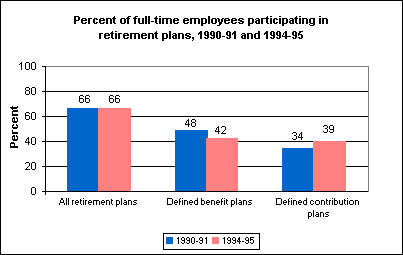
In 1994-95, 66 percent of full-time employees participated in one or more employer-provided retirement plans. Although the participation rate was the same as in 1990-91, there was a shift in the type of plan: "defined contribution" retirement plans were on the verge of overtaking "defined benefit" pensions.
[Chart data—TXT]
In 1994-95, 39 percent of full-time employees participated in "defined contribution" plans with employer contributions, up from 34 percent in 1990-91. In contrast, 42 percent of full-time employees participated in a "defined benefit" plans, down from 48 percent in 1990-91.
Savings and thrift plans are the most common form of defined contribution plan, with 24 percent of all full-time employees participating in 1994-95. In these plans, participants contribute a predetermined portion of earnings, all or part of which the employer matches. Other defined contribution plans are deferred profit sharing; employee stock ownership; and money purchase pension.
Data on retirement plans and other employee benefits are available from the BLS Employee Benefits Survey. Defined benefit pension plans provide employees with a fixed retirement payment using predetermined formulas. Defined contribution plans are accounts set up for each participant, to which the employer and often the employee make fixed contributions; the retirement payment is not fixed, but determined by these contributions. For additional information, see "Factors Affecting Employer-provided Retirement Benefits" (PDF 57K),Compensation and Working Conditions, Winter 1998.
Bureau of Labor Statistics, U.S. Department of Labor, The Economics Daily, Defined contribution retirement plans becoming more prevalent at https://www.bls.gov/opub/ted/1999/jan/wk1/art03.htm (visited July 11, 2026).


