An official website of the United States government
 United States Department of Labor
An official website of the United States government
United States Department of Labor

The .gov means it's official.
Federal government websites often end in .gov or .mil. Before sharing sensitive information,
make sure you're on a federal government site.

The site is secure.
The
https:// ensures that you are connecting to the official website and that any
information you provide is encrypted and transmitted securely.
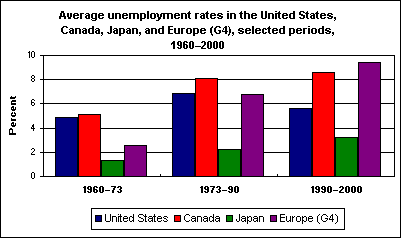
During the 40-year period from 1960 to 2000, the United States moved from being a country with relatively high unemployment to a position of having one of the lowest jobless rates among the G7 industrial economies (U.S., Canada, Japan, France, Germany, Italy, and the United Kingdom).
At the beginning of the period and throughout the 1960s, unemployment was comparatively high in both the United States and Canada and very low in Japan and Europe. Between 1960 and 1973, the U.S. unemployment rate was 4.9 percent, on average, and the rate for Canada was 5.1 percent. Over the same period, the unemployment rate was 1.3 percent for Japan and 2.6 percent for G4 Europe (France, Germany, Italy, and the U.K.).
In 1973–90, unemployment rose, on average, in all of the countries, with the highest relative increases occurring in Europe, where the average unemployment rate increased to 6.8 percent. The U.S rate for this period was 6.9 percent, and the rate for Canada was 8.1 percent. Japan’s unemployment rate, while still the lowest among the G7 countries, rose to 2.2 percent.
During the 1990–2000 period, the United States was the only G7 country in which the average unemployment rate (5.6 percent) was lower than it was in 1973–90. The rates for Canada and Europe (G4) during this period rose to 8.6 percent and 9.4 percent, respectively. Unemployment continued to increase in Japan, where the jobless rate reached 3.2 percent, on average, for the period.
These data are a product of the Foreign Labor Statistics program. Find out more in "U.S. labor market performance in international perspective," by Constance Sorrentino and Joyanna Moy, Monthly Labor Review, June 2002.
Bureau of Labor Statistics, U.S. Department of Labor, The Economics Daily, Unemployment in the G7 countries: 1960–2000 at https://www.bls.gov/opub/ted/2002/sept/wk1/art03.htm (visited July 20, 2026).