An official website of the United States government
 United States Department of Labor
An official website of the United States government
United States Department of Labor

The .gov means it's official.
Federal government websites often end in .gov or .mil. Before sharing sensitive information,
make sure you're on a federal government site.

The site is secure.
The
https:// ensures that you are connecting to the official website and that any
information you provide is encrypted and transmitted securely.

| May 2026
In 2024, over 12.8 million workers were employed in manufacturing, according to the U.S. Bureau of Labor Statistics (BLS). BLS projects this top-line number to be little changed over the 2024–34 decade. However, certain manufacturing industries—and occupations employed in manufacturing—are projected to have job growth over the decade.
Additionally, BLS projects nearly 1 million openings in production occupations each year, on average, from 2024 to 2034. These openings represent future opportunities to enter an occupation, and they are expected to arise primarily from the need to replace workers who leave an occupation permanently, such as to retire or to transfer to a different occupation.
Keep reading to find out more about careers in manufacturing and where the future jobs might be. Information also is provided about industry and occupational wages, as well as typical education and training requirements for the selected occupations. Notably, $51,670 is the median wage for workers employed in manufacturing in 2024, compared with the $49,500 median annual wage for all workers.
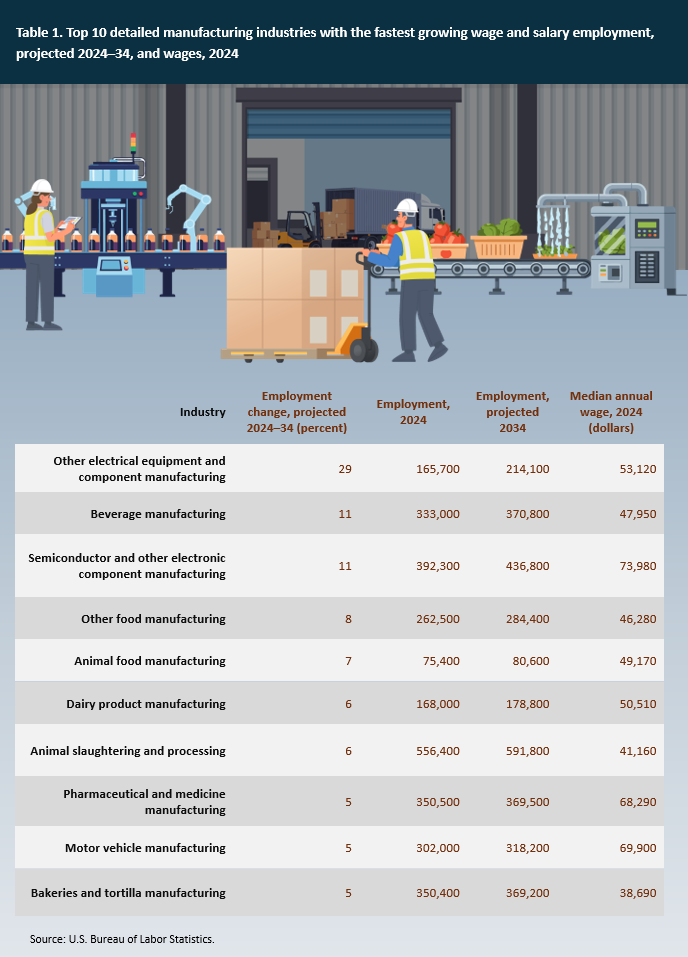
While overall employment in manufacturing is projected to show little change from 2024 to 2034, about half of all detailed manufacturing industries are expected to experience job growth. Table 1 shows the manufacturing industries with the fastest projected employment growth over the 2024–34 decade.
The other electrical equipment and component manufacturing industry, which includes battery manufacturing, is projected to be the fastest growing manufacturing industry and the fifth-fastest growing industry overall. As more consumers choose to drive electric vehicles, manufacturers will need more electric vehicle batteries to produce these types of cars. Similarly, batteries will also be needed by the utilities sector to store surplus energy from wind and solar power infrastructure to use during peak electricity demand.
Six of the 10 industries featured in table 1 are in food and beverage manufacturing. Consumer demand for ready-to-eat or convenient food products and beverages and an increase in the variety of food and beverage products available on the market is expected to lead to more jobs in these industries.
Of the industries in table 1, semiconductor and other electronic component manufacturing had the highest median annual wage in 2024 of $73,980.
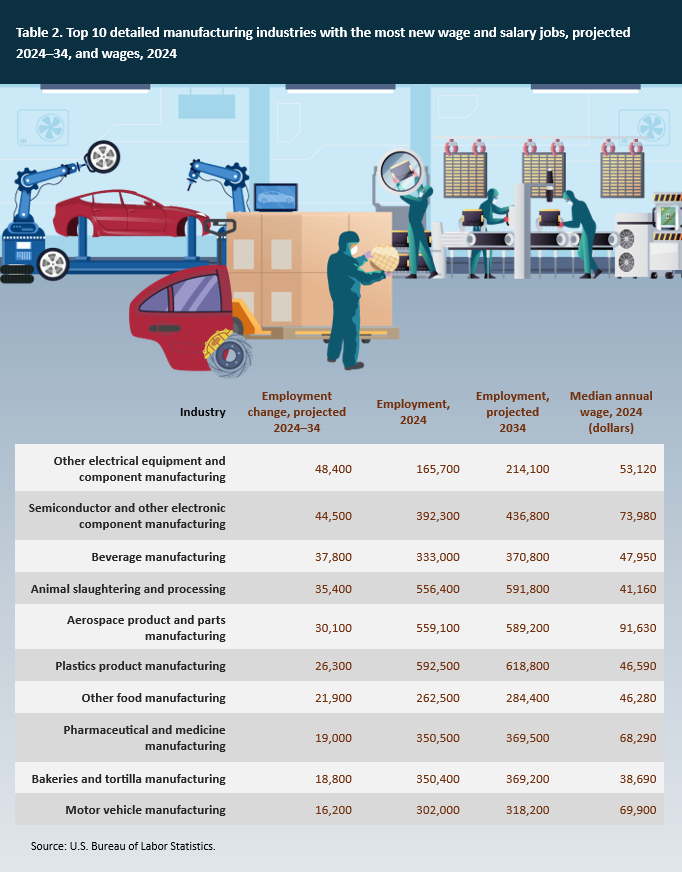
Projected employment change can be viewed in two ways: as percent change and as numeric change. Table 2 presents the 10 manufacturing industries with the largest numeric increase in jobs projected over the 2024–34 decade.
In addition to being the fastest growing manufacturing industry, other electrical equipment and component manufacturing is also projected to add the most jobs of any manufacturing industry from 2024 to 2034, about 48,400 jobs.
Among the industries in table 2, aerospace product and parts manufacturing had the highest median annual wage in 2024 of $91,630, the third-highest pay of all manufacturing industries. This industry tends to pay more than similar industries due to the complex nature of aircraft production and the high level of technical expertise required.
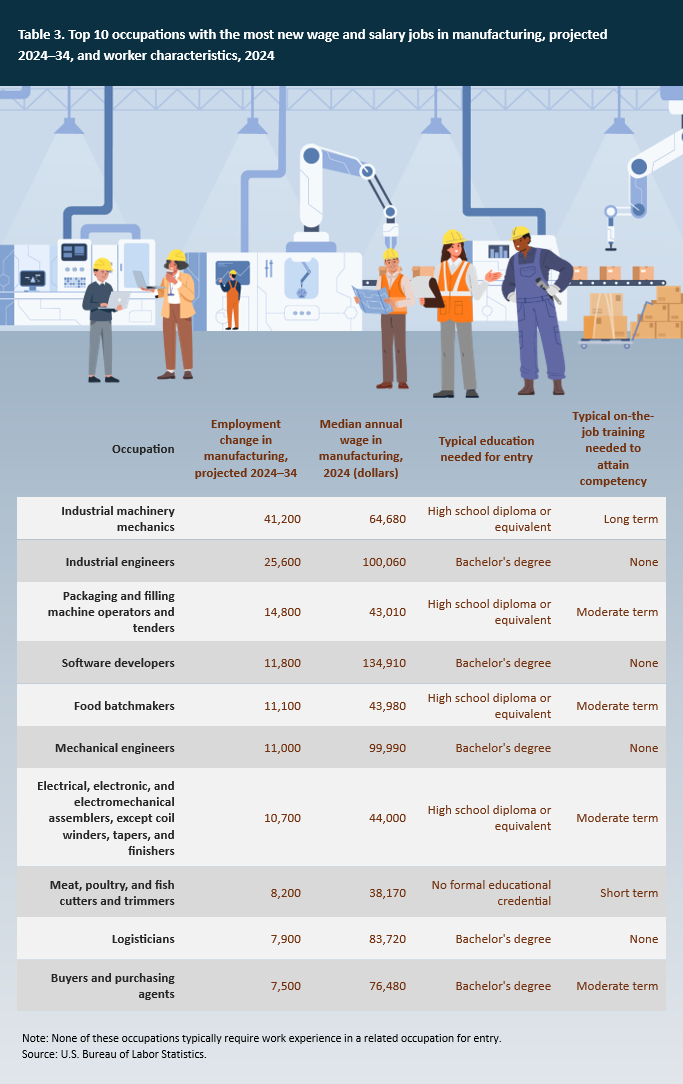
Manufacturing may bring to mind images of workers along an assembly line, but, in fact, a variety of nonproduction occupations are also employed in this sector. Table 3 shows the occupations projected to add the largest number of jobs in manufacturing from 2024 to 2034, nearly 150,000 new jobs in total over the decade.
Industrial machinery mechanics is projected to add the most jobs in the manufacturing sector from 2024–34, with 41,200 new jobs projected. The continued adoption of automated manufacturing machinery is expected to create jobs for these mechanics, as they will be needed to maintain and repair production equipment.
Education requirements vary for the occupations covered in table 3. Some, such as meat, poultry, and fish cutters and trimmers, have no formal educational requirement. In contrast, some manufacturing occupations usually require a college degree. Software developers, the occupation with a 2024 median annual wage in manufacturing of $134,910 (the highest paying occupation covered in table 3), typically requires a bachelor’s degree for entry into the occupation. Similarly, on-the-job training requirements vary by occupation. For example, industrial engineers typically do not require on-the-job training to attain competency, whereas packaging and filling machine operators and tenders typically need more than one month of on-the-job training.
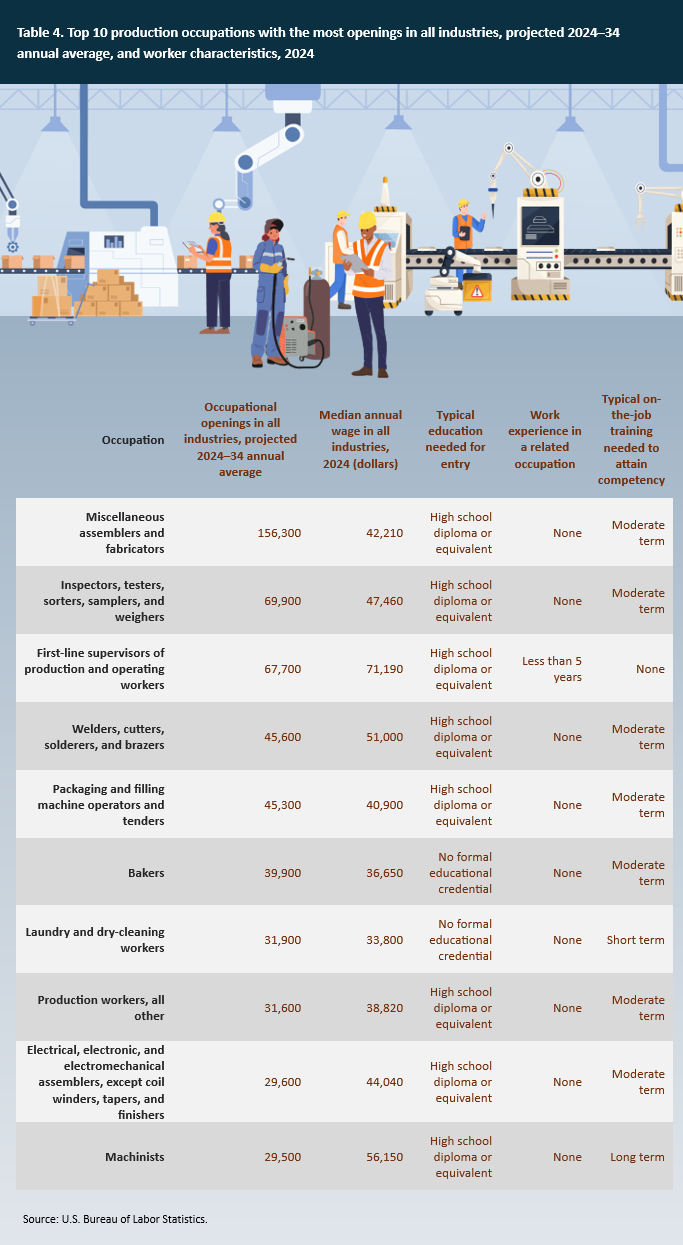
Production occupations represent a large share of employment in manufacturing, about half of all jobs in 2024. Table 4 shows the production occupations projected to have the most annual average openings across all industries from 2024 to 2034. Collectively, these occupations are projected to account for nearly 550,000 openings each year, on average, over the decade.
Of the occupations in table 4, miscellaneous assemblers and fabricators is projected to have the most occupational openings each year, on average, from 2024–34. This occupation includes team assemblers, who rotate through different tasks on an assembly line, rather than specializing in a single task. Miscellaneous assemblers and fabricators was also the largest production occupation in 2024, with employment of about 1.5 million, which contributes to the large number of projected openings.
All the selected occupations in table 4 typically require a high school diploma or less education for entry. Most require some amount of on-the-job training to attain competency. The exception is first-line supervisors of production and operating workers, who typically need work experience in a related occupation. These workers supervise and coordinate the activities of other production workers, such as inspectors, metal and plastic machine workers, and assemblers, and they often work their way up from one of these positions.
First-line supervisors of production and operating workers was also the highest paying occupation in table 4, with a 2024 median annual wage in all industries of $71,190.
Visit the BLS Employment Projections (EP) program online for industry and occupational projections data. In addition to projections, EP develops information on other topics, such as education and training and skills data by detailed occupation.
The Occupational Employment and Wage Statistics (OEWS) program has additional information about wages, including detailed occupational wages by industry.
Learn more about the occupations in this article and hundreds of others in the Occupational Outlook Handbook (OOH). The OOH describes what workers do, where they work, their wages, job outlook, and more.
Ryan Farrell and Lindsey Ice, "Producing the goods of the future: Job opportunities in manufacturing," Career Outlook, U.S. Bureau of Labor Statistics, May 2026.