An official website of the United States government
 United States Department of Labor
An official website of the United States government
United States Department of Labor

The .gov means it's official.
Federal government websites often end in .gov or .mil. Before sharing sensitive information,
make sure you're on a federal government site.

The site is secure.
The
https:// ensures that you are connecting to the official website and that any
information you provide is encrypted and transmitted securely.
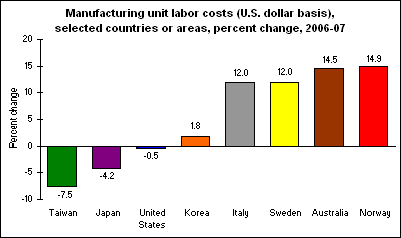
Expressed in U.S. dollars, manufacturing unit labor costs increased in 13 economies under comparison in 2007 and declined in 3. Taiwan experienced the largest drop in unit labor costs, followed by Japan and the United States.
Norway experienced the largest rise in unit labor costs in 2007 among the 13 economies under comparison.
Movements in exchange rates often are the dominant force behind changes in comparative unit labor costs and international competitiveness. In 2007, the U.S. dollar weakened against most of the currencies being compared. The only exceptions were Japan and Taiwan, where the currencies depreciated against the dollar. This depreciation of the U.S. dollar against most currencies continues a trend that began in 2001. In 2007, the dollar fell 9.1 percent against the euro, following a decline of 0.9 percent in 2006.
These data are from the Foreign Labor Statistics program. Data are subject to revision. Additional information is available in "International Comparisons of Manufacturing Productivity and Unit Labor Cost Trends, 2007," (PDF) (HTML) news release USDL 08-1343. Unit labor costs are defined as the cost of labor input required to produce one unit of output. They are computed as labor compensation in nominal terms divided by real output.
Bureau of Labor Statistics, U.S. Department of Labor, The Economics Daily, Manufacturing unit labor costs fell in 2007 in Taiwan, Japan, U.S. at https://www.bls.gov/opub/ted/2008/sept/wk5/art04.htm (visited July 02, 2025).