An official website of the United States government
 United States Department of Labor
An official website of the United States government
United States Department of Labor

The .gov means it's official.
Federal government websites often end in .gov or .mil. Before sharing sensitive information,
make sure you're on a federal government site.

The site is secure.
The
https:// ensures that you are connecting to the official website and that any
information you provide is encrypted and transmitted securely.
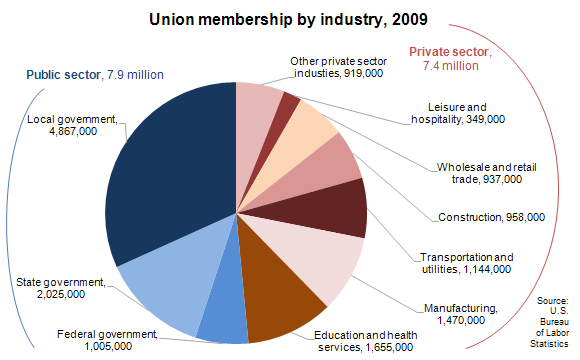
The number of wage and salary workers belonging to unions declined by 771,000 to 15.3 million in 2009, largely reflecting the overall drop in employment due to the recession. In 1983, the first year for which comparable union data are available, there were 17.7 million union workers.
In 2009, 7.9 million public sector employees belonged to a union, compared with 7.4 million union workers in the private sector. The union membership rate for public sector workers (37.4 percent) was substantially higher than the rate for private industry workers (7.2 percent).
Within the public sector, local government workers had the highest union membership rate (4.9 million members, or a rate of 43.3 percent). This group includes workers in heavily unionized occupations, such as teachers, police officers, and fire fighters.
Private sector industries with high unionization rates included transportation and utilities (1.1 million members, or a rate of 22.2 percent), and construction (1.0 million members, or a rate of 14.5 percent).
In 2009, low unionization rates occurred in agriculture and related industries (12,000 union members, or a rate of 1.1 percent) and financial activities (150,000 members, or a rate of 1.8 percent).
These data on union membership are from the Current Population Survey. Unionization data are for wage and salary workers. Find out more in "Union Members — 2009" (HTML) (PDF), news release USDL-10-0069.
Bureau of Labor Statistics, U.S. Department of Labor, The Economics Daily, Union membership declines in 2009 at https://www.bls.gov/opub/ted/2010/ted_20100201.htm (visited October 24, 2026).