An official website of the United States government
 United States Department of Labor
An official website of the United States government
United States Department of Labor

The .gov means it's official.
Federal government websites often end in .gov or .mil. Before sharing sensitive information,
make sure you're on a federal government site.

The site is secure.
The
https:// ensures that you are connecting to the official website and that any
information you provide is encrypted and transmitted securely.
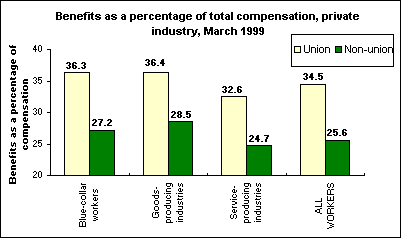
In March 1999, union workers received much more of their compensation in the form of benefits than did nonunion workers.
The proportion of compensation costs accounted for by benefits was 34.5 percent for all union workers and 25.6 percent for nonunion workers. Blue-collar union workers received benefits totaling 36.3 percent of their compensation while blue-collar nonunion workers received 27.2 percent.
In goods-producing industries, benefit costs accounted for 36.4 percent of compensation for union workers compared with 28.5 percent for nonunion workers. In service-producing industries, union workers received benefits totaling 32.6 percent of compensation compared with 24.7 percent for nonunion members. In both goods-producing and service-producing industries, the differential between the union and nonunion percentages was the same—7.9 percentage points.
These data are a product of the BLS Employment Cost Trends program. Additional information is available from "Employer Costs for Employee Compensation, 1986-99," BLS Bulletin 2526.
Bureau of Labor Statistics, U.S. Department of Labor, The Economics Daily, Benefits bigger piece of union compensation at https://www.bls.gov/opub/ted/2000/may/wk5/art01.htm (visited September 19, 2024).