An official website of the United States government
 United States Department of Labor
An official website of the United States government
United States Department of Labor

The .gov means it's official.
Federal government websites often end in .gov or .mil. Before sharing sensitive information,
make sure you're on a federal government site.

The site is secure.
The
https:// ensures that you are connecting to the official website and that any
information you provide is encrypted and transmitted securely.
Health savings accounts allow employees to set aside money on a tax-free basis to pay for future medical expenses.
Health savings accounts must be used in conjunction with employer-provided, high-deductible health plans with an annual maximum limit on out-of-pocket and deductible expenses. Other features of health savings accounts include the rollover of unused contributions, the portability of accounts, and tax-free interest.
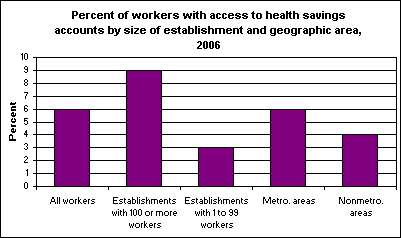
The chart shows that, in 2006, 9 percent of employees who worked in establishments with 100 or more employees had access to health savings accounts, while 3 percent of employees who worked in establishments with 1 to 99 workers had access to such accounts.
It also shows that 6 percent of workers who worked in metropolitan areas had access to health savings accounts and that 4 percent of workers in nonmetropolitan areas had access to such accounts.
These data are from the BLS National Compensation Survey program. Learn more in "Pretax Benefits: Access to Section 125 Cafeteria Benefits and Health Savings Accounts in the United States, Private Industry," in the March 2007 issue of Compensation and Working Conditions Online.
Related TED article:
Bureau of Labor Statistics, U.S. Department of Labor, The Economics Daily, Health savings accounts at https://www.bls.gov/opub/ted/2007/apr/wk1/art04.htm (visited June 12, 2026).