An official website of the United States government
 United States Department of Labor
An official website of the United States government
United States Department of Labor

The .gov means it's official.
Federal government websites often end in .gov or .mil. Before sharing sensitive information,
make sure you're on a federal government site.

The site is secure.
The
https:// ensures that you are connecting to the official website and that any
information you provide is encrypted and transmitted securely.
Health educators promote wellness and healthy lifestyles. Covering a wide range of topics, these workers teach individuals and communities about behaviors that encourage healthy living and prevent diseases and other problems.
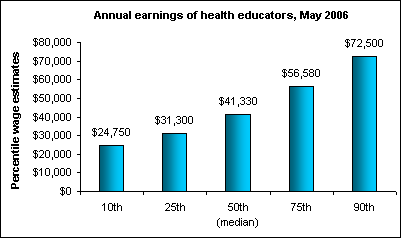
Health educators held 57,900 jobs in May 2006. Median annual wages of health educators were $41,330. The highest earning 10 percent made more than $72,500, and the lowest earning 10 percent made less than $24,750.
The specific duties of health educators vary by work setting. But whether they work in a hospital, school, business, or other setting, all health educators use similar skills and tools. In general, health educators begin by assessing their audience and planning a program that suits its needs. Then, they implement the program and evaluate its success.
A bachelor’s degree is generally the minimum requirement for an entry-level health educator position. However, some employers may prefer to hire people who have a bachelor’s degree plus related experience from an internship or volunteer work. A master’s degree in health education or a related field is usually required for higher level positions or to work in public health.
These data are from the Occupational Employment Statistics program. For more information, see "Health educators: Working for wellness," by Colleen Teixeira, Occupational Outlook Quarterly, Summer 2007.
Bureau of Labor Statistics, U.S. Department of Labor, The Economics Daily, Health educators at https://www.bls.gov/opub/ted/2007/oct/wk1/art01.htm (visited July 13, 2026).