An official website of the United States government
 United States Department of Labor
An official website of the United States government
United States Department of Labor

The .gov means it's official.
Federal government websites often end in .gov or .mil. Before sharing sensitive information,
make sure you're on a federal government site.

The site is secure.
The
https:// ensures that you are connecting to the official website and that any
information you provide is encrypted and transmitted securely.
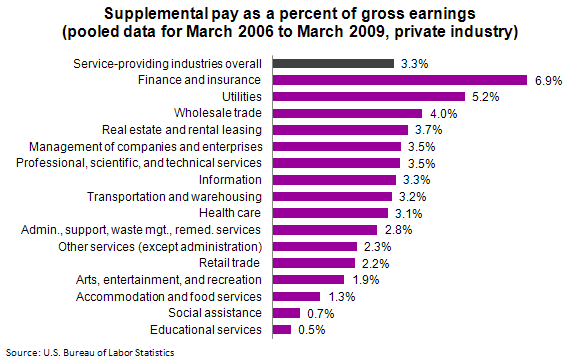
Over the period from 2006 to 2009, supplemental pay—overtime, bonuses, and shift differentials combined—accounted for 6.9 percent of gross earnings in finance and insurance, compared with 3.3 percent for the service-providing sector overall.
Finance and insurance is among the industries that pay the highest percentage of gross earnings in the form of supplemental pay, along with utilities (5.2 percent) and wholesale trade (4.0 percent). Industries for which supplemental pay makes up a considerably smaller percentage of gross earnings include educational services (0.5 percent), accommodation and food services (1.3 percent), and retail trade (2.2 percent).
Among the components of supplemental pay, the percentage of gross earnings received as bonuses is greater for finance and insurance (6.5 percent) than it is for other service-providing industries (1.4 percent). The percentage for overtime and shift differentials is smaller for finance and insurance than it is for the other service-providing industries.
These data are from the National Compensation Survey. The data are pooled from 2006 to 2009 using the first quarter of data for each year. Supplemental pay differs from benefits such as health or life insurance in that the employee receives it as a cash payment. To learn more, see "Supplemental Pay in the Finance and Insurance Industry" (HTML), Compensation and Working Conditions Online, April 2010.
Bureau of Labor Statistics, U.S. Department of Labor, The Economics Daily, Supplemental pay in the finance and insurance industry at https://www.bls.gov/opub/ted/2010/ted_20100427.htm (visited August 04, 2026).