An official website of the United States government
 United States Department of Labor
An official website of the United States government
United States Department of Labor

The .gov means it's official.
Federal government websites often end in .gov or .mil. Before sharing sensitive information,
make sure you're on a federal government site.

The site is secure.
The
https:// ensures that you are connecting to the official website and that any
information you provide is encrypted and transmitted securely.


| March 2026

Learn more about this occupation in the Occupational Outlook Handbook.
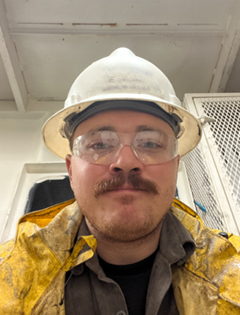
I am a floorhand on an oil drilling rig in the Permian Basin. I assist with all tasks on the drilling rig floor, such as moving or replacing pipe and maintaining the equipment used to extract crude oil.
I work 12-hour shifts while in the field. We start each day with a meeting to cover tasks for the day and end each day with a short meeting to debrief.
During normal drilling operations, we’ll do our daily, weekly, and monthly maintenance tasks wherever required. We’ll often need to “make connections,” which is adding more pipe to drill with, by staging the sections of long pipe and connecting them. After the driller drills down the previous section of pipe, they’ll disconnect from that section and grab the new one that we just built, tighten up the connections, put it on top of where they are drilling, and keep on drilling.
If we’re not drilling, we’re doing our regular maintenance and cleaning.
As a floorhand, I have a variety of other tasks. We may need to move the drilling rig, and this is referred to as “walking the rig.” Maintenance tasks involve greasing and inspecting equipment. There’s also a lot of cleaning and a lot of pressure washing. The cleaning never ends.
I had a friend who worked in the oil and gas industry, and the work sounded interesting. I also saw him come home with a new truck after working in the industry for a little while, and that sparked my interest.
I started with 2 days of classroom instruction that included quizzes and tests. I then had 1 day of hands-on training in the shop yard where I got some initial instructions on pieces of equipment used on the oil rig.
From there, I had 5 months of on-the-job training, where I had to prove that I could complete all tasks within my job description. I was required to demonstrate that I understood every piece of equipment and policy that applied to me. During training, I was assigned to work with a more experienced worker throughout the process, and I also sought help and feedback from others on my work crew.
We’ll also have periodic e-learning courses throughout the year. These cover company policies and safety training, such as working in hot weather, how to administer first aid, or how to properly use a fire extinguisher.
After high school, I went to community college for a year before entering the food service industry. I worked in the food service industry for about 6 years and eventually worked my way up to managing a restaurant.
After leaving the food service industry, I briefly started an e-commerce business. It was while working on that business that I spoke to my friend about working in the oil and gas industry. I’ve worked in this position for the last 2 years.
Patience and perseverance. Perseverance to stick it out. We work outside in all weather conditions, and it can be tough in cold temperatures or with the wind blowing on your back. There were 45 to 50 people in my training group and only 3 or 4 of them are still working. And patience in the sense that you need to be patient with yourself, because you’re learning something brand new. I wasn’t familiar with any of the equipment before I came out here, and it’s a lot of learning on the job.
People skills are important. There’s a variety of different people and personalities on the oil rig, and you have to adapt to working with them and understanding their communication styles.
Time management and staying organized. There are a lot of routine tasks or maintenance work that need to be done throughout each shift, and I have to manage my time wisely to ensure that I get these tasks done. It’s easy to push these tasks off for later, but then an emergency or more pressing work comes up and I’m in a bind. The job can change at a moment’s notice, so I’ve learned to get things done when I have time and not put them off for later.
I like the schedule. I work 2 weeks on and 2 weeks off. We work 12-hour shifts, 7 days a week (for 2 weeks) while in the field, but that is followed by 2 weeks off. During those 2 weeks, I can completely disconnect from work, and I’m free to spend my time however I want.
I like working with my crew. I’m on a good crew with good leaders, and at times it feels like it’s not so much work as it is hanging out, with some manual labor on the side. The work is also rewarding, and I feel a sense of accomplishment.
I’ve gained a lot of valuable experience over the last couple of years, and that has opened opportunities for other jobs in this field. There’s a variety of other oil field service jobs I could go into, or I could move into the inspection side. My short-term goal is to move up to the motorhand position. That’s the next position up in the career ladder. The motorhand maintains the generators that we use and generally acts as the mechanic for the rig.
Find a good mentor. I was initially assigned a mentor who did not have much more experience than me, and he was limited in how much he could help me. I ended up reaching out to one of the more experienced workers, and he became a mentor for me. I would ask him questions about the job and get feedback on my work and what I needed to work on or improve.
Give it a shot and hang in there. The job can be hard, but you’ll never know if you like it unless you try.
Ryan Farrell, "Floorhand," Career Outlook, U.S. Bureau of Labor Statistics, March 2026.