Department of Labor Logo United States Department of Labor
Dot gov

The .gov means it's official.
Federal government websites often end in .gov or .mil. Before sharing sensitive information, make sure you're on a federal government site.

Https

The site is secure.
The https:// ensures that you are connecting to the official website and that any information you provide is encrypted and transmitted securely.

Construction and Building Inspectors

Summary

Please enable javascript to play this video.

Video transcript available at https://www.youtube.com/watch?v=PgnWqyol0Pk.
Quick Facts: Construction and Building Inspectors
2025 Median Pay $74,690 per year
$35.91 per hour
Typical Entry-Level Education High school diploma or equivalent
Work Experience in a Related Occupation 5 years or more
On-the-job Training Moderate-term on-the-job training
Number of Jobs, 2025 153,900
Job Outlook, 2025–35 0% (Little or no change)
Employment Change, 2025–35 0

What Construction and Building Inspectors Do

Construction and building inspectors ensure that construction meets building codes and ordinances, zoning regulations, and contract specifications.

Work Environment

Construction and building inspectors examine worksites, both alone and as part of a team. Some inspectors climb ladders or crawl in tight spaces. Most work full time during regular business hours.

How to Become a Construction or Building Inspector

Construction and building inspectors usually need a high school diploma and work experience in a construction trade to enter the occupation. They typically learn on the job to attain competency. Many states and localities require some type of license or certification.

Pay

The median annual wage for construction and building inspectors was $74,690 in May 2025.

Job Outlook

Employment of construction and building inspectors is projected to show little or no change from 2025 to 2035.

Despite limited employment growth, about 14,800 openings for construction and building inspectors are projected each year, on average, over the decade. Most of those openings are expected to result from the need to replace workers who transfer to different occupations or exit the labor force, such as to retire.

State & Area Data

Explore resources for employment and wages by state and area for construction and building inspectors.

Similar Occupations

Compare the job duties, education, job growth, and pay of construction and building inspectors with similar occupations.

More Information, Including Links to O*NET

Learn more about construction and building inspectors by visiting additional resources, including O*NET, a source on key characteristics of workers and occupations.

What Construction and Building Inspectors Do About this section

Construction and building inspectors
Home inspectors inform potential homebuyers of a home’s deficiencies.

Construction and building inspectors ensure that construction meets local and national building codes and ordinances, zoning regulations, and contract specifications.

Duties

Construction and building inspectors typically do the following:

  • Review building plans and approve those that meet requirements
  • Monitor construction sites periodically to ensure overall compliance
  • Use equipment and testing devices, such as moisture meters to check for plumbing leaks or flooding damage and electrical testers to ensure that electrical components are functional
  • Inspect plumbing, electrical, and other systems to ensure that they meet code
  • Use survey equipment to verify alignment, level, and elevation of structures and ensure building meets specifications
  • Issue violation notices and stop-work orders if building is not compliant
  • Keep daily logs, which may include digital images from inspections
  • Document findings in writing

Construction and building inspectors ensure safety compliance of buildings, dams, bridges, and other structures; highways and streets; and sewer and water systems. They also inspect electrical; heating, ventilation, air-conditioning, and refrigeration (HVACR); and plumbing systems. Inspectors typically check a project several times: for an initial check in the early construction phase, for followup inspections as the project progresses, and for a comprehensive examination after its completion. At each inspection, they may provide written or oral feedback about their findings.

The following are examples of types of construction and building inspectors:

Building inspectors check the structural quality, architectural requirements, and general safety of buildings. Some building inspectors focus on fire prevention and safety. Fire inspectors and investigators ensure that buildings meet fire codes.

Coating inspectors examine the exterior paint and coating on bridges, pipelines, and large holding tanks. In their checks throughout the painting process, inspectors ensure that protective layers are correctly applied.

Electrical inspectors examine a building’s installed electrical systems to ensure compliance and proper functioning. These systems may include new and existing sound and security systems, lighting, photovoltaic systems, generating equipment, and wiring for HVACR systems and appliances.

Elevator inspectors examine lifting and conveying devices, such as elevators, escalators, moving sidewalks, lifts and hoists, inclined railways, ski lifts, and amusement rides. They inspect both the mechanical and electrical control systems.

Home inspectors typically examine houses, condominiums, townhomes, and other dwellings to report on their structure and overall condition. Home sellers or home buyers, or both, may seek inspectors’ objective assessment of a dwelling before placing it on the market or submitting an offer.

In addition to checking structural quality, home inspectors examine home systems and features, including the roof, foundation, interior and exterior walls, and plumbing, electrical, and HVACR systems. They may identify violations of building codes but do not have the authority to enforce compliance.

Mechanical inspectors examine HVACR systems and equipment to ensure that they are installed and function properly. They also may inspect commercial kitchen equipment, gas-fired appliances, and boilers. Mechanical inspectors’ work differs from that of quality control inspectors, who inspect goods at manufacturing plants.

Plans examiners determine whether the plans for a building or other structure comply with adopted building codes, regulations, and ordinances.

Plumbing inspectors examine the installation of systems that ensure the safety of drinking water and industrial piping and the sanitary disposal of waste.

Public works inspectors ensure that the construction of federal, state, and local government water and sewer systems; roads and bridges; and dams conforms to specifications. They may specialize in projects such as highways, structural steel, or dredging operations required for bridges, dams, or harbors.

Special inspectors ensure that critical construction work, such as high-strength concrete, steel fabrication, and welding, is installed and tested according to design specifications. Special inspectors represent the owner’s interests, not those of the general public. Insurance companies and financial institutions also may use their services.

Work Environment About this section

Construction and building inspectors
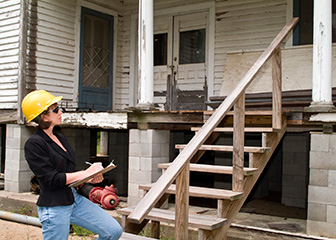
Building inspectors often work outdoors to check the exterior structure of a house.

Construction and building inspectors held about 153,900 jobs in 2025. Some of the largest employers of construction and building inspectors were as follows:

Local government, excluding education and hospitals 36%
Engineering services 19
Construction 9
State government, excluding education and hospitals 4
Self-employed workers 3

Although construction and building inspectors spend most of their time examining worksites, they also spend time in an office reviewing blueprints, writing reports, and scheduling inspections.

Some inspectors climb ladders or crawl in tight spaces as part of their work.

Inspectors typically work alone. However, inspectors may work as part of a team on large, complex projects, particularly if they specialize in one area of construction.

Work Schedules

Most inspectors work full time during regular business hours. However, some work additional hours during periods of heavy construction. Also, if an accident occurs at a construction site, inspectors must respond immediately and may work additional hours to complete their report. Some inspectors—especially those who are self-employed—work evenings and weekends. This is particularly true of home inspectors, who typically inspect homes during the day and write reports in the evening.

How to Become a Construction or Building Inspector About this section

Construction and building inspectors
Inspectors often have a combination of certifications and previous experience in various construction and maintenance trades.

Construction and building inspectors usually need a high school diploma and work experience in a construction trade to enter the occupation. They typically learn on the job to attain competency. Many states and localities require some type of license or certification.

Education

Most employers require inspectors to have at least a high school diploma, even for workers who have considerable experience.

Some employers may seek candidates who have a bachelor’s degree in engineering or architecture or who have another postsecondary credential. Many community colleges offer a certificate or an associate’s degree program in building inspection technology and have courses in building inspection, home inspection, construction technology, and drafting. Courses in blueprint reading, vocational subjects, algebra, geometry, and writing are also useful. Courses in business management are helpful for those who plan to run their own inspection business.

Some jurisdictions require that construction and building inspectors take continuing education courses to maintain their credentials.

Training

Training requirements vary by state, locality, and type of inspector. In general, construction and building inspectors receive much of their training on the job. Construction and building inspectors learn building codes and standards as a prerequisite to obtaining their license and through continuing education. Working with an experienced inspector, they learn about inspection techniques; codes, ordinances, and regulations; contract specifications; and recordkeeping and reporting duties. Training also may include supervised onsite inspections.

Work Experience in a Related Occupation

Employers may prefer to hire applicants who have both training and experience in a construction trade. For example, many inspectors have experience working as carpenters, electricians, or plumbers. Many home inspectors get experience in multiple specialties and enter the occupation with a combination of certifications and experience.

Licenses, Certifications, and Registrations

Most states and localities require construction and building inspectors to have a license or certification. Some states have individual licensing programs for construction and building inspectors. Others may require certification by professional associations.

Similarly, most states require home inspectors to follow defined trade practices or to get a state-issued license or certification.

Home inspector license or certification requirements vary by state but may require that inspectors have experience with inspections, maintain liability insurance, and pass an exam.

Information on state licensing board requirements is available from CareerOneStop.

Information on certifications is available from CareerOneStop.

Inspectors must have a valid driver’s license to travel to inspection sites.

Advancement

Construction and building inspectors may advance to become a plans examiner or building official. Advancement opportunities may require additional education, along with experience as a construction or building inspector. 

Important Qualities

The following are examples of qualities that are important for these workers to perform their duties. For more information, visit the Employment Projections (EP) skills data page.

Communication skills. Inspectors must be able to explain problems they discover and to write a report that clearly describes their findings.

Detail oriented. Inspectors thoroughly examine many different construction activities. They must pay close attention so as not to overlook any details.

Mechanical knowledge. Inspectors use a variety of testing equipment to check complex systems and must therefore understand how the systems operate.

Physical stamina. Inspectors are frequently on their feet and often climb and crawl through attics and other tight spaces. As a result, they should be physically fit.

Pay About this section

Construction and Building Inspectors

Median annual wages, May 2025

Construction and building inspectors

$74,690

Other construction and related workers

$58,450

Total, all occupations

$50,980


The median annual wage for construction and building inspectors was $74,690 in May 2025. The median wage is the wage at which half the workers in an occupation earned more than that amount and half earned less. The lowest 10 percent earned less than $47,140, and the highest 10 percent earned more than $114,200.

In May 2025, the median annual wages for construction and building inspectors in some of the top industries in which they worked were as follows:

Engineering services $77,500
Construction 74,460
Local government, excluding education and hospitals 73,930
State government, excluding education and hospitals 73,520

Most inspectors work full time during regular business hours. However, some work additional hours during periods of heavy construction. Also, if an accident occurs at a construction site, inspectors must respond immediately and may work additional hours to complete their report. Some inspectors—especially those who are self-employed—work evenings and weekends. This is particularly true of home inspectors, who typically inspect homes during the day and write reports in the evening.

Job Outlook About this section

Construction and Building Inspectors

Percent change in employment, projected 2025–35

Other construction and related workers

3%

Total, all occupations

3%

Construction and building inspectors

0%


Employment of construction and building inspectors is projected to show little or no change from 2025 to 2035.

Despite limited employment growth, about 14,800 openings for construction and building inspectors are projected each year, on average, over the decade. Most of those openings are expected to result from the need to replace workers who transfer to different occupations or exit the labor force, such as to retire.

Employment

The increasing use of remote inspections is projected to reduce the need for inspectors in state and local government. However, continued public interest in safety and the desire to improve the quality of construction is expected to support some demand for inspectors.

Employment projections data for construction and building inspectors, 2025–35
Occupational Title SOC Code Employment, 2025 Projected Employment, 2035 Change, 2025–35 Employment by Industry
Percent Numeric

Note:
Employment subcategories do not necessarily add to higher categories due to rounding.
Employment and projected employment change values are rounded to the nearest 100 or percent.
Data is unavailable for values denoted with a "—".
Source: U.S. Bureau of Labor Statistics.

Construction and building inspectors

47-4011 153,900 153,900 0 0 Get data

State & Area Data About this section

Occupational Employment and Wage Statistics (OEWS)

The Occupational Employment and Wage Statistics (OEWS) program produces employment and wage estimates annually for over 800 occupations. These estimates are available for the nation as a whole, for individual states, and for metropolitan and nonmetropolitan areas. The link below goes to OEWS data maps for employment and wages by state and area. Use the dropdown boxes to select an occupation.

Projections Central

Occupational employment projections are developed for all states by Labor Market Information (LMI) or individual state Employment Projections offices. All state projections data are available at https://projectionscentral.org. Information on this site allows projected employment growth for an occupation to be compared among states or to be compared within one state. In addition, states may produce projections for areas; there are links to each state’s websites where these data may be retrieved.

CareerOneStop

CareerOneStop includes hundreds of occupational profiles with data available by state and metro area. There are links in the left-hand side menu to compare occupational employment by state and occupational wages by local area or metro area. There is also a salary info tool to search for wages by zip code.

Similar Occupations About this section

This table shows a list of occupations with job duties that are similar to those of construction and building inspectors.

Occupation Job Duties ENTRY-LEVEL EDUCATION Help on Entry-Level Education 2025 MEDIAN PAY Help on Median Pay
Appraisers and assessors of real estate Property Appraisers and Assessors

Property appraisers and assessors provide a value estimate on real estate and on tangible personal and business property.

Bachelor's degree $67,960
Architects Architects

Architects plan and design houses, factories, office buildings, and other structures.

Bachelor's degree $99,280
Carpenters Carpenters

Carpenters construct, repair, and install building frameworks and structures made from wood and other materials.

High school diploma or equivalent $60,580
Electricians Electricians

Electricians install, maintain, and repair electrical power, communications, lighting, and control systems.

High school diploma or equivalent $63,190
Plumbers, pipefitters, and steamfitters Plumbers, Pipefitters, and Steamfitters

Plumbers, pipefitters, and steamfitters install and repair piping fixtures and systems.

High school diploma or equivalent $63,800
Electrical and electronic engineering technicians Electrical and Electronic Engineering Technologists and Technicians

Electrical and electronic engineering technologists and technicians help engineers design and develop equipment that is powered by electricity or electric current.

Associate's degree $78,190
Electrical and electronics engineers Electrical and Electronics Engineers

Electrical and electronics engineers design, develop, and test electrical and electronic equipment, components, and systems.

Bachelor's degree $125,040
Surveyors Surveyors

Surveyors make precise measurements to determine property boundaries.

Bachelor's degree $75,440
Construction managers Construction Managers

Construction managers plan, coordinate, budget, and supervise construction projects from start to finish.

Bachelor's degree $114,990
Occupational health and safety specialists Occupational Health and Safety Specialists and Technicians

Occupational health and safety specialists and technicians collect data on, analyze, and design improvements to work environments and procedures.

See How to Become One $83,740
Suggested citation:

Bureau of Labor Statistics, U.S. Department of Labor, Occupational Outlook Handbook, Construction and Building Inspectors,
at https://www.bls.gov/ooh/construction-and-extraction/construction-and-building-inspectors.htm (visited August 27, 2026).

Last modified date: August 27, 2026

What They Do

The What They Do tab describes the typical duties and responsibilities of workers in the occupation, including what tools and equipment they use and how closely they are supervised. This tab also covers different types of occupational specialties.

Work Environment

The Work Environment tab includes the number of jobs held in the occupation and describes the workplace, the level of physical activity expected, and typical hours worked. It may also discuss the major industries that employed the occupation. This tab may also describe opportunities for part-time work, the amount and type of travel required, any safety equipment that is used, and the risk of injury that workers may face.

How to Become One

The How to Become One tab describes how to prepare for a job in the occupation. This tab can include information on education, training, work experience, licensing and certification, and important qualities that are required or helpful for entering or working in the occupation.

Pay

The Pay tab describes typical earnings and how workers in the occupation are compensated—annual salaries, hourly wages, commissions, tips, or bonuses. Within every occupation, earnings vary by experience, responsibility, performance, tenure, and geographic area. For most profiles, this tab has a table with wages in the major industries employing the occupation. It does not include pay for self-employed workers, agriculture workers, or workers in private households because these data are not collected by the Occupational Employment and Wage Statistics (OEWS) survey, the source of BLS wage data in the OOH.

State & Area Data

The State and Area Data tab provides links to state and area occupational data from the Occupational Employment and Wage Statistics (OEWS) program, state projections data from Projections Central, and occupational information from the Department of Labor's CareerOneStop.

Job Outlook

The Job Outlook tab describes the factors that affect employment growth or decline in the occupation, and in some instances, describes the relationship between the number of job seekers and the number of job openings.

Similar Occupations

The Similar Occupations tab describes occupations that share similar duties, skills, interests, education, or training with the occupation covered in the profile.

Contacts for More Information

The More Information tab provides the Internet addresses of associations, government agencies, unions, and other organizations that can provide additional information on the occupation. This tab also includes links to relevant occupational information from the Occupational Information Network (O*NET).

2025 Median Pay

The wage at which half of the workers in the occupation earned more than that amount and half earned less. Median wage data are from the BLS Occupational Employment and Wage Statistics survey. In May 2025, the median annual wage for all workers was $50,980.

On-the-job Training

Additional training needed (postemployment) to attain competency in the skills needed in this occupation.

Entry-level Education

Typical level of education that most workers need to enter this occupation.

Work experience in a related occupation

Work experience that is commonly considered necessary by employers, or is a commonly accepted substitute for more formal types of training or education.

Number of Jobs, 2025

The employment, or size, of this occupation in 2025, which is the base year of the 2025–35 employment projections.

Job Outlook, 2025-35

The projected percent change in employment from 2025 to 2035. The average growth rate for all occupations is 3 percent.

Employment Change, 2025-35

The projected numeric change in employment from 2025 to 2035.

Entry-level Education

Typical level of education that most workers need to enter this occupation.

On-the-job Training

Additional training needed (postemployment) to attain competency in the skills needed in this occupation.

Employment Change, projected 2025-35

The projected numeric change in employment from 2025 to 2035.

Growth Rate (Projected)

The percent change of employment for each occupation from 2025 to 2035.

Projected Number of New Jobs

The projected numeric change in employment from 2025 to 2035.

Projected Growth Rate

The projected percent change in employment from 2025 to 2035.

2025 Median Pay

The wage at which half of the workers in the occupation earned more than that amount and half earned less. Median wage data are from the BLS Occupational Employment and Wage Statistics survey. In May 2025, the median annual wage for all workers was $50,980.