
An official website of the United States government
 United States Department of Labor
An official website of the United States government
United States Department of Labor

The .gov means it's official.
Federal government websites often end in .gov or .mil. Before sharing sensitive information,
make sure you're on a federal government site.

The site is secure.
The
https:// ensures that you are connecting to the official website and that any
information you provide is encrypted and transmitted securely.


26-928-DAL
Friday, June 12, 2026
Private industry employer costs for employee compensation among the four regions of the country ranged from $41.59 per hour in the South to $54.61 in the Northeast in March 2026, the U.S. Bureau of Labor Statistics reported today. In the other two regions, hourly employer costs for employee compensation stood at $43.82 in the Midwest and $51.16 in the West. (See chart 1.) In addition to regional estimates, employer costs for nine smaller geographic divisions are also available. Within divisions, total compensation costs ranged from $37.29 per hour in the East South Central division to $55.14 in the Pacific region. (See table 1.) Employer Costs for Employee Compensation (ECEC) are based on the National Compensation Survey, which measures employer costs for wages, salaries, and employee benefits. (Geographic definitions of the regions and divisions follow in the Technical Note.)
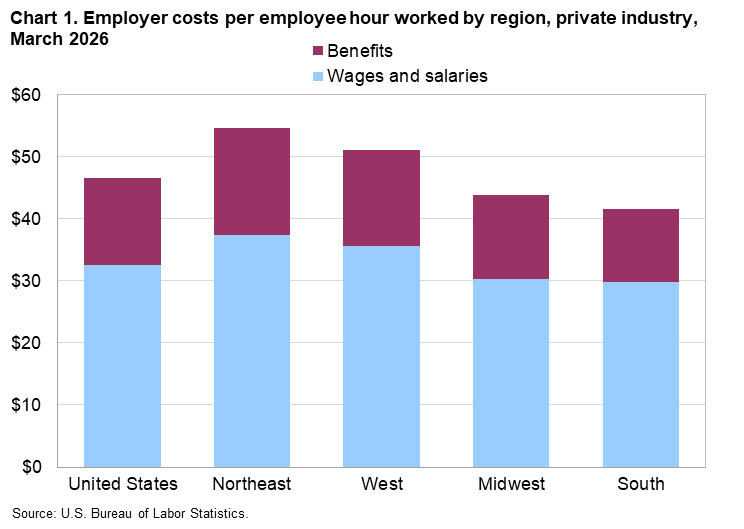
| Private Industry | Wages and salaries | Benefits | Total compensation |
|---|---|---|---|
| United States | $32.60 | $14.01 | $46.60 |
| Northeast | $37.43 | $17.19 | $54.61 |
| West | $35.62 | $15.55 | $51.16 |
| Midwest | $30.34 | $13.48 | $43.82 |
| South | $29.77 | $11.82 | $41.59 |
In the Northeast, hourly total compensation costs in March 2026 were comprised of the following: wages and salaries ($37.43) made up 68.5 percent, while total benefits ($17.19) accounted for the remaining 31.5 percent of compensation costs. Insurance, which includes life, health, and short- and long-term disability, averaged $4.68 per hour worked, or 8.6 percent of all compensation costs. Costs for paid leave, which include vacation, holiday, sick, and personal leave, averaged $4.63 per hour worked, accounting for 8.5 percent of total compensation costs. Legally required benefits, which include Social Security, Medicare, unemployment insurance (both state and federal), and workers' compensation, averaged $3.93 per hour and represented 7.2 percent of total compensation costs.
In the West, hourly wages and salaries averaged $35.62 and accounted for 69.6 percent of all compensation costs. Total benefits averaged $15.55, or 30.4 percent of compensation costs. Paid leave averaged $3.94 per hour, or 7.7 percent of compensation costs. Legally required benefits costs were $3.90 per hour, or 7.6 percent of regional compensation costs. Insurance costs averaged $3.62 per hour, accounting for 7.1 percent of total compensation costs in the West.
The Midwest region recorded an hourly wage and salary average of $30.34 in March 2026, representing 69.2 percent of all compensation costs. Total benefits averaged $13.48 and accounted for the remaining 30.8 percent of total compensation costs. The three highest major categories for employer benefits were insurance benefits ($3.69 per hour worked), legally required benefits ($3.15), and paid leave ($3.14). These categories represented 8.4 percent, 7.2 percent, and 7.2 percent, respectively, of total employer compensation costs in the Midwest.
In the South, wages and salaries averaged $29.77 per hour and comprised 71.6 percent of total employer compensation costs, while benefits, at $11.82 per hour, accounted for the remaining 28.4 percent. Insurance benefits costs averaged $3.06 per hour worked, followed by paid leave at $3.02 per hour; these categories accounted for 7.4 percent and 7.3 percent, respectively, of total compensation costs in the South. Legally required benefits were the third-highest benefit cost and averaged $2.91 per hour, accounting for 7.0 percent of employer compensation for the region.
Overall, compensation costs among private industry employers in the United States averaged $46.60 per hour worked in March 2026. Wages and salaries, at $32.60 per hour, accounted for 69.9 percent of these costs, while benefits, at $14.01, made up the remaining 30.1 percent.
The June 2026 national release on Employer Costs for Employee Compensation is scheduled to be released on Wednesday, September 9, 2026, at 10:00 a.m. (ET).
Beginning with the publication of Employer Costs for Employee Compensation (ECEC) data for December 2026, the ECEC will remove workers’ compensation costs. For more information, see www.bls.gov/ecec/notices/2026/removing-workers-compensation-costs.htm.
Employer Costs for Employee Compensation (ECEC) provides the average employer cost for wages and salaries as well as benefits per employee hour worked.
Employer Costs for Employee Compensation data in this release cover private industry. Excluded from private industry are the self-employed, agricultural workers, and private household workers. Data for this reference period were collected from a probability sample of approximately 28,500 occupational observations selected from a sample of about 6,700 private industry establishments. The private industry sample is rotated over approximately three years, which makes the sample more representative of the economy and reduces respondent burden. Data are collected for the pay period including the 12th day of the survey months of March, June, September, and December.
Employer Costs for Employee Compensation data on total compensation, wages and salaries, and benefits in private industry are produced annually in the March reference period for 15 combined and metropolitan statistical areas (CSA and MSA). Further information about metropolitan area ECEC estimates is available at www.bls.gov/opub/mlr/cwc/bls-introduces-new-employer-costs-for-employee-compensation-data-for-private-industry-workers-in-15-metropolitan-areas.pdf.
For detailed information on ECEC, see “National Compensation Measures,” of the BLS Handbook of Methods at www.bls.gov/opub/hom/ncs/home.htm. Current and historical BLS data are also available online at www.bls.gov/ecec.
If you are deaf, hard of hearing, or have a speech disability, please dial 7-1-1 to access telecommunications relay services.
Regional definitions
Northeast region
Midwest region
South region
West region
| Area(1) | Total compensation(2) | Wages and salaries | Total benefits | Paid leave | Supplemental pay | Insurance | Retirement and savings | Legally required benefits | ||||||||
|---|---|---|---|---|---|---|---|---|---|---|---|---|---|---|---|---|
| Cost ($) | Percent | Cost ($) | Percent | Cost ($) | Percent | Cost ($) | Percent | Cost ($) | Percent | Cost ($) | Percent | Cost ($) | Percent | Cost ($) | Percent | |
Northeast | 54.61 | 100.0 | 37.43 | 68.5 | 17.19 | 31.5 | 4.63 | 8.5 | 1.85 | 3.4 | 4.68 | 8.6 | 2.09 | 3.8 | 3.93 | 7.2 |
New England | 54.57 | 100.0 | 37.76 | 69.2 | 16.81 | 30.8 | 4.80 | 8.8 | 1.56 | 2.9 | 4.65 | 8.5 | 2.03 | 3.7 | 3.77 | 6.9 |
Middle Atlantic | 54.63 | 100.0 | 37.30 | 68.3 | 17.33 | 31.7 | 4.57 | 8.4 | 1.96 | 3.6 | 4.69 | 8.6 | 2.12 | 3.9 | 3.99 | 7.3 |
South | 41.59 | 100.0 | 29.77 | 71.6 | 11.82 | 28.4 | 3.02 | 7.3 | 1.63 | 3.9 | 3.06 | 7.4 | 1.19 | 2.9 | 2.91 | 7.0 |
South Atlantic | 43.29 | 100.0 | 30.92 | 71.4 | 12.37 | 28.6 | 3.24 | 7.5 | 1.67 | 3.8 | 3.14 | 7.3 | 1.30 | 3.0 | 3.02 | 7.0 |
East South Central | 37.29 | 100.0 | 27.20 | 72.9 | 10.09 | 27.1 | 2.42 | 6.5 | 1.41 | 3.8 | 2.78 | 7.5 | 0.83 | 2.2 | 2.65 | 7.1 |
West South Central | 40.64 | 100.0 | 28.97 | 71.3 | 11.67 | 28.7 | 2.92 | 7.2 | 1.67 | 4.1 | 3.06 | 7.5 | 1.18 | 2.9 | 2.85 | 7.0 |
Midwest | 43.82 | 100.0 | 30.34 | 69.2 | 13.48 | 30.8 | 3.14 | 7.2 | 1.97 | 4.5 | 3.69 | 8.4 | 1.53 | 3.5 | 3.15 | 7.2 |
East North Central | 43.53 | 100.0 | 30.02 | 69.0 | 13.51 | 31.0 | 3.12 | 7.2 | 2.06 | 4.7 | 3.62 | 8.3 | 1.58 | 3.6 | 3.12 | 7.2 |
West North Central | 44.43 | 100.0 | 31.02 | 69.8 | 13.41 | 30.2 | 3.18 | 7.2 | 1.76 | 4.0 | 3.83 | 8.6 | 1.43 | 3.2 | 3.22 | 7.2 |
West | 51.16 | 100.0 | 35.62 | 69.6 | 15.55 | 30.4 | 3.94 | 7.7 | 2.31 | 4.5 | 3.62 | 7.1 | 1.78 | 3.5 | 3.90 | 7.6 |
Mountain | 44.11 | 100.0 | 31.78 | 72.1 | 12.33 | 27.9 | 3.04 | 6.9 | 1.74 | 3.9 | 3.01 | 6.8 | 1.24 | 2.8 | 3.30 | 7.5 |
Pacific | 55.14 | 100.0 | 37.78 | 68.5 | 17.36 | 31.5 | 4.44 | 8.1 | 2.63 | 4.8 | 3.96 | 7.2 | 2.09 | 3.8 | 4.24 | 7.7 |
(1) The census divisions are defined as follows: New England: Connecticut, Maine, Massachusetts, New Hampshire, Rhode Island, and Vermont; Middle Atlantic: New Jersey, New York, and Pennsylvania; South Atlantic: Delaware, District of Columbia, Florida, Georgia, Maryland, North Carolina, South Carolina, Virginia, and West Virginia; East South Central: Alabama, Kentucky, Mississippi, and Tennessee; West South Central: Arkansas, Louisiana, Oklahoma, and Texas; East North Central: Illinois, Indiana, Michigan, Ohio, and Wisconsin; West North Central: Iowa, Kansas, Minnesota, Missouri, Nebraska, North Dakota, and South Dakota; Mountain: Arizona, Colorado, Idaho, Montana, Nevada, New Mexico, Utah, and Wyoming; and Pacific: Alaska, California, Hawaii, Oregon, and Washington. | ||||||||||||||||
Last Modified Date: Friday, June 12, 2026