An official website of the United States government
 United States Department of Labor
An official website of the United States government
United States Department of Labor

The .gov means it's official.
Federal government websites often end in .gov or .mil. Before sharing sensitive information,
make sure you're on a federal government site.

The site is secure.
The
https:// ensures that you are connecting to the official website and that any
information you provide is encrypted and transmitted securely.


26-1480-DAL
Friday, September 04, 2026
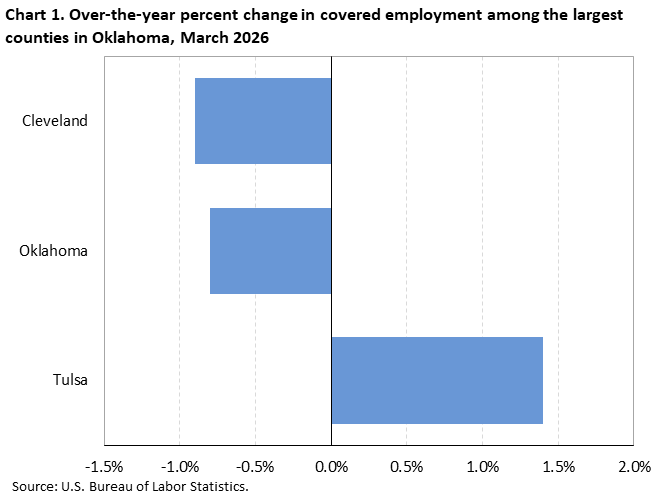
Employment declined in 2 of the 3 largest counties in Oklahoma from March 2025 to March 2026, the U.S. Bureau of Labor Statistics reported today. Oklahoma employment was essentially unchanged over the year at 1,700,600 in March 2026, as measured by the Quarterly Census of Employment and Wages (QCEW) program. (See table 1.) Regional Commissioner James B. Howard, Jr., noted that employment decreased in Cleveland (-0.9 percent) and Oklahoma (-0.8 percent) Counties. (See chart 1.)
Oklahoma County (493,100) had the highest employment level in Oklahoma in March 2026. Together, the three largest counties accounted for 56.4 percent of total covered employment within the state. Nationwide, the 376 largest counties comprise 73.5 percent of total covered employment in the United States. (Large counties and county equivalents are those with annual average employment levels of 75,000 or more in 2025.)
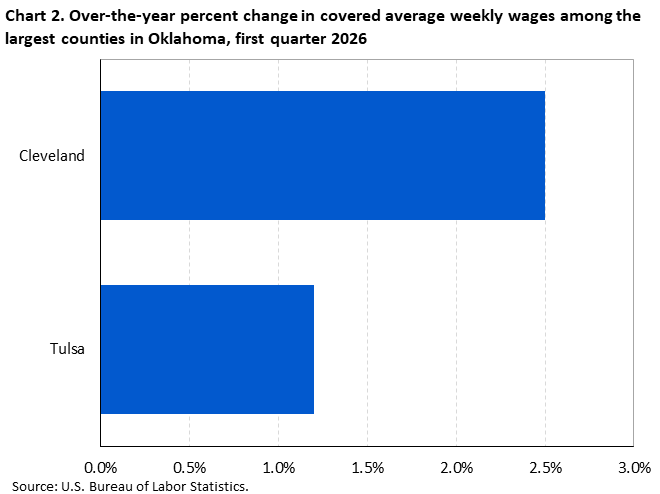
Average weekly wage gains in both large counties in Oklahoma with published data were below the national average of 3.9 percent. (See chart 2.) Cleveland had the largest gain (+2.5 percent). In Tulsa, the average weekly wage increased 1.2 percent over the year.
Weekly wages in all three large counties in Oklahoma were below the national average of $1,654: $1,441 in Oklahoma County, $1,352 in Tulsa County, and $1,014 in Cleveland County.
Statewide, average weekly wages increased 3.6 percent over the year to $1,235. Oklahoma ranked 46th in average weekly wages among the 50 states and the District of Columbia and 28th in wage growth.
Employment and wage levels (but not over-the-year changes) are also available for the 74 smaller counties in Oklahoma, defined as having employment below 75,000 in 2025. (See table 2.) Wage levels in all of the smaller counties were below the national average. Dewey reported the highest average weekly wage ($1,637) in the state. Jefferson reported the lowest average weekly wage ($680).
Among all 77 Oklahoma counties, 19 reported average weekly wages of $899 and lower, 26 had wages from $900 to $999, 19 had wages from $1,000 to $1,099, and 13 had average weekly wages of $1,100 and higher. (See map 1 and table 2.)
QCEW data for all states have been included in this release in table 3.
Nationwide coverage of the largest counties is published in the County Employment and Wages news release. Additional information about quarterly employment and wages data is available in the news release Technical Note and from the Quarterly Census of Employment and Wages website.
If you are deaf, hard of hearing, or have a speech disability, please dial 7-1-1 to access telecommunications relay services.
The County Employment and Wages release for the second quarter 2026 is scheduled to be released on Wednesday, December 2, 2026.
Counties with annual average employment of 75,000 or more in 2025 are included in this release and will be included in future 2026 releases. Five counties have been added to the publication tables: Kenton, KY; Union, NC; Licking, OH; Gregg, TX; and Kenosha, WI. One county has been dropped from the publication tables: Wood, OH.
| Area | Establishments, first quarter (thousands) | Employment | Average weekly wage(1) | |||||
|---|---|---|---|---|---|---|---|---|
| March 2026 (thousands) | Percent change, March 2025–26(2) | National ranking by percent change(3) | First quarter 2026 ($) | National ranking by level(3) | Percent change, first quarter 2025–26(2) | National ranking by percent change(3) | ||
United States(4) | 12,381.8 | 154,771.9 | 0.1 | -- | 1,654 | -- | 3.9 | -- |
Oklahoma | 130.2 | 1,700.6 | 0.0 | -- | 1,235 | 46 | 3.6 | 28 |
Cleveland | 7.4 | 92.3 | -0.9 | 278 | 1,014 | 372 | 2.5 | 260 |
Oklahoma | 33.5 | 493.1 | -0.8 | 268 | 1,441 | 162 | (5) | - |
Tulsa | 26.6 | 373.8 | 1.4 | 28 | 1,352 | 205 | 1.2 | 339 |
(1) Average weekly wages were calculated using unrounded data. | ||||||||
Note: Data are preliminary. Dashes indicate data not applicable or available. Covered employment and wages include workers covered by Unemployment Insurance (UI) and Unemployment Compensation for Federal Employees (UCFE) programs. | ||||||||
| Area | Establishments | Employment March 2026 | Average weekly wage ($)(1) |
|---|---|---|---|
United States(2) | 12,381,750 | 154,771,941 | 1,654 |
Oklahoma | 130,200 | 1,700,570 | 1,235 |
Adair | 357 | 4,288 | 825 |
Alfalfa | 149 | 1,225 | 978 |
Atoka | 348 | 3,503 | 770 |
Beaver | 174 | 1,313 | 968 |
Beckham | 762 | 9,480 | 1,113 |
Blaine | 281 | 3,134 | 1,010 |
Bryan | 1,257 | 21,966 | 1,065 |
Caddo | 583 | 7,282 | 1,062 |
Canadian | 4,251 | 39,133 | 1,007 |
Carter | 1,709 | 22,400 | 1,028 |
Cherokee | 955 | 18,705 | 966 |
Choctaw | 400 | 5,305 | 878 |
Cimarron | 92 | 583 | 854 |
Cleveland | 7,410 | 92,276 | 1,014 |
Coal | 133 | 1,298 | 1,011 |
Comanche | 2,676 | 40,255 | 997 |
Cotton | 130 | 1,879 | 808 |
Craig | 437 | 4,894 | 919 |
Creek | 1,665 | 21,201 | 1,155 |
Custer | 993 | 12,678 | 967 |
Delaware | 971 | 9,504 | 860 |
Dewey | 185 | 2,361 | 1,637 |
Ellis | 138 | 1,227 | 958 |
Garfield | 1,728 | 22,736 | 1,008 |
Garvin | 824 | 9,240 | 1,119 |
Grady | 1,275 | 13,982 | 1,010 |
Grant | 151 | 1,350 | 1,173 |
Greer | 99 | 935 | 803 |
Harmon | 74 | 621 | 903 |
Harper | 144 | 1,073 | 940 |
Haskell | 293 | 3,076 | 863 |
Hughes | 274 | 2,845 | 786 |
Jackson | 680 | 9,606 | 1,082 |
Jefferson | 146 | 911 | 680 |
Johnston | 256 | 3,005 | 955 |
Kay | 1,183 | 17,477 | 1,070 |
Kingfisher | 604 | 6,913 | 1,062 |
Kiowa | 234 | 1,949 | 890 |
Latimer | 221 | 3,191 | 1,148 |
LeFlore | 1,015 | 12,214 | 828 |
Lincoln | 736 | 7,780 | 998 |
Logan | 974 | 9,244 | 963 |
Love | 252 | 5,110 | 903 |
McClain | 1,352 | 12,753 | 976 |
McCurtain | 881 | 12,599 | 915 |
McIntosh | 435 | 4,616 | 774 |
Major | 246 | 1,956 | 960 |
Marshall | 373 | 5,528 | 982 |
Mayes | 1,048 | 14,667 | 1,244 |
Murray | 369 | 4,978 | 909 |
Muskogee | 1,594 | 26,204 | 1,087 |
Noble | 259 | 4,757 | 1,035 |
Nowata | 202 | 1,698 | 828 |
Okfuskee | 217 | 2,648 | 842 |
Oklahoma | 33,477 | 493,081 | 1,441 |
Okmulgee | 808 | 10,608 | 980 |
Osage | 552 | 8,308 | 1,034 |
Ottawa | 800 | 12,639 | 927 |
Pawnee | 344 | 3,367 | 902 |
Payne | 2,276 | 35,001 | 1,064 |
Pittsburg | 1,057 | 14,638 | 1,000 |
Pontotoc | 1,197 | 19,844 | 1,083 |
Pottawatomie | 1,486 | 23,164 | 940 |
Pushmataha | 300 | 2,491 | 798 |
Roger Mills | 110 | 852 | 886 |
Rogers | 2,219 | 31,427 | 1,173 |
Seminole | 498 | 7,069 | 921 |
Sequoyah | 803 | 9,541 | 764 |
Stephens | 1,204 | 14,809 | 1,059 |
Texas | 575 | 9,957 | 945 |
Tillman | 172 | 1,472 | 838 |
Tulsa | 26,577 | 373,773 | 1,352 |
Wagoner | 1,319 | 11,995 | 1,204 |
Washington | 1,421 | 18,718 | 1,492 |
Washita | 284 | 2,187 | 906 |
Woods | 300 | 3,206 | 965 |
Woodward | 795 | 7,985 | 1,146 |
(1) Average weekly wages were calculated using unrounded data. | |||
Note: Data are preliminary. Dashes indicate data not applicable or available. Covered employment and wages include workers covered by Unemployment Insurance (UI) and Unemployment Compensation for Federal Employees (UCFE) programs. | |||
| State | Establishments, first quarter (thousands) | Employment | Average weekly wage(1) | ||||
|---|---|---|---|---|---|---|---|
| March 2026 (thousands) | Percent change, March 2025–26 | First quarter 2026 ($) | National ranking by level | Percent change, first quarter 2025–26 | National ranking by percent change | ||
United States(2) | 12,381.8 | 154,771.9 | 0.1 | 1,654 | -- | 3.9 | -- |
Alabama | 168.7 | 2,121.2 | 0.7 | 1,292 | 38 | 3.6 | 28 |
Alaska | 25.4 | 320.1 | -1.3 | 1,519 | 18 | 4.8 | 6 |
Arizona | 227.8 | 3,249.1 | -0.6 | 1,495 | 21 | 4.5 | 10 |
Arkansas | 109.4 | 1,305.2 | -0.1 | 1,291 | 39 | 4.6 | 8 |
California | 1,990.7 | 18,211.8 | 0.9 | 1,986 | 6 | 2.7 | 44 |
Colorado | 264.7 | 2,848.5 | -0.7 | 1,774 | 8 | 5.4 | 4 |
Connecticut | 150.0 | 1,668.2 | -0.4 | 2,080 | 4 | 5.2 | 5 |
Delaware | 47.1 | 473.6 | -0.3 | 1,606 | 15 | 3.1 | 39 |
District of Columbia | 51.4 | 715.8 | -4.5 | 2,725 | 1 | 4.5 | 10 |
Florida | 894.1 | 9,962.8 | 0.0 | 1,518 | 19 | 4.3 | 13 |
Georgia | 397.4 | 4,865.2 | 0.0 | 1,539 | 17 | 3.3 | 34 |
Hawaii | 64.6 | 643.9 | -0.3 | 1,387 | 29 | 1.7 | 51 |
Idaho | 100.8 | 867.9 | 1.9 | 1,254 | 44 | 6.2 | 2 |
Illinois | 389.4 | 5,992.4 | 0.0 | 1,731 | 9 | 4.1 | 16 |
Indiana | 197.7 | 3,160.7 | -0.1 | 1,356 | 30 | 2.7 | 44 |
Iowa | 110.8 | 1,537.5 | -0.1 | 1,301 | 36 | 3.9 | 22 |
Kansas | 102.2 | 1,425.3 | 0.0 | 1,286 | 41 | 3.1 | 39 |
Kentucky | 163.0 | 1,979.1 | -0.4 | 1,248 | 45 | 2.9 | 43 |
Louisiana | 159.6 | 1,917.2 | -0.5 | 1,274 | 42 | 4.0 | 17 |
Maine | 67.5 | 629.1 | -0.5 | 1,327 | 34 | 3.5 | 30 |
Maryland | 201.1 | 2,700.3 | -1.7 | 1,676 | 10 | 2.7 | 44 |
Massachusetts | 296.4 | 3,552.9 | -0.9 | 2,201 | 3 | 4.8 | 6 |
Michigan | 312.6 | 4,357.5 | 0.3 | 1,445 | 24 | 3.9 | 22 |
Minnesota | 213.9 | 2,878.1 | -0.3 | 1,630 | 14 | 3.8 | 24 |
Mississippi | 93.3 | 1,162.9 | -0.2 | 1,051 | 51 | 3.3 | 34 |
Missouri | 263.5 | 2,890.5 | 0.1 | 1,354 | 31 | 3.4 | 32 |
Montana | 63.2 | 506.6 | 0.6 | 1,229 | 48 | 3.5 | 30 |
Nebraska | 78.9 | 1,008.2 | -0.1 | 1,274 | 42 | 3.7 | 26 |
Nevada | 112.8 | 1,575.7 | 2.0 | 1,391 | 28 | 2.1 | 50 |
New Hampshire | 66.1 | 675.0 | -1.2 | 1,656 | 12 | 3.0 | 41 |
New Jersey | 343.4 | 4,247.8 | 0.0 | 1,879 | 7 | 3.3 | 34 |
New Mexico | 67.1 | 867.4 | -0.4 | 1,235 | 46 | 2.7 | 44 |
New York | 710.5 | 9,743.6 | -0.3 | 2,363 | 2 | 6.5 | 1 |
North Carolina | 375.3 | 4,942.7 | 0.8 | 1,515 | 20 | 3.3 | 34 |
North Dakota | 36.9 | 420.7 | -0.5 | 1,333 | 33 | 2.4 | 49 |
Ohio | 344.6 | 5,458.3 | -0.2 | 1,417 | 26 | 4.0 | 17 |
Oklahoma | 130.2 | 1,700.6 | 0.0 | 1,235 | 46 | 3.6 | 28 |
Oregon | 173.5 | 1,952.3 | -1.3 | 1,481 | 23 | 4.6 | 8 |
Pennsylvania | 394.1 | 6,002.1 | -0.1 | 1,550 | 16 | 3.3 | 34 |
Rhode Island | 49.1 | 486.9 | -0.6 | 1,487 | 22 | 4.2 | 14 |
South Carolina | 193.1 | 2,326.6 | 0.7 | 1,296 | 37 | 4.0 | 17 |
South Dakota | 41.1 | 451.7 | 0.2 | 1,211 | 49 | 4.2 | 14 |
Tennessee | 228.1 | 3,254.1 | -0.2 | 1,426 | 25 | 4.4 | 12 |
Texas | 868.8 | 14,124.6 | 0.6 | 1,646 | 13 | 3.8 | 24 |
Utah | 140.6 | 1,737.8 | 0.9 | 1,415 | 27 | 4.0 | 17 |
Vermont | 33.4 | 304.2 | -1.0 | 1,322 | 35 | 3.0 | 41 |
Virginia | 324.8 | 4,118.7 | -0.2 | 1,665 | 11 | 4.0 | 17 |
Washington | 240.6 | 3,558.6 | -0.2 | 1,998 | 5 | 2.7 | 44 |
West Virginia | 63.0 | 693.3 | -0.4 | 1,188 | 50 | 3.4 | 32 |
Wisconsin | 208.0 | 2,902.6 | 0.0 | 1,353 | 32 | 3.7 | 26 |
Wyoming | 31.8 | 275.2 | -0.1 | 1,287 | 40 | 5.8 | 3 |
Puerto Rico | 52.9 | 944.5 | -0.8 | 724 | (3) | 3.4 | (3) |
Virgin Islands | 2.9 | 34.9 | 1.2 | 1,054 | (3) | 1.5 | (3) |
(1) Average weekly wages were calculated using unrounded data. | |||||||
Note: Data are preliminary. Dashes indicate data not applicable or available. Covered employment and wages include workers covered by Unemployment Insurance (UI) and Unemployment Compensation for Federal Employees (UCFE) programs. | |||||||
Last Modified Date: Friday, September 04, 2026