Department of Labor Logo United States Department of Labor
Dot gov

The .gov means it's official.
Federal government websites often end in .gov or .mil. Before sharing sensitive information, make sure you're on a federal government site.

Https

The site is secure.
The https:// ensures that you are connecting to the official website and that any information you provide is encrypted and transmitted securely.

Diesel Service Technicians and Mechanics

Summary

Please enable javascript to play this video.

Video transcript available at https://www.youtube.com/watch?v=-PcpkHT8xaU.
Quick Facts: Diesel Service Technicians and Mechanics
2024 Median Pay $60,640 per year
$29.15 per hour
Typical Entry-Level Education High school diploma or equivalent
Work Experience in a Related Occupation None
On-the-job Training Long-term on-the-job training
Number of Jobs, 2024 319,900
Job Outlook, 2024–34 2% (Slower than average)
Employment Change, 2024–34 7,800

What Diesel Service Technicians and Mechanics Do

Diesel service technicians and mechanics inspect, repair, and overhaul buses, trucks, or any vehicle with a diesel engine.

Work Environment

Diesel service technicians and mechanics usually work in well-ventilated and sometimes noisy repair shops. They occasionally repair vehicles on roadsides or at worksites. Most diesel technicians work full time, and some work more than 40 hours per week.

How to Become a Diesel Service Technician or Mechanic

Although diesel service technicians and mechanics typically learn on the job after a high school education, employers may prefer to hire candidates who have completed postsecondary training programs in diesel engine repair. In addition, industry certification may be required.

Pay

The median annual wage for diesel service technicians and mechanics was $60,640 in May 2024.

Job Outlook

Employment of diesel service technicians and mechanics is projected to grow 2 percent from 2024 to 2034, slower than the average for all occupations.

Despite limited employment growth, about 26,500 openings for diesel service technicians and mechanics are projected each year, on average, over the decade. Most of those openings are expected to result from the need to replace workers who transfer to different occupations or exit the labor force, such as to retire.

State & Area Data

Explore resources for employment and wages by state and area for diesel service technicians and mechanics.

Similar Occupations

Compare the job duties, education, job growth, and pay of diesel service technicians and mechanics with similar occupations.

More Information, Including Links to O*NET

Learn more about diesel service technicians and mechanics by visiting additional resources, including O*NET, a source on key characteristics of workers and occupations.
What Diesel Service Technicians and Mechanics Do About this section

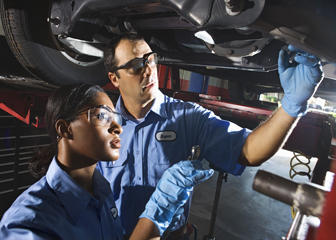
Two workers repair vehicle.
Diesel service technicians and mechanics may work on a vehicle’s electrical system, make major engine repairs, or retrofit engines with emission control systems to comply with pollution regulations.

Diesel service technicians and mechanics (also known as diesel technicians) inspect, repair, or overhaul buses and trucks, or maintain and repair any type of diesel engine.

Duties

Diesel service technicians and mechanics typically do the following:

  • Inspect and test brake systems, steering mechanisms, transmissions, engines, and other parts of vehicles
  • Read and interpret diagnostic test results to identify mechanical problems
  • Follow checklists to ensure that all critical parts are examined
  • Repair or replace malfunctioning parts and other mechanical or electrical equipment
  • Perform basic care and maintenance, including changing oil, checking fluid levels, and rotating tires
  • Document repairs and maintenance performed, including parts used, hours worked, and vehicle condition
  • Explain problems and repairs to clients 

Diesel technicians make engine repairs on a variety of vehicles, including trucks, bulldozers, commercial boats, and passenger vehicles. They also work on a vehicle’s electrical and exhaust systems to comply with pollution regulations.

In many shops, workers use computer diagnostic equipment to detect problems and adjust engine functions. Diesel technicians also use a variety of power and machine tools, such as pneumatic wrenches, lathes, grinding machines, and welding equipment. Hand tools are commonly used, including pliers, sockets and ratchets, and screwdrivers.

Technicians and mechanics who work primarily on automobiles are described in the profile on automotive service technicians and mechanics.

Technicians and mechanics who work primarily on farm equipment, construction vehicles, and railcars are described in the profile on heavy vehicle and mobile equipment service technicians.

Technicians and mechanics who work primarily on motorboats, motorcycles, and small all-terrain vehicles are described in the small engine mechanics profile.

Work Environment About this section

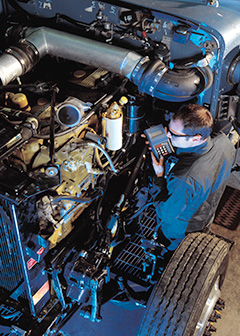
Worker examining vehicle engine.
Diesel technicians usually work in well-ventilated and sometimes noisy repair shops.

Diesel service technicians and mechanics held about 319,900 jobs in 2024. The largest employers of diesel service technicians and mechanics were as follows:

Truck transportation 18%
Wholesale trade 14
Automotive repair and maintenance 9
Local government, excluding education and hospitals 9
Rental and leasing services 5

Diesel technicians usually work in well-ventilated and sometimes noisy repair shops. They occasionally repair vehicles on roadsides or at worksites.

Injuries and Illnesses

Diesel service technicians and mechanics often lift heavy parts and tools, handle greasy or dirty equipment, and work in uncomfortable positions. Sprains and cuts are common among these workers. Diesel technicians need to follow some safety precautions when in the workplace.

Work Schedules

Most diesel technicians work full time, and some work more than 40 hours per week. Some repair shops extend their service hours during evenings and weekends. In addition, some truck and bus repair shops provide 24-hour maintenance and repair services.

How to Become a Diesel Service Technician or Mechanic About this section

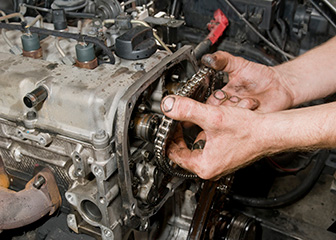
Engine with replacement part installed.
Diesel technicians initially learn to perform routine maintenance and repair tasks.

Although most diesel technicians learn on the job after a high school education, employers may prefer to hire candidates who have completed postsecondary training programs in diesel engine repair. In addition, industry certification may be required.

Education

Most employers require a high school diploma or equivalent. High school or postsecondary courses in automotive repair, electronics, and mathematics provide a strong educational background for a career as a diesel technician.

Some employers may prefer to hire candidates with postsecondary education in diesel engine repair. Some community colleges and vocational-technical schools offer certificate or degree programs in diesel engine repair.

These programs mix classroom instruction with hands-on training and include learning the basics of diesel technology, repair techniques and equipment, and practical exercises. Students also learn how to interpret technical manuals and electronic diagnostic reports.

Training

Diesel technicians who begin working without any postsecondary education are trained extensively on the job. Trainees are assigned basic tasks, such as cleaning parts, checking fuel and oil levels, and driving vehicles in and out of the shop.

After they learn routine maintenance and repair tasks and demonstrate competence, trainees move on to more complicated subjects, such as vehicle diagnostics.

Over the course of their careers, diesel technicians must learn to use new techniques and equipment. Employers may send experienced technicians to special training classes conducted by manufacturers and vendors to learn about the latest diesel technology.

Licenses, Certifications, and Registrations

Employers may require or prefer that their diesel technicians become certified. Having industry certifications demonstrates competence and may bring higher pay.

To become certified, diesel technicians may need previous experience and must pass an exam. Information on certifications is available from CareerOneStop.

Diesel technicians might need a commercial driver’s license to test-drive buses and large trucks.

Important Qualities

The following are examples of qualities that are important for these workers to perform their duties. For more information, visit the Employment Projections (EP) skills data page.

Customer-service skills. Diesel technicians discuss problems and necessary repairs with their customers. They must be courteous, listen well, and be ready to answer customers’ questions.

Detail oriented. Diesel technicians must be aware of small details when inspecting or repairing engines and components, because mechanical and electronic malfunctions may be due to misalignments and other easy-to-miss causes.

Dexterity. Mechanics need a steady hand and good hand–eye coordination for many tasks, such as disassembling engine parts, connecting or attaching components, and using hand tools.

Mechanical skills. Diesel technicians must be familiar with engine components and systems and know how they interact with each other. They often disassemble major parts for repairs, and they must be able to put them back together properly.

Organizational skills. Diesel technicians must keep workspaces clean and organized to maintain safety and accountability for parts.

Physical strength. Diesel technicians often lift heavy parts and tools, such as exhaust system components and pneumatic wrenches.

Problem-solving skills. Diesel technicians must be able to diagnose problems with diesel engines and systems to determine the best way to repair them.

Pay About this section

Diesel Service Technicians and Mechanics

Median annual wages, May 2024

Bus and truck mechanics and diesel engine specialists

$60,640

Vehicle and mobile equipment mechanics, installers, and repairers

$56,220

Total, all occupations

$49,500


The median annual wage for diesel service technicians and mechanics was $60,640 in May 2024. The median wage is the wage at which half the workers in an occupation earned more than that amount and half earned less. The lowest 10 percent earned less than $41,670, and the highest 10 percent earned more than $85,980.

In May 2024, the median annual wages for diesel service technicians and mechanics in the top industries in which they worked were as follows:

Local government, excluding education and hospitals $67,710
Wholesale trade 62,370
Automotive repair and maintenance 60,350
Rental and leasing services 58,600
Truck transportation 57,360

Most diesel technicians work full time, and some work more than 40 hours per week. Some repair shops extend their service hours during evenings and weekends. In addition, some truck and bus repair shops provide 24-hour maintenance and repair services.

Job Outlook About this section

Diesel Service Technicians and Mechanics

Percent change in employment, projected 2024–34

Vehicle and mobile equipment mechanics, installers, and repairers

4%

Total, all occupations

3%

Bus and truck mechanics and diesel engine specialists

2%


Employment of diesel service technicians and mechanics is projected to grow 2 percent from 2024 to 2034, slower than the average for all occupations.

Despite limited employment growth, about 26,500 openings for diesel service technicians and mechanics are projected each year, on average, over the decade. Most of those openings are expected to result from the need to replace workers who transfer to different occupations or exit the labor force, such as to retire.

Employment

Demand for these workers may be reduced as more firms turn away from diesel-powered trucks and vehicles in favor of those that require less maintenance and repair. For example, trucks used for short-haul transportation, such as local delivery services, are expected to increasingly be electric.

However, as more freight is shipped across the country, diesel-powered trucks will continue to be needed to carry freight wherever trains and pipelines are neither available nor economical. In addition, aging vehicles with diesel engines are likely to require more maintenance and repair, supporting the need for diesel technicians.

Employment projections data for diesel service technicians and mechanics, 2024–34
Occupational Title SOC Code Employment, 2024 Projected Employment, 2034 Change, 2024–34 Employment by Industry
Percent Numeric

SOURCE: U.S. Bureau of Labor Statistics, Employment Projections program

Bus and truck mechanics and diesel engine specialists

49-3031 319,900 327,700 2 7,800 Get data

State & Area Data About this section

Occupational Employment and Wage Statistics (OEWS)

The Occupational Employment and Wage Statistics (OEWS) program produces employment and wage estimates annually for over 800 occupations. These estimates are available for the nation as a whole, for individual states, and for metropolitan and nonmetropolitan areas. The link below goes to OEWS data maps for employment and wages by state and area. Use the dropdown boxes to select an occupation.

Projections Central

Occupational employment projections are developed for all states by Labor Market Information (LMI) or individual state Employment Projections offices. All state projections data are available at www.projectionscentral.org. Information on this site allows projected employment growth for an occupation to be compared among states or to be compared within one state. In addition, states may produce projections for areas; there are links to each state’s websites where these data may be retrieved.

CareerOneStop

CareerOneStop includes hundreds of occupational profiles with data available by state and metro area. There are links in the left-hand side menu to compare occupational employment by state and occupational wages by local area or metro area. There is also a salary info tool to search for wages by zip code.

Similar Occupations About this section

This table shows a list of occupations with job duties that are similar to those of diesel service technicians and mechanics.

Occupation Job Duties ENTRY-LEVEL EDUCATION Help on Entry-Level Education 2024 MEDIAN PAY Help on Median Pay
Aircraft and avionics equipment mechanics and technicians Aircraft and Avionics Equipment Mechanics and Technicians

Aircraft and avionics equipment mechanics and technicians install, test, adjust, and repair equipment and systems in aircraft.

Postsecondary nondegree award $79,140
Automotive body and glass repairers Automotive Body and Glass Repairers

Automotive body and glass repairers restore, refinish, and replace vehicle bodies and frames, windshields, and window glass.

High school diploma or equivalent $50,680
Automotive service technicians and mechanics Automotive Service Technicians and Mechanics

Automotive service technicians and mechanics inspect, maintain, and repair cars and light trucks.

Postsecondary nondegree award $49,670
Heavy vehicle and mobile equipment service technicians Heavy Vehicle and Mobile Equipment Service Technicians

Heavy vehicle and mobile equipment service technicians inspect, maintain, and repair vehicles and machinery used in construction, farming, and other industries.

High school diploma or equivalent $62,740
Small engine mechanics Small Engine Mechanics

Small engine mechanics inspect, service, and repair motorized power equipment.

See How to Become One $48,240
Suggested citation:

Bureau of Labor Statistics, U.S. Department of Labor, Occupational Outlook Handbook, Diesel Service Technicians and Mechanics,
at https://www.bls.gov/ooh/installation-maintenance-and-repair/diesel-service-technicians-and-mechanics.htm (visited May 11, 2026).

Last modified date: April 22, 2026

What They Do

The What They Do tab describes the typical duties and responsibilities of workers in the occupation, including what tools and equipment they use and how closely they are supervised. This tab also covers different types of occupational specialties.

Work Environment

The Work Environment tab includes the number of jobs held in the occupation and describes the workplace, the level of physical activity expected, and typical hours worked. It may also discuss the major industries that employed the occupation. This tab may also describe opportunities for part-time work, the amount and type of travel required, any safety equipment that is used, and the risk of injury that workers may face.

How to Become One

The How to Become One tab describes how to prepare for a job in the occupation. This tab can include information on education, training, work experience, licensing and certification, and important qualities that are required or helpful for entering or working in the occupation.

Pay

The Pay tab describes typical earnings and how workers in the occupation are compensated—annual salaries, hourly wages, commissions, tips, or bonuses. Within every occupation, earnings vary by experience, responsibility, performance, tenure, and geographic area. For most profiles, this tab has a table with wages in the major industries employing the occupation. It does not include pay for self-employed workers, agriculture workers, or workers in private households because these data are not collected by the Occupational Employment and Wage Statistics (OEWS) survey, the source of BLS wage data in the OOH.

State & Area Data

The State and Area Data tab provides links to state and area occupational data from the Occupational Employment and Wage Statistics (OEWS) program, state projections data from Projections Central, and occupational information from the Department of Labor's CareerOneStop.

Job Outlook

The Job Outlook tab describes the factors that affect employment growth or decline in the occupation, and in some instances, describes the relationship between the number of job seekers and the number of job openings.

Similar Occupations

The Similar Occupations tab describes occupations that share similar duties, skills, interests, education, or training with the occupation covered in the profile.

Contacts for More Information

The More Information tab provides the Internet addresses of associations, government agencies, unions, and other organizations that can provide additional information on the occupation. This tab also includes links to relevant occupational information from the Occupational Information Network (O*NET).

2024 Median Pay

The wage at which half of the workers in the occupation earned more than that amount and half earned less. Median wage data are from the BLS Occupational Employment and Wage Statistics survey. In May 2024, the median annual wage for all workers was $49,500.

On-the-job Training

Additional training needed (postemployment) to attain competency in the skills needed in this occupation.

Entry-level Education

Typical level of education that most workers need to enter this occupation.

Work experience in a related occupation

Work experience that is commonly considered necessary by employers, or is a commonly accepted substitute for more formal types of training or education.

Number of Jobs, 2024

The employment, or size, of this occupation in 2024, which is the base year of the 2024–34 employment projections.

Job Outlook, 2024-34

The projected percent change in employment from 2024 to 2034. The average growth rate for all occupations is 3 percent.

Employment Change, 2024-34

The projected numeric change in employment from 2024 to 2034.

Entry-level Education

Typical level of education that most workers need to enter this occupation.

On-the-job Training

Additional training needed (postemployment) to attain competency in the skills needed in this occupation.

Employment Change, projected 2024-34

The projected numeric change in employment from 2024 to 2034.

Growth Rate (Projected)

The percent change of employment for each occupation from 2024 to 2034.

Projected Number of New Jobs

The projected numeric change in employment from 2024 to 2034.

Projected Growth Rate

The projected percent change in employment from 2024 to 2034.

2024 Median Pay

The wage at which half of the workers in the occupation earned more than that amount and half earned less. Median wage data are from the BLS Occupational Employment and Wage Statistics survey. In May 2024, the median annual wage for all workers was $49,500.