Department of Labor Logo United States Department of Labor
Dot gov

The .gov means it's official.
Federal government websites often end in .gov or .mil. Before sharing sensitive information, make sure you're on a federal government site.

Https

The site is secure.
The https:// ensures that you are connecting to the official website and that any information you provide is encrypted and transmitted securely.

General Maintenance and Repair Workers

Summary

Please enable javascript to play this video.

Video transcript available at https://www.youtube.com/watch?v=I_mhZjRcH5s.
Quick Facts: General Maintenance and Repair Workers
2024 Median Pay $48,620 per year
$23.38 per hour
Typical Entry-Level Education High school diploma or equivalent
Work Experience in a Related Occupation None
On-the-job Training Moderate-term on-the-job training
Number of Jobs, 2024 1,629,700
Job Outlook, 2024–34 4% (As fast as average)
Employment Change, 2024–34 62,400

What General Maintenance and Repair Workers Do

General maintenance and repair workers fix and maintain machines, mechanical equipment, and buildings.

Work Environment

General maintenance and repair workers carry out tasks in varied indoor or outdoor locations. They might work inside a single building, such as a hotel, or be responsible for the maintenance of many buildings, such as those in an apartment complex. Most work full time, and they may be on call for emergency repairs.

How to Become a General Maintenance and Repair Worker

General maintenance and repair workers typically need a high school diploma or equivalent. They usually learn their skills on the job while working alongside more experienced workers. Some may enter the occupation through apprenticeships or training programs.

Pay

The median annual wage for general maintenance and repair workers was $48,620 in May 2024.

Job Outlook

Employment of general maintenance and repair workers is projected to grow 4 percent from 2024 to 2034, about as fast as the average for all occupations.

About 159,800 openings for general maintenance and repair workers are projected each year, on average, over the decade. Many of those openings are expected to result from the need to replace workers who transfer to different occupations or exit the labor force, such as to retire.

State & Area Data

Explore resources for employment and wages by state and area for general maintenance and repair workers.

Similar Occupations

Compare the job duties, education, job growth, and pay of general maintenance and repair workers with similar occupations.

More Information, Including Links to O*NET

Learn more about general maintenance and repair workers by visiting additional resources, including O*NET, a source on key characteristics of workers and occupations.

What General Maintenance and Repair Workers Do About this section

A man and a woman performing repairs on a kitchen sink.
Workers are responsible for the upkeep of many homes and apartment buildings.

General maintenance and repair workers fix and maintain machines, mechanical equipment, and buildings. They paint, repair flooring, and work on plumbing, electrical, and air-conditioning and heating systems.

Duties

General maintenance and repair workers typically do the following:

  • Maintain and repair machines, mechanical equipment, and buildings
  • Fix or replace faulty electrical switches, outlets, and circuit breakers
  • Inspect and diagnose problems and figure out the best way to correct them
  • Perform preventive maintenance and service
  • Assemble and set up machinery or equipment
  • Plan repair work using blueprints or diagrams
  • Order parts, supplies, or equipment
  • Meet with clients to estimate repairs and costs
  • Keep detailed records of their work

General maintenance and repair workers are hired for maintenance and repair tasks that are not complex enough to need the specialized training of a licensed tradesperson, such as a plumber or electrician.

When a job is above their skill level or requires a greater level of expertise, general maintenance and repair workers may coordinate with other workers such as electricians; carpenters; or heating, air-conditioning, and refrigeration mechanics or installers.

General maintenance and repair workers may fix or paint roofs, windows, doors, floors, woodwork, walls, and other parts of buildings. They also maintain and repair specialized equipment and machinery in a variety of locations, such as cafeterias, factories, and offices.

General maintenance and repair workers get supplies and parts from distributors or storerooms to fix problems. They use common hand and power tools, such as screwdrivers, saws, drills, wrenches, and hammers to fix, replace, or repair equipment and parts of buildings.

Work Environment About this section

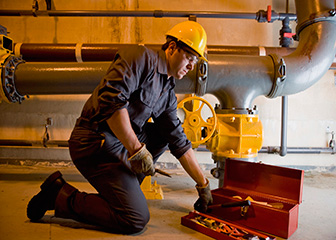
A man wearing protective gear kneeling next to a toolbox.
Many workers need safety gear when working with certain tools and equipment.

General maintenance and repair workers held about 1.6 million jobs in 2024. The largest employers of general maintenance and repair workers were as follows:

Real estate and rental and leasing 20%
Manufacturing 13
Government, excluding state and local education and hospitals 12
Accommodation and food services 8
Educational services; state, local, and private 8

General maintenance and repair workers often carry out many different tasks in a single day at any number of indoor or outdoor locations. They may work inside a single building, such as a hotel or hospital, or be responsible for the maintenance of many buildings, such as those in an apartment complex or on a college campus.

General maintenance and repair workers may have to stand for long periods or lift heavy objects. These workers may work in uncomfortably hot or cold environments, in uncomfortable or cramped positions, or on ladders. The work involves a lot of walking, climbing, and reaching.

Injuries and Illnesses

General maintenance and repair workers have one of the highest rates of injuries and illnesses of all occupations. They must take precautions to avoid injury in many situations, such as when lifting heavy objects, working on ladders, or operating tools and machinery. Common injuries include sprains, cuts, and fractures.

Work Schedules

Most general maintenance and repair workers work full time. They may need to be on call outside normal business hours, such as during evenings and weekends, for emergency repairs.

How to Become a General Maintenance and Repair Worker About this section

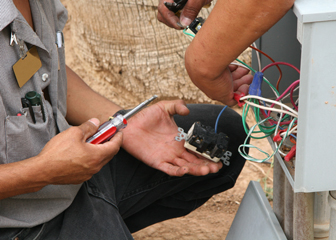
A man examining some electrical wiring with help from another worker.
Beginners often work under the supervision of more experienced workers.

General maintenance and repair workers typically need a high school diploma or equivalent. They usually learn their skills on the job or in apprenticeships or training programs.

Education

A high school diploma or equivalent is typically required to enter the occupation. Many general maintenance and repair workers learn some basic skills in high school technical education classes, postsecondary trade or vocational schools, or community colleges.

Training

General maintenance and repair workers usually start by watching and learning from skilled maintenance workers. They begin by doing simple tasks, such as fixing leaky faucets and replacing lightbulbs. After gaining experience, general maintenance and repair workers move on to more difficult tasks, such as overhauling machinery or building walls.

Some general maintenance and repair workers learn their skills by assisting other types of repair or construction workers, including machinery repairers, carpenters, or electricians. Others may complete an apprenticeship program, which usually combines paid on-the-job training with technical instruction. More information on apprenticeships can be found at apprenticeship.gov.

Those with work experience or that have completed a vocational-technical program in a related trade may have a shorter period of on-the-job training.

Licenses, Certifications, and Registrations

For more complex tasks, workers may need to be licensed or certified in a particular specialty, such as electrical or plumbing work. Licensing requirements vary by state and locality. Information on state licensing board requirements is available from CareerOneStop.

Advancement

Some general maintenance and repair workers decide to train in one specific trade and become trades workers, such as electricians, heating and air-conditioning mechanics, or plumbers.

Others might go on to become supervisors or managers or open their own repair business. To qualify for certain jobs, such as facilities manager or construction manager, a college degree may be required.

Important Qualities

The following are examples of qualities that are important for these workers to perform their duties. For more information, visit the Employment Projections (EP) skills data page.

Adaptability. General maintenance and repair workers need to be able to shift work and priorities to handle multiple repair requests. They also may need to be on call for emergency repairs.

Customer-service skills. These workers interact with customers on a regular basis. They need to be friendly and able to address customers’ questions.

Dexterity. Many repair and maintenance tasks, such as repairing small devices, connecting or attaching components, and using hand tools, require a steady hand and good hand–eye coordination.

Mechanical skills. General maintenance and repair workers need a basic understanding of how tools, systems, and machines work to do routine maintenance and make needed repairs.

Physical strength. General maintenance and repair workers must be able to lift or move heavy equipment, parts, or materials.

Problem-solving skills. General maintenance and repair workers must diagnose and repair a wide variety of building and equipment issues. They may perform tests to figure out the cause of a problem before fixing it.

Pay About this section

General Maintenance and Repair Workers

Median annual wages, May 2024

Other installation, maintenance, and repair occupations

$54,790

Total, all occupations

$49,500

Maintenance and repair workers, general

$48,620


The median annual wage for general maintenance and repair workers was $48,620 in May 2024. The median wage is the wage at which half the workers in an occupation earned more than that amount and half earned less. The lowest 10 percent earned less than $33,860, and the highest 10 percent earned more than $76,110.

In May 2024, the median annual wages for general maintenance and repair workers in the top industries in which they worked were as follows:

Manufacturing $60,440
Government, excluding state and local education and hospitals 49,920
Educational services; state, local, and private 49,290
Real estate and rental and leasing 47,610
Accommodation and food services 38,340

Most general maintenance and repair workers work full time. They may need to be on call during evenings and weekends for emergency repairs.

Job Outlook About this section

General Maintenance and Repair Workers

Percent change in employment, projected 2024–34

Other installation, maintenance, and repair occupations

6%

Maintenance and repair workers, general

4%

Total, all occupations

3%


Employment of general maintenance and repair workers is projected to grow 4 percent from 2024 to 2034, about as fast as the average for all occupations.

About 159,800 openings for general maintenance and repair workers are projected each year, on average, over the decade. Many of those openings are expected to result from the need to replace workers who transfer to different occupations or exit the labor force, such as to retire.

Employment

Maintenance and repair workers will continue to be needed to improve and renovate residential and nonresidential properties, such as apartment buildings, commercial offices, and public buildings. This is especially true for older structures, which typically require more maintenance or repair.

Employment projections data for general maintenance and repair workers, 2024–34
Occupational Title SOC Code Employment, 2024 Projected Employment, 2034 Change, 2024–34 Employment by Industry
Percent Numeric

SOURCE: U.S. Bureau of Labor Statistics, Employment Projections program

Maintenance and repair workers, general

49-9071 1,629,700 1,692,100 4 62,400 Get data

State & Area Data About this section

Occupational Employment and Wage Statistics (OEWS)

The Occupational Employment and Wage Statistics (OEWS) program produces employment and wage estimates annually for over 800 occupations. These estimates are available for the nation as a whole, for individual states, and for metropolitan and nonmetropolitan areas. The link below goes to OEWS data maps for employment and wages by state and area. Use the dropdown boxes to select an occupation.

Projections Central

Occupational employment projections are developed for all states by Labor Market Information (LMI) or individual state Employment Projections offices. All state projections data are available at www.projectionscentral.org. Information on this site allows projected employment growth for an occupation to be compared among states or to be compared within one state. In addition, states may produce projections for areas; there are links to each state’s websites where these data may be retrieved.

CareerOneStop

CareerOneStop includes hundreds of occupational profiles with data available by state and metro area. There are links in the left-hand side menu to compare occupational employment by state and occupational wages by local area or metro area. There is also a salary info tool to search for wages by zip code.

Similar Occupations About this section

This table shows a list of occupations with job duties that are similar to those of general maintenance and repair workers.

Occupation Job Duties ENTRY-LEVEL EDUCATION Help on Entry-Level Education 2024 MEDIAN PAY Help on Median Pay
Boilermakers Boilermakers

Boilermakers assemble, install, maintain, and repair boilers, closed vats, and other large vessels or containers that hold liquids and gases.

High school diploma or equivalent $73,340
Carpenters Carpenters

Carpenters construct, repair, and install building frameworks and structures made from wood and other materials.

High school diploma or equivalent $59,310
Construction managers Construction Managers

Construction managers plan, coordinate, budget, and supervise construction projects from start to finish.

Bachelor's degree $106,980
Electrical and electronics installers and repairers Electrical and Electronics Installers and Repairers

Electrical and electronics installers and repairers install or repair a variety of electrical equipment.

See How to Become One $71,270
Electricians Electricians

Electricians install, maintain, and repair electrical power, communications, lighting, and control systems.

High school diploma or equivalent $62,350
Heating, air conditioning, and refrigeration and mechanics and installers Heating, Air Conditioning, and Refrigeration Mechanics and Installers

Heating, air conditioning, and refrigeration mechanics and installers work on heating, ventilation, cooling, and refrigeration systems.

Postsecondary nondegree award $59,810
Plumbers, pipefitters, and steamfitters Plumbers, Pipefitters, and Steamfitters

Plumbers, pipefitters, and steamfitters install and repair piping fixtures and systems.

High school diploma or equivalent $62,970

Contacts for More Information About this section

For more details about apprenticeships or work opportunities in this occupation, contact your local employment office or firms that employ general maintenance and repair workers. Apprenticeship information is available from the U.S. Department of Labor's Apprenticeship program online or by phone at 877-872-5627. Visit apprenticeship.gov to search for apprenticeship opportunities. 

For information about state licensing board requirements and certifications, visit CareerOneStop.

CareerOneStop

For a career video on general maintenance and repair workers, visit

General Maintenance and Repair Workers

O*NET

Maintenance and Repair Workers, General

Suggested citation:

Bureau of Labor Statistics, U.S. Department of Labor, Occupational Outlook Handbook, General Maintenance and Repair Workers,
at https://www.bls.gov/ooh/installation-maintenance-and-repair/general-maintenance-and-repair-workers.htm (visited April 29, 2026).

Last Modified Date: Friday, April 24, 2026

What They Do

The What They Do tab describes the typical duties and responsibilities of workers in the occupation, including what tools and equipment they use and how closely they are supervised. This tab also covers different types of occupational specialties.

Work Environment

The Work Environment tab includes the number of jobs held in the occupation and describes the workplace, the level of physical activity expected, and typical hours worked. It may also discuss the major industries that employed the occupation. This tab may also describe opportunities for part-time work, the amount and type of travel required, any safety equipment that is used, and the risk of injury that workers may face.

How to Become One

The How to Become One tab describes how to prepare for a job in the occupation. This tab can include information on education, training, work experience, licensing and certification, and important qualities that are required or helpful for entering or working in the occupation.

Pay

The Pay tab describes typical earnings and how workers in the occupation are compensated—annual salaries, hourly wages, commissions, tips, or bonuses. Within every occupation, earnings vary by experience, responsibility, performance, tenure, and geographic area. For most profiles, this tab has a table with wages in the major industries employing the occupation. It does not include pay for self-employed workers, agriculture workers, or workers in private households because these data are not collected by the Occupational Employment and Wage Statistics (OEWS) survey, the source of BLS wage data in the OOH.

State & Area Data

The State and Area Data tab provides links to state and area occupational data from the Occupational Employment and Wage Statistics (OEWS) program, state projections data from Projections Central, and occupational information from the Department of Labor's CareerOneStop.

Job Outlook

The Job Outlook tab describes the factors that affect employment growth or decline in the occupation, and in some instances, describes the relationship between the number of job seekers and the number of job openings.

Similar Occupations

The Similar Occupations tab describes occupations that share similar duties, skills, interests, education, or training with the occupation covered in the profile.

Contacts for More Information

The More Information tab provides the Internet addresses of associations, government agencies, unions, and other organizations that can provide additional information on the occupation. This tab also includes links to relevant occupational information from the Occupational Information Network (O*NET).

2024 Median Pay

The wage at which half of the workers in the occupation earned more than that amount and half earned less. Median wage data are from the BLS Occupational Employment and Wage Statistics survey. In May 2024, the median annual wage for all workers was $49,500.

On-the-job Training

Additional training needed (postemployment) to attain competency in the skills needed in this occupation.

Entry-level Education

Typical level of education that most workers need to enter this occupation.

Work experience in a related occupation

Work experience that is commonly considered necessary by employers, or is a commonly accepted substitute for more formal types of training or education.

Number of Jobs, 2024

The employment, or size, of this occupation in 2024, which is the base year of the 2024–34 employment projections.

Job Outlook, 2024-34

The projected percent change in employment from 2024 to 2034. The average growth rate for all occupations is 3 percent.

Employment Change, 2024-34

The projected numeric change in employment from 2024 to 2034.

Entry-level Education

Typical level of education that most workers need to enter this occupation.

On-the-job Training

Additional training needed (postemployment) to attain competency in the skills needed in this occupation.

Employment Change, projected 2024-34

The projected numeric change in employment from 2024 to 2034.

Growth Rate (Projected)

The percent change of employment for each occupation from 2024 to 2034.

Projected Number of New Jobs

The projected numeric change in employment from 2024 to 2034.

Projected Growth Rate

The projected percent change in employment from 2024 to 2034.

2024 Median Pay

The wage at which half of the workers in the occupation earned more than that amount and half earned less. Median wage data are from the BLS Occupational Employment and Wage Statistics survey. In May 2024, the median annual wage for all workers was $49,500.