
An official website of the United States government
 United States Department of Labor
An official website of the United States government
United States Department of Labor

The .gov means it's official.
Federal government websites often end in .gov or .mil. Before sharing sensitive information,
make sure you're on a federal government site.

The site is secure.
The
https:// ensures that you are connecting to the official website and that any
information you provide is encrypted and transmitted securely.
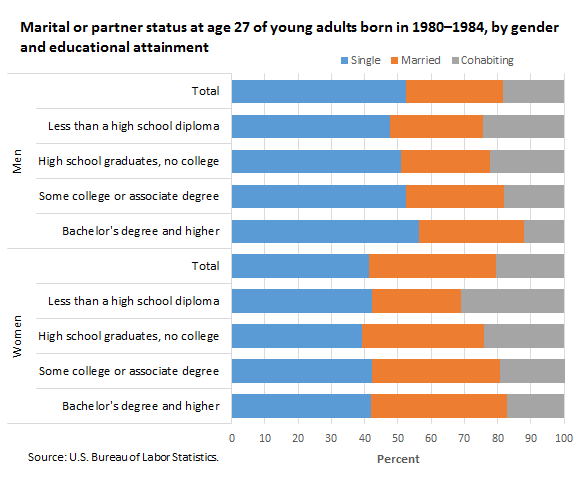
Among young adults who were born in the early 1980s, 34 percent were married at age 27, while 20 percent were unmarried and living with a partner (cohabiting) and 47 percent were single. On average, young adults with more education were more likely to be married and less likely to be cohabiting.
| Characteristic | Single | Married | Cohabiting |
|---|---|---|---|
Men | 52.4 | 29.2 | 18.4 |
Less than a high school diploma | 47.5 | 28.0 | 24.5 |
High school graduates, no college | 51.0 | 26.8 | 22.2 |
Some college or associate degree | 52.3 | 29.7 | 17.9 |
Bachelor's degree and higher | 56.2 | 31.8 | 12.0 |
Women | 41.4 | 38.0 | 20.6 |
Less than a high school diploma | 42.3 | 26.6 | 31.1 |
High school graduates, no college | 39.1 | 36.8 | 24.1 |
Some college or associate degree | 42.2 | 38.6 | 19.3 |
Bachelor's degree and higher | 41.9 | 40.8 | 17.2 |
At 27 years of age, 28 percent of high school dropouts were cohabiting and 27 percent were married. By comparison, 15 percent of college graduates were cohabiting and 37 percent were married.
At every level of educational attainment, men were more likely than women to be single at age 27. Men were less likely than women to be married at age 27, except among those without a high school diploma; men and women without a diploma were equally likely to be married. There was less of a difference between men and women in the percentage who were cohabiting at age 27.
These data are from the National Longitudinal Surveys program. To learn more, see “America’s Young Adults at 27: Labor Market Activity, Education, and Household Composition: Results from a Longitudinal Survey” (HTML) (PDF), news release USDL‑14‑0491.
Bureau of Labor Statistics, U.S. Department of Labor, The Economics Daily, College graduates more likely than those with less education to be married at age 27 at https://www.bls.gov/opub/ted/2014/ted_20140328.htm (visited October 13, 2026).


