
An official website of the United States government
 United States Department of Labor
An official website of the United States government
United States Department of Labor

The .gov means it's official.
Federal government websites often end in .gov or .mil. Before sharing sensitive information,
make sure you're on a federal government site.

The site is secure.
The
https:// ensures that you are connecting to the official website and that any
information you provide is encrypted and transmitted securely.


This news release was reissued on June 24, 2026. Sample size and response rate data were incorrect as originally published.
26-799-BOS
Friday, June 05, 2026
Workers in the Boston-Cambridge-Newton, MA-NH Metropolitan Statistical Area had an average (mean) hourly wage of $43.09 in May 2025, compared to the nationwide average of $33.54, the U.S. Bureau of Labor Statistics reported today. Regional Commissioner Mark J. Maggi noted that higher paying major occupational groups included management ($88.02) and legal ($84.93). Lower paying occupational groups included food preparation and serving related ($20.59), healthcare support ($22.69), and personal care and service ($23.12). (See table A.)
Occupational groups with the highest employment shares in the Boston area included office and administrative support (9.8 percent), management (9.4 percent), and business and financial operations (9.0 percent). Major occupational groups on the lower end of local employment included legal (1.1 percent); arts, design, entertainment, sports, and media (1.4 percent); and community and social service (2.0 percent).
| Major occupational group | Percent of total employment | Mean hourly wage ($) | |||
|---|---|---|---|---|---|
| United States | Boston | United States | Boston | ||
| Total, all occupations | 100.0 | 100.0 | 33.54 | 43.09 | |
| Management | 7.2 | 9.4 | 69.84 | 88.02 | |
| Business and financial operations | 6.8 | 9.0 | 45.78 | 54.89 | |
| Computer and mathematical | 3.4 | 4.7 | 57.73 | 65.47 | |
| Architecture and engineering | 1.7 | 2.4 | 51.36 | 57.17 | |
| Life, physical, and social science | 0.9 | 2.5 | 45.48 | 56.22 | |
| Community and social service | 1.7 | 2.0 | 30.49 | 34.42 | |
| Legal | 0.8 | 1.1 | 67.07 | 84.93 | |
| Educational instruction and library | 5.9 | 6.7 | 32.47 | 41.04 | |
| Arts, design, entertainment, sports, and media | 1.3 | 1.4 | 38.36 | 41.93 | |
| Healthcare practitioners and technical | 6.3 | 6.8 | 52.26 | 59.87 | |
| Healthcare support | 5.1 | 4.8 | 19.62 | 22.69 | |
| Protective service | 2.4 | 2.2 | 29.19 | 33.65 | |
| Food preparation and serving related | 8.8 | 8.0 | 17.86 | 20.59 | |
| Building and grounds cleaning and maintenance | 2.9 | 2.8 | 19.66 | 23.20 | |
| Personal care and service | 2.1 | 2.4 | 19.74 | 23.12 | |
| Sales and related | 8.6 | 7.9 | 26.43 | 32.10 | |
| Office and administrative support | 11.4 | 9.8 | 24.79 | 28.64 | |
| Farming, fishing, and forestry | 0.3 | 0.1 | 19.96 | 22.70 | |
| Construction and extraction | 4.1 | 3.4 | 31.42 | 39.88 | |
| Installation, maintenance, and repair | 3.9 | 2.8 | 30.44 | 34.98 | |
| Production | 5.5 | 3.5 | 24.81 | 27.29 | |
| Transportation and material moving | 8.8 | 6.0 | 23.96 | 25.64 | |
One occupational group—business and financial operations—was chosen to illustrate the diversity of data available for any of the 22 major occupational categories. Boston had 242,960 jobs in business and financial operations, accounting for 9.0 percent of local area employment, compared to the 6.8-percent share nationally. The average hourly wage for this occupational group locally was $54.89, compared to the national wage of $45.78.
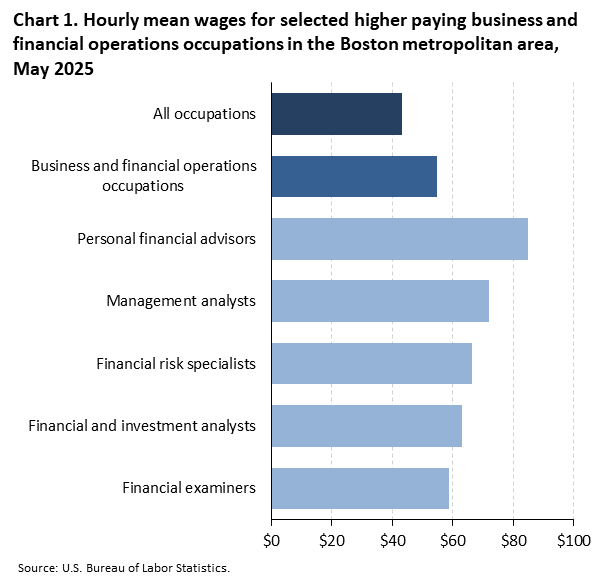
| Occupation | Wage |
|---|---|
| All occupations | $43.09 |
| Business and financial operations occupations | 54.89 |
| Personal financial advisors | 84.99 |
| Management analysts | 71.92 |
| Financial risk specialists | 66.22 |
| Financial and investment analysts | 63.13 |
| Financial examiners | 58.79 |
Some of the larger detailed occupations within the business and financial operations group included accountants and auditors (37,150), market research analysts and marketing specialists (32,310), and management analysts (26,450). Among the higher paying jobs in this group were personal financial advisors ($84.99) and management analysts ($71.92). (See chart 1.) At the lower end of the wage scale were tax preparers ($29.30) and credit counselors ($32.97). (Detailed data for business and financial operations occupations are presented in table 1; for a complete listing of detailed occupations available go to data.bls.gov/oes/#/area/0014460/2025.)
Location quotients allow us to explore the occupational make-up of a metropolitan area by comparing the composition of jobs in an area relative to the national average. (See table 1.) For example, a location quotient of 2.00 indicates that an occupation accounts for twice the share of employment in the area than it does nationally. In the Boston area, above-average concentrations of employment were found in some of the occupations within the business and financial operations group. For instance, fundraisers were employed at 2.39 times the national rate in Boston, and market research analysts and marketing specialists, at 2.07 times the U.S. average. Project management specialists had a location quotient of 1.02 in Boston, indicating that this particular occupation’s local and national employment shares were similar.
The statistics in this release are from the Occupational Employment and Wage Statistics (OEWS) survey, a cooperative effort between BLS and the State Workforce Agencies (SWAs). BLS funds the survey and provides the procedures and technical support. State Workforce Agencies collect most of the data: in this case, the Massachusetts Department of Economic Research, and the New Hampshire Employment Security.
Because of the lapse in federal appropriations from October 1 through November 12, 2025, additional collection and processing time were required for the May 2025 OEWS survey panel once appropriations resumed. The response rate for the May 2025 survey panel was within the normal range and no additional modifications to the OEWS methodology and procedures were necessary as a result of the shutdown.
The Occupational Employment and Wage Statistics (OEWS) survey is a semiannual survey measuring occupational employment and wage rates for wage and salary workers in nonfarm establishments in the United States. The OEWS data available from BLS include cross-industry occupational employment and wage estimates for the nation; over 530 areas, including states and the District of Columbia, metropolitan statistical areas (MSAs), nonmetropolitan areas, and territories; national industry-specific estimates at the NAICS sector, 3-digit, most 4-digit, and selected 5- and 6-digit industry levels; and national estimates by ownership across all industries and for schools and hospitals. Full OEWS data tables are available online.
Additional information about the OEWS estimates and methodology is available in the national Technical Notes. The overall national response rate for the six panels, based on the 50 states and the District of Columbia, is 66.2 percent based on establishments and 67.2 percent based on weighted sampled employment. Sample sizes and response rates by metropolitan and nonmetropolitan area are available on the Additional OEWS data sets page.
Metropolitan area definitions
The substate area data published in this release reflect the standards and definitions established by the U.S. Office of Management and Budget.
The Boston-Cambridge-Newton, MA-NH Metropolitan Statistical Area includes Essex County, MA; Middlesex County, MA; Norfolk County, MA; Plymouth County, MA; Suffolk County, MA; Rockingham County, NH; and Strafford County, NH.
For more information
Answers to frequently asked questions about the OEWS data, as well as general program documentation, are available on the OEWS website.
If you are deaf, hard of hearing, or have a speech disability, please dial 7-1-1 to access telecommunications relay services.
| Occupation(1) | Employment | Mean wages ($) | ||
|---|---|---|---|---|
| Level(2) | Location quotient(3) | Hourly | Annual(4) | |
|
Business and financial operations occupations |
242,960 | 1.33 | 54.89 | 114,170 |
|
Agents and business managers of artists, performers, and athletes |
50 | 0.21 | (5) | (5) |
|
Buyers and purchasing agents |
10,090 | 1.18 | 47.03 | 97,820 |
|
Claims adjusters, examiners, and investigators |
3,380 | 0.60 | 43.43 | 90,330 |
|
Insurance appraisers, auto damage |
350 | 1.75 | 38.16 | 79,370 |
|
Compliance officers |
10,920 | 1.51 | 53.29 | 110,840 |
|
Cost estimators |
3,110 | 0.80 | 52.11 | 108,390 |
|
Human resources specialists |
21,770 | 1.37 | 46.56 | 96,840 |
|
Labor relations specialists |
1,280 | 1.13 | 54.71 | 113,790 |
|
Logisticians |
4,510 | 1.03 | 52.11 | 108,390 |
|
Project management specialists |
18,840 | 1.02 | 58.52 | 121,710 |
|
Management analysts |
26,450 | 1.69 | 71.92 | 149,600 |
|
Meeting, convention, and event planners |
3,650 | 1.47 | 40.37 | 83,970 |
|
Fundraisers |
4,620 | 2.39 | 41.78 | 86,910 |
|
Compensation, benefits, and job analysis specialists |
2,630 | 1.34 | 51.41 | 106,940 |
|
Training and development specialists |
9,360 | 1.17 | 43.17 | 89,790 |
|
Market research analysts and marketing specialists |
32,310 | 2.07 | 52.81 | 109,840 |
|
Business operations specialists, all other |
14,230 | 0.75 | 48.92 | 101,750 |
|
Accountants and auditors |
37,150 | 1.47 | 52.24 | 108,660 |
|
Property appraisers and assessors |
740 | 0.75 | 48.35 | 100,560 |
|
Budget analysts |
930 | 1.13 | 48.47 | 100,810 |
|
Credit analysts |
1,080 | 0.97 | 53.43 | 111,140 |
|
Financial and investment analysts |
13,010 | 2.07 | 63.13 | 131,310 |
|
Personal financial advisors |
(5) | (5) | 84.99 | 176,780 |
|
Insurance underwriters |
2,080 | 1.13 | 55.58 | 115,600 |
|
Financial risk specialists |
1,120 | 1.01 | 66.22 | 137,740 |
|
Financial examiners |
820 | 0.69 | 58.79 | 122,280 |
|
Credit counselors |
620 | 1.28 | 32.97 | 68,580 |
|
Loan officers |
3,420 | 0.72 | 57.84 | 120,300 |
|
Tax examiners and collectors, and revenue agents |
1,190 | 1.21 | 38.73 | 80,570 |
|
Tax preparers |
1,110 | 0.83 | 29.30 | 60,940 |
|
Financial specialists, all other |
(5) | (5) | 50.14 | 104,290 |
|
Footnotes: |
||||
Last Modified Date: Friday, June 05, 2026