Department of Labor Logo United States Department of Labor
Dot gov

The .gov means it's official.
Federal government websites often end in .gov or .mil. Before sharing sensitive information, make sure you're on a federal government site.

Https

The site is secure.
The https:// ensures that you are connecting to the official website and that any information you provide is encrypted and transmitted securely.

Industrial Production Managers

Summary

Please enable javascript to play this video.

Video transcript available at https://www.youtube.com/watch?v=DiPbRluXk1o.
Quick Facts: Industrial Production Managers
2025 Median Pay $126,060 per year
$60.61 per hour
Typical Entry-Level Education Bachelor's degree
Work Experience in a Related Occupation 5 years or more
On-the-job Training None
Number of Jobs, 2025 252,100
Job Outlook, 2025–35 3% (As fast as average)
Employment Change, 2025–35 6,500

What Industrial Production Managers Do

Industrial production managers oversee the operations of manufacturing and related plants.

Work Environment

Most industrial production managers work full time, and some work more than 40 hours per week.

How to Become an Industrial Production Manager

Industrial production managers typically need a bachelor’s degree and several years of related work experience.

Pay

The median annual wage for industrial production managers was $126,060 in May 2025.

Job Outlook

Employment of industrial production managers is projected to grow 3 percent from 2025 to 2035, about as fast as the average for all occupations.

About 17,000 openings for industrial production managers are projected each year, on average, over the decade. Many of those openings are expected to result from the need to replace workers who transfer to different occupations or exit the labor force, such as to retire.

State & Area Data

Explore resources for employment and wages by state and area for industrial production managers.

Similar Occupations

Compare the job duties, education, job growth, and pay of industrial production managers with similar occupations.

More Information, Including Links to O*NET

Learn more about industrial production managers by visiting additional resources, including O*NET, a source on key characteristics of workers and occupations.


What Industrial Production Managers Do About this section

Industrial production managers
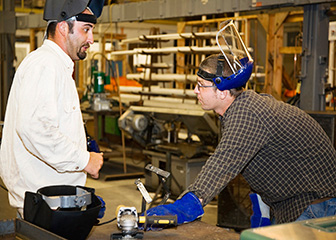
Industrial production managers monitor a plant’s workers to ensure they meet safety standards.

Industrial production managers oversee the operations of manufacturing and related plants. They coordinate, plan, and direct activities involved in creating a range of goods, such as cars, computer equipment, and paper products.

Duties

Industrial production managers typically do the following:

  • Decide how best to use a plant’s workers and equipment to meet production goals
  • Ensure that production stays on schedule and within budget
  • Communicate with sales staff, customers, and suppliers
  • Hire, train, and evaluate workers
  • Analyze production data
  • Review production reports
  • Monitor a plant’s workers and programs to ensure they meet performance and safety requirements
  • Streamline the production process
  • Assess whether production needs, such as for equipment upgrades or overtime work, are within budget 
  • Lead staff in resolving problems or improving production

Industrial production managers, also called plant managers, may oversee an entire manufacturing plant or a specific area of production.

Some industrial production managers are responsible for carrying out quality control programs to make sure the finished product meets standards for quality. Often called quality control systems managers, their work helps to identify a defect in products, identify the cause of the defect, and solve the problem that created it. For example, a manager may determine that a defect is being caused by parts from an outside supplier. The manager can then work with the supplier to improve the quality of the parts.

Industrial production managers who oversee an entire plant often work closely with managers from other departments, such as sales, warehousing, and research and design. For example, they might coordinate with a manager for the procurement (buying) department about orders for supplies that the production department needs.

Work Environment About this section

Industrial production managers
Industrial production managers work in a variety of manufacturing industries.

Industrial production managers held about 252,100 jobs in 2025. Some of the largest employers of industrial production managers were as follows:

Transportation equipment manufacturing 10%
Fabricated metal product manufacturing 9
Chemical manufacturing 9
Food manufacturing 8
Machinery manufacturing 7

Industrial production managers spend some of their time in an office and some of it in the production area. When they are in the production area, they may need to wear protective equipment, such as a helmet, hearing protection, or safety goggles.

Work Schedules

Most industrial production managers work full time, and some work more than 40 hours per week. They may need to be on call to deal with emergencies at any time. Some industrial production managers work night or weekend shifts.

How to Become an Industrial Production Manager About this section

Industrial production managers
Industrial production managers need leadership and interpersonal skills to supervise manufacturing employees.

Industrial production managers typically need a bachelor’s degree and several years of related work experience.

Education

Employers typically require or prefer that industrial production managers have a bachelor’s degree. However, some workers qualify for jobs if they have a high school diploma and extensive production experience.

For workers who have a degree, common majors include business and engineering. Some employers prefer to hire industrial production managers who have a Master of Business Administration (MBA) or a graduate degree in industrial management.

Work Experience in a Related Occupation

Industrial production managers usually need years of work experience in supervisory or other leadership positions. Some begin as production workers and move up through the ranks.

Industrial production workers usually advance to supervisory or other leadership positions before eventually becoming industrial production managers. Some take company-sponsored management classes to increase their chances of a promotion.

Those with a college degree might begin as a supervisor or lower-level manager. Other college graduates may be hired as an industrial production manager and complete training programs. Some begin working as an industrial production manager directly after college or graduate school. They may spend their first few months in training programs, becoming familiar with the production process, company policies, and safety regulations. In large companies, they may spend short periods of time working in other departments, such as purchasing or accounting, to learn more about the company.

Licenses, Certifications, and Registrations

Although they are not required to do so, industrial production managers may earn certifications to demonstrate competency in quality or management systems. Because these credentials often require specific work experience, they typically are not available prior to entering the occupation. Information on certifications is available from CareerOneStop.

Important Qualities

The following are examples of qualities that are important for these workers to perform their duties. For more information, visit the Employment Projections (EP) skills data page.

Business skills. Industrial production managers handle budgets for production facilities, hire and manage staff, and coordinate work between different departments.

Interpersonal skills. Industrial production managers must have excellent communication skills to work well other managers and with staff. Some industrial production managers oversee customer relationships.

Leadership skills. To keep the production process running smoothly, industrial production managers must motivate and direct employees.

Organizational skills. Industrial production managers must keep track of many details to efficiently manage the operations of a production facility.

Problem-solving skills. Production managers must identify and address problems that arise. For example, if a product has a defect, the manager determines whether it is a one-time problem or the result of the production process.

Pay About this section

Industrial Production Managers

Median annual wages, May 2025

Operations specialties managers

$150,690

Industrial production managers

$126,060

Total, all occupations

$50,980


The median annual wage for industrial production managers was $126,060 in May 2025. The median wage is the wage at which half the workers in an occupation earned more than that amount and half earned less. The lowest 10 percent earned less than $78,000, and the highest 10 percent earned more than $205,520.

In May 2025, the median annual wages for industrial production managers in some of the top industries in which they worked were as follows:

Chemical manufacturing $135,530
Transportation equipment manufacturing 131,510
Machinery manufacturing 124,850
Food manufacturing 116,250
Fabricated metal product manufacturing 109,920

Most industrial production managers work full time, and some work more than 40 hours per week. They may need to be on call to deal with emergencies at any time. Some industrial production managers work night or weekend shifts.

Job Outlook About this section

Industrial Production Managers

Percent change in employment, projected 2025–35

Operations specialties managers

9%

Total, all occupations

3%

Industrial production managers

3%


Employment of industrial production managers is projected to grow 3 percent from 2025 to 2035, about as fast as the average for all occupations.

About 17,000 openings for industrial production managers are projected each year, on average, over the decade. Many of those openings are expected to result from the need to replace workers who transfer to different occupations or exit the labor force, such as to retire.

Employment

Industrial production managers will continue to be needed in manufacturing and other industries. However, in some industries with declining employment, fewer of these managers may be needed.

Employment projections data for industrial production managers, 2025–35
Occupational Title SOC Code Employment, 2025 Projected Employment, 2035 Change, 2025–35 Employment by Industry
Percent Numeric

Note:
Employment subcategories do not necessarily add to higher categories due to rounding.
Employment and projected employment change values are rounded to the nearest 100 or percent.
Data is unavailable for values denoted with a "—".
Source: U.S. Bureau of Labor Statistics.

Industrial production managers

11-3051 252,100 258,600 3 6,500 Get data

State & Area Data About this section

Occupational Employment and Wage Statistics (OEWS)

The Occupational Employment and Wage Statistics (OEWS) program produces employment and wage estimates annually for over 800 occupations. These estimates are available for the nation as a whole, for individual states, and for metropolitan and nonmetropolitan areas. The link below goes to OEWS data maps for employment and wages by state and area. Use the dropdown boxes to select an occupation.

Projections Central

Occupational employment projections are developed for all states by Labor Market Information (LMI) or individual state Employment Projections offices. All state projections data are available at https://projectionscentral.org. Information on this site allows projected employment growth for an occupation to be compared among states or to be compared within one state. In addition, states may produce projections for areas; there are links to each state’s websites where these data may be retrieved.

CareerOneStop

CareerOneStop includes hundreds of occupational profiles with data available by state and metro area. There are links in the left-hand side menu to compare occupational employment by state and occupational wages by local area or metro area. There is also a salary info tool to search for wages by zip code.

Similar Occupations About this section

This table shows a list of occupations with job duties that are similar to those of industrial production managers.

Occupation Job Duties ENTRY-LEVEL EDUCATION Help on Entry-Level Education 2025 MEDIAN PAY Help on Median Pay
Advertising, promotions, and marketing managers Advertising, Promotions, and Marketing Managers

Advertising, promotions, and marketing managers plan programs to generate interest in products or services.

Bachelor's degree $165,780
Architectural and engineering managers Architectural and Engineering Managers

Architectural and engineering managers plan, direct, and coordinate activities in the fields of architecture and engineering.

Bachelor's degree $171,270
calibration technologists and technicians Calibration Technologists and Technicians

Calibration technologists and technicians inspect, adjust, and test measurement devices against standards, such as those used in manufacturing, healthcare, and other industries.

Associate's degree $67,820
Construction managers Construction Managers

Construction managers plan, coordinate, budget, and supervise construction projects from start to finish.

Bachelor's degree $114,990
Health and safety engineers Health and Safety Engineers

Health and safety engineers apply their knowledge of industrial processes, mechanics, psychology, and other disciplines to promote worksite or product safety.

Bachelor's degree $115,160
Industrial engineers Industrial Engineers

Industrial engineers design, develop, and test integrated systems for managing industrial production processes.

Bachelor's degree $102,440
Management analysts Management Analysts

Management analysts recommend ways to improve an organization’s efficiency.

Bachelor's degree $101,860
Mechanical engineers Mechanical Engineers

Mechanical engineers design, develop, build, and test mechanical and thermal sensors and devices.

Bachelor's degree $104,110
Operations research analysts Operations Research Analysts

Operations research analysts use mathematics and logic to help solve complex issues.

Bachelor's degree $88,940
Sales managers Sales Managers

Sales managers plan, direct, or coordinate the delivery of a product or service to the customer.

Bachelor's degree $148,270
Top executives Top Executives

Top executives plan strategies and policies to ensure that an organization meets its goals.

Bachelor's degree $108,780
Suggested citation:

Bureau of Labor Statistics, U.S. Department of Labor, Occupational Outlook Handbook, Industrial Production Managers,
at https://www.bls.gov/ooh/management/industrial-production-managers.htm (visited August 27, 2026).

Last modified date: August 27, 2026

What They Do

The What They Do tab describes the typical duties and responsibilities of workers in the occupation, including what tools and equipment they use and how closely they are supervised. This tab also covers different types of occupational specialties.

Work Environment

The Work Environment tab includes the number of jobs held in the occupation and describes the workplace, the level of physical activity expected, and typical hours worked. It may also discuss the major industries that employed the occupation. This tab may also describe opportunities for part-time work, the amount and type of travel required, any safety equipment that is used, and the risk of injury that workers may face.

How to Become One

The How to Become One tab describes how to prepare for a job in the occupation. This tab can include information on education, training, work experience, licensing and certification, and important qualities that are required or helpful for entering or working in the occupation.

Pay

The Pay tab describes typical earnings and how workers in the occupation are compensated—annual salaries, hourly wages, commissions, tips, or bonuses. Within every occupation, earnings vary by experience, responsibility, performance, tenure, and geographic area. For most profiles, this tab has a table with wages in the major industries employing the occupation. It does not include pay for self-employed workers, agriculture workers, or workers in private households because these data are not collected by the Occupational Employment and Wage Statistics (OEWS) survey, the source of BLS wage data in the OOH.

State & Area Data

The State and Area Data tab provides links to state and area occupational data from the Occupational Employment and Wage Statistics (OEWS) program, state projections data from Projections Central, and occupational information from the Department of Labor's CareerOneStop.

Job Outlook

The Job Outlook tab describes the factors that affect employment growth or decline in the occupation, and in some instances, describes the relationship between the number of job seekers and the number of job openings.

Similar Occupations

The Similar Occupations tab describes occupations that share similar duties, skills, interests, education, or training with the occupation covered in the profile.

Contacts for More Information

The More Information tab provides the Internet addresses of associations, government agencies, unions, and other organizations that can provide additional information on the occupation. This tab also includes links to relevant occupational information from the Occupational Information Network (O*NET).

2025 Median Pay

The wage at which half of the workers in the occupation earned more than that amount and half earned less. Median wage data are from the BLS Occupational Employment and Wage Statistics survey. In May 2025, the median annual wage for all workers was $50,980.

On-the-job Training

Additional training needed (postemployment) to attain competency in the skills needed in this occupation.

Entry-level Education

Typical level of education that most workers need to enter this occupation.

Work experience in a related occupation

Work experience that is commonly considered necessary by employers, or is a commonly accepted substitute for more formal types of training or education.

Number of Jobs, 2025

The employment, or size, of this occupation in 2025, which is the base year of the 2025–35 employment projections.

Job Outlook, 2025-35

The projected percent change in employment from 2025 to 2035. The average growth rate for all occupations is 3 percent.

Employment Change, 2025-35

The projected numeric change in employment from 2025 to 2035.

Entry-level Education

Typical level of education that most workers need to enter this occupation.

On-the-job Training

Additional training needed (postemployment) to attain competency in the skills needed in this occupation.

Employment Change, projected 2025-35

The projected numeric change in employment from 2025 to 2035.

Growth Rate (Projected)

The percent change of employment for each occupation from 2025 to 2035.

Projected Number of New Jobs

The projected numeric change in employment from 2025 to 2035.

Projected Growth Rate

The projected percent change in employment from 2025 to 2035.

2025 Median Pay

The wage at which half of the workers in the occupation earned more than that amount and half earned less. Median wage data are from the BLS Occupational Employment and Wage Statistics survey. In May 2025, the median annual wage for all workers was $50,980.