
An official website of the United States government
 United States Department of Labor
An official website of the United States government
United States Department of Labor

The .gov means it's official.
Federal government websites often end in .gov or .mil. Before sharing sensitive information,
make sure you're on a federal government site.

The site is secure.
The
https:// ensures that you are connecting to the official website and that any
information you provide is encrypted and transmitted securely.


Perform tasks involving physical labor at construction sites. May operate hand and power tools of all types: air hammers, earth tampers, cement mixers, small mechanical hoists, surveying and measuring equipment, and a variety of other equipment and instruments. May clean and prepare sites, dig trenches, set braces to support the sides of excavations, erect scaffolding, and clean up rubble, debris and other waste materials. May assist other craft workers. Construction laborers who primarily assist a particular craft worker are classified under "Helpers, Construction Trades" (47-3010). Excludes "Hazardous Materials Removal Workers" (47-4041).
Employment estimate and mean wage estimates for this occupation:
| Employment (1) | Employment RSE (3) |
Mean hourly wage |
Mean annual wage (2) |
Wage RSE (3) |
|---|---|---|---|---|
| 1,001,470 | 0.7 % | $19.40 | $40,350 | 0.3 % |
Percentile wage estimates for this occupation:
| Percentile | 10% | 25% | 50% (Median) |
75% | 90% |
|---|---|---|---|---|---|
| Hourly Wage | $11.28 | $13.71 | $17.21 | $23.03 | $31.53 |
| Annual Wage (2) | $23,460 | $28,520 | $35,800 | $47,910 | $65,590 |
Industries with the highest published employment and wages for this occupation are provided. For a list of all industries with employment in this occupation, see the Create Customized Tables function.
Industries with the highest levels of employment in this occupation:
| Industry | Employment (1) | Percent of industry employment | Hourly mean wage | Annual mean wage (2) |
|---|---|---|---|---|
| Other Specialty Trade Contractors | 165,470 | 24.11 | $19.24 | $40,020 |
| Residential Building Construction | 125,610 | 16.13 | $18.22 | $37,910 |
| Nonresidential Building Construction | 123,660 | 15.30 | $20.83 | $43,330 |
| Foundation, Structure, and Building Exterior Contractors | 118,340 | 12.96 | $18.86 | $39,220 |
| Utility System Construction | 113,090 | 21.30 | $20.13 | $41,880 |
Industries with the highest concentration of employment in this occupation:
| Industry | Employment (1) | Percent of industry employment | Hourly mean wage | Annual mean wage (2) |
|---|---|---|---|---|
| Highway, Street, and Bridge Construction | 88,340 | 25.75 | $22.12 | $46,010 |
| Other Specialty Trade Contractors | 165,470 | 24.11 | $19.24 | $40,020 |
| Other Heavy and Civil Engineering Construction | 27,050 | 22.97 | $20.37 | $42,360 |
| Utility System Construction | 113,090 | 21.30 | $20.13 | $41,880 |
| Residential Building Construction | 125,610 | 16.13 | $18.22 | $37,910 |
Top paying industries for this occupation:
| Industry | Employment (1) | Percent of industry employment | Hourly mean wage | Annual mean wage (2) |
|---|---|---|---|---|
| Performing Arts Companies | 60 | 0.05 | $33.61 | $69,900 |
| Electric Power Generation, Transmission and Distribution | 940 | 0.24 | $25.76 | $53,590 |
| General Medical and Surgical Hospitals | 220 | (7) | $25.58 | $53,210 |
| Other Professional, Scientific, and Technical Services | 510 | 0.07 | $25.33 | $52,690 |
| Rail Transportation | 610 | 0.26 | $25.05 | $52,110 |
States and areas with the highest published employment, location quotients, and wages for this occupation are provided. For a list of all areas with employment in this occupation, see the Create Customized Tables function.
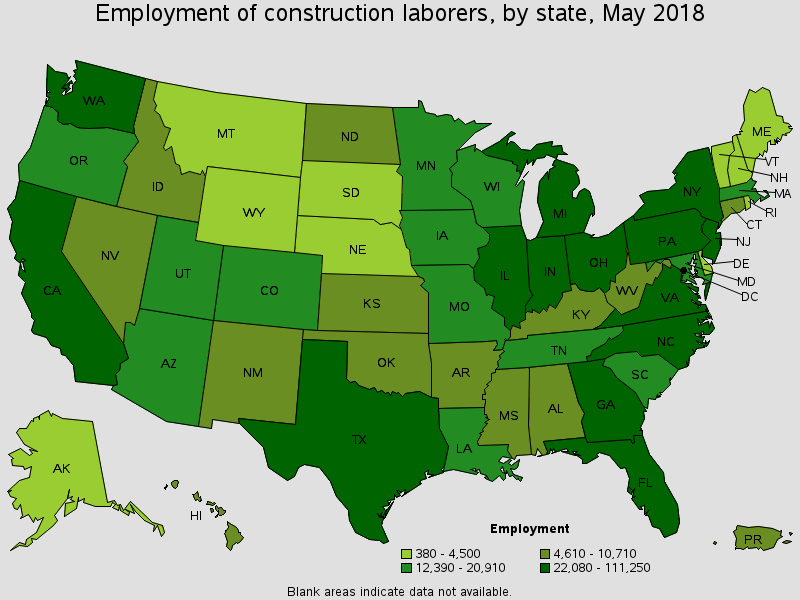
States with the highest employment level in this occupation:
| State | Employment (1) | Employment per thousand jobs | Location quotient (9) | Hourly mean wage | Annual mean wage (2) |
|---|---|---|---|---|---|
| Texas | 111,250 | 9.18 | 1.33 | $15.69 | $32,630 |
| California | 104,150 | 6.12 | 0.89 | $23.20 | $48,250 |
| Florida | 68,430 | 7.95 | 1.15 | $15.21 | $31,630 |
| New York | 63,020 | 6.71 | 0.97 | $24.87 | $51,720 |
| Pennsylvania | 41,280 | 7.06 | 1.02 | $19.84 | $41,260 |
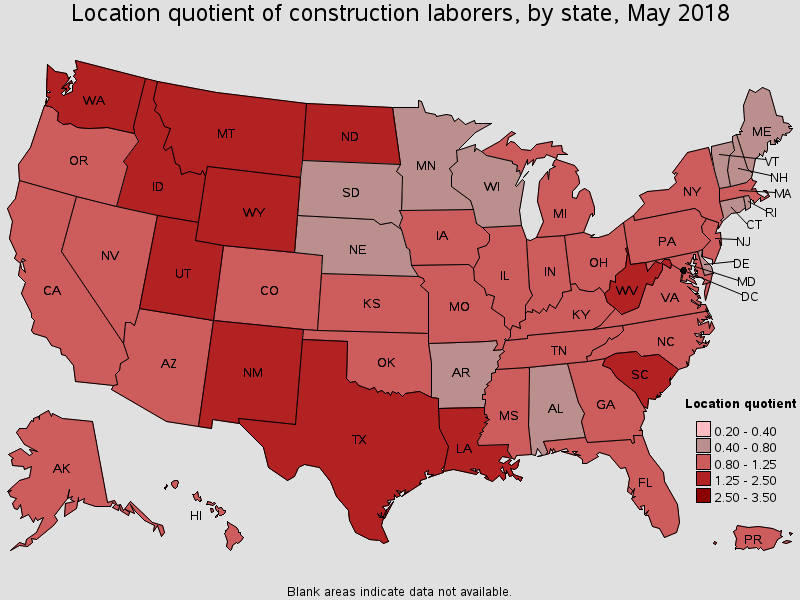
States with the highest concentration of jobs and location quotients in this occupation:
| State | Employment (1) | Employment per thousand jobs | Location quotient (9) | Hourly mean wage | Annual mean wage (2) |
|---|---|---|---|---|---|
| West Virginia | 9,080 | 13.03 | 1.88 | $17.52 | $36,450 |
| New Mexico | 9,370 | 11.55 | 1.67 | $15.42 | $32,070 |
| Wyoming | 3,110 | 11.54 | 1.67 | $17.38 | $36,160 |
| North Dakota | 4,610 | 11.07 | 1.60 | $20.19 | $42,000 |
| Louisiana | 20,710 | 10.82 | 1.56 | $16.89 | $35,120 |
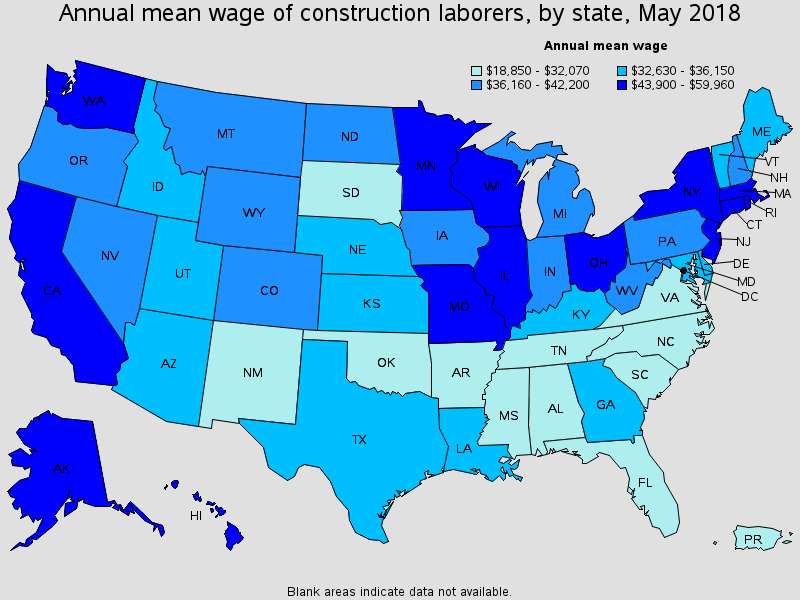
Top paying States for this occupation:
| State | Employment (1) | Employment per thousand jobs | Location quotient (9) | Hourly mean wage | Annual mean wage (2) |
|---|---|---|---|---|---|
| Illinois | 33,270 | 5.55 | 0.80 | $28.83 | $59,960 |
| Hawaii | 5,110 | 7.97 | 1.15 | $28.26 | $58,770 |
| New Jersey | 23,900 | 5.90 | 0.85 | $25.74 | $53,540 |
| Massachusetts | 19,930 | 5.58 | 0.81 | $25.38 | $52,780 |
| Minnesota | 12,810 | 4.47 | 0.65 | $25.07 | $52,150 |
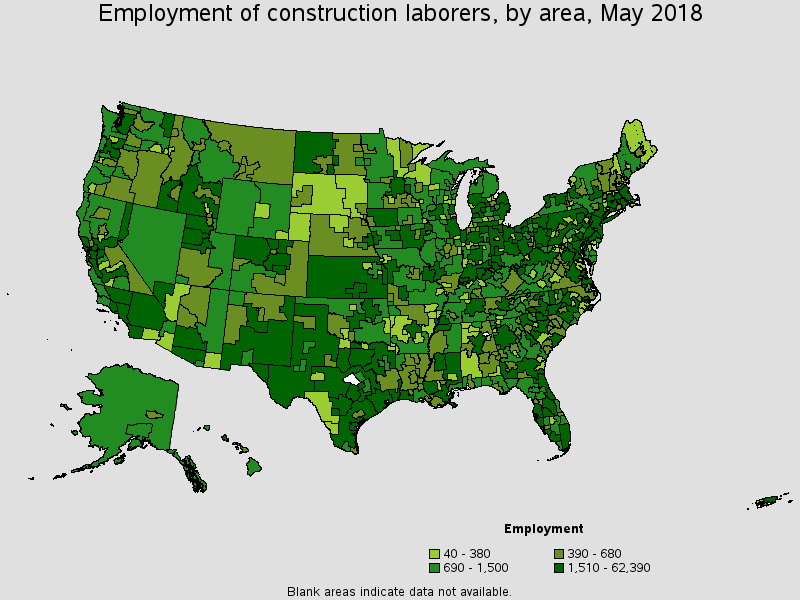
Metropolitan areas with the highest employment level in this occupation:
| Metropolitan area | Employment (1) | Employment per thousand jobs | Location quotient (9) | Hourly mean wage | Annual mean wage (2) |
|---|---|---|---|---|---|
| New York-Newark-Jersey City, NY-NJ-PA | 62,390 | 6.57 | 0.95 | $26.42 | $54,940 |
| Houston-The Woodlands-Sugar Land, TX | 31,500 | 10.56 | 1.53 | $16.54 | $34,410 |
| Los Angeles-Long Beach-Anaheim, CA | 30,930 | 5.05 | 0.73 | $22.44 | $46,680 |
| Dallas-Fort Worth-Arlington, TX | 28,480 | 7.98 | 1.15 | $15.92 | $33,120 |
| Chicago-Naperville-Elgin, IL-IN-WI | 25,930 | 5.59 | 0.81 | $30.23 | $62,870 |
| Atlanta-Sandy Springs-Roswell, GA | 18,860 | 7.03 | 1.02 | $17.18 | $35,720 |
| Washington-Arlington-Alexandria, DC-VA-MD-WV | 18,130 | 5.78 | 0.84 | $17.36 | $36,110 |
| Miami-Fort Lauderdale-West Palm Beach, FL | 16,460 | 6.35 | 0.92 | $15.35 | $31,930 |
| Seattle-Tacoma-Bellevue, WA | 16,250 | 8.19 | 1.18 | $24.57 | $51,100 |
| San Francisco-Oakland-Hayward, CA | 15,520 | 6.42 | 0.93 | $26.12 | $54,330 |
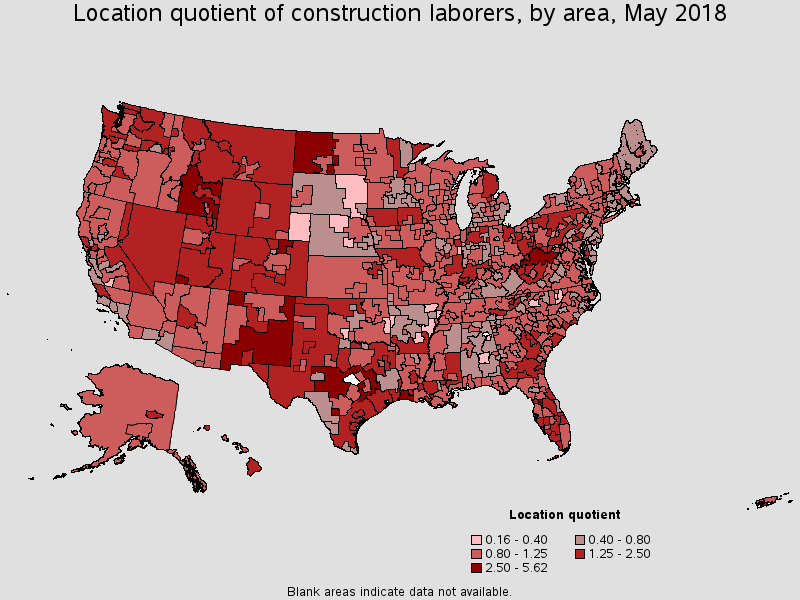
Metropolitan areas with the highest concentration of jobs and location quotients in this occupation:
| Metropolitan area | Employment (1) | Employment per thousand jobs | Location quotient (9) | Hourly mean wage | Annual mean wage (2) |
|---|---|---|---|---|---|
| Lake Charles, LA | 4,510 | 38.87 | 5.62 | (8) | (8) |
| The Villages, FL | 570 | 20.84 | 3.01 | $15.19 | $31,600 |
| Farmington, NM | 950 | 19.70 | 2.85 | $15.80 | $32,860 |
| St. George, UT | 1,220 | 18.75 | 2.71 | $15.44 | $32,110 |
| Greeley, CO | 1,830 | 17.73 | 2.56 | $17.40 | $36,200 |
| Augusta-Richmond County, GA-SC | 3,850 | 17.24 | 2.49 | $15.29 | $31,800 |
| Corpus Christi, TX | 3,210 | 17.12 | 2.47 | $16.22 | $33,740 |
| Morgantown, WV | 1,120 | 16.93 | 2.45 | $16.47 | $34,260 |
| Cape Coral-Fort Myers, FL | 4,480 | 16.87 | 2.44 | $15.63 | $32,520 |
| Huntington-Ashland, WV-KY-OH | 2,160 | 16.52 | 2.39 | $21.18 | $44,050 |
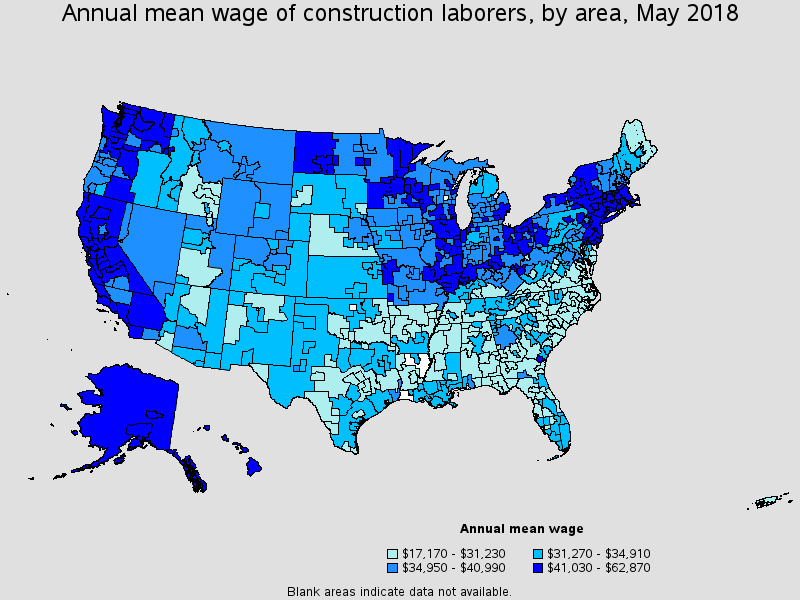
Top paying metropolitan areas for this occupation:
| Metropolitan area | Employment (1) | Employment per thousand jobs | Location quotient (9) | Hourly mean wage | Annual mean wage (2) |
|---|---|---|---|---|---|
| Chicago-Naperville-Elgin, IL-IN-WI | 25,930 | 5.59 | 0.81 | $30.23 | $62,870 |
| Kahului-Wailuku-Lahaina, HI | 520 | 6.84 | 0.99 | $29.12 | $60,570 |
| Napa, CA | 410 | 5.49 | 0.79 | $28.66 | $59,620 |
| Urban Honolulu, HI | 3,660 | 7.85 | 1.14 | $28.66 | $59,610 |
| Minneapolis-St. Paul-Bloomington, MN-WI | 7,890 | 4.03 | 0.58 | $28.12 | $58,480 |
| Bloomington, IL | 440 | 4.92 | 0.71 | $27.54 | $57,280 |
| Atlantic City-Hammonton, NJ | 690 | 5.47 | 0.79 | $27.24 | $56,650 |
| San Jose-Sunnyvale-Santa Clara, CA | 5,540 | 4.95 | 0.72 | $26.97 | $56,090 |
| Springfield, MA-CT | 1,510 | 4.54 | 0.66 | $26.75 | $55,640 |
| Stockton-Lodi, CA | 2,020 | 8.18 | 1.18 | $26.54 | $55,210 |
Nonmetropolitan areas with the highest employment in this occupation:
| Nonmetropolitan area | Employment (1) | Employment per thousand jobs | Location quotient (9) | Hourly mean wage | Annual mean wage (2) |
|---|---|---|---|---|---|
| North Northeastern Ohio non-metropolitan area (non-contiguous) | 3,950 | 11.80 | 1.71 | $21.34 | $44,390 |
| Hill Country Region of Texas nonmetropolitan area | 3,830 | 20.00 | 2.89 | $14.52 | $30,200 |
| North Texas Region of Texas nonmetropolitan area | 3,540 | 13.01 | 1.88 | $15.93 | $33,130 |
| West Texas Region of Texas nonmetropolitan area | 2,930 | 15.05 | 2.18 | $15.61 | $32,480 |
| Kansas nonmetropolitan area | 2,810 | 7.15 | 1.03 | $15.42 | $32,070 |
Nonmetropolitan areas with the highest concentration of jobs and location quotients in this occupation:
| Nonmetropolitan area | Employment (1) | Employment per thousand jobs | Location quotient (9) | Hourly mean wage | Annual mean wage (2) |
|---|---|---|---|---|---|
| Hill Country Region of Texas nonmetropolitan area | 3,830 | 20.00 | 2.89 | $14.52 | $30,200 |
| Southeast-Central Idaho nonmetropolitan area | 2,400 | 18.68 | 2.70 | $13.79 | $28,680 |
| West North Dakota nonmetropolitan area | 2,220 | 18.33 | 2.65 | $20.95 | $43,570 |
| Northern West Virginia nonmetropolitan area | 2,640 | 17.84 | 2.58 | $17.41 | $36,220 |
| Eastern New Mexico nonmetropolitan area | 2,750 | 17.37 | 2.51 | $15.45 | $32,130 |
Top paying nonmetropolitan areas for this occupation:
| Nonmetropolitan area | Employment (1) | Employment per thousand jobs | Location quotient (9) | Hourly mean wage | Annual mean wage (2) |
|---|---|---|---|---|---|
| Northwest Illinois nonmetropolitan area | 890 | 6.52 | 0.94 | $28.28 | $58,810 |
| Hawaii / Kauai nonmetropolitan area | 940 | 9.35 | 1.35 | $26.20 | $54,490 |
| South Illinois nonmetropolitan area | 550 | 6.03 | 0.87 | $24.19 | $50,320 |
| Alaska nonmetropolitan area | 910 | 8.58 | 1.24 | $23.67 | $49,240 |
| Southwest Minnesota nonmetropolitan area | 720 | 5.88 | 0.85 | $23.19 | $48,230 |
These estimates are calculated with data collected from employers in all industry sectors, all metropolitan and nonmetropolitan areas, and all states and the District of Columbia. The top employment and wage figures are provided above. The complete list is available in the downloadable XLS files.
The percentile wage estimate is the value of a wage below which a certain percent of workers fall. The median wage is the 50th percentile wage estimate--50 percent of workers earn less than the median and 50 percent of workers earn more than the median. More about percentile wages.
(1) Estimates for detailed occupations do not sum to the totals because the totals include occupations not shown separately. Estimates do not include self-employed workers.
(2) Annual wages have been calculated by multiplying the hourly mean wage by a "year-round, full-time" hours figure of 2,080 hours; for those occupations where there is not an hourly wage published, the annual wage has been directly calculated from the reported survey data.
(3) The relative standard error (RSE) is a measure of the reliability of a survey statistic. The smaller the relative standard error, the more precise the estimate.
(7) The value is less than .005 percent of industry employment.
(8) Estimate not released.
(9) The location quotient is the ratio of the area concentration of occupational employment to the national average concentration. A location quotient greater than one indicates the occupation has a higher share of employment than average, and a location quotient less than one indicates the occupation is less prevalent in the area than average.
Other OES estimates and related information:
May 2018 National Occupational Employment and Wage Estimates
May 2018 State Occupational Employment and Wage Estimates
May 2018 Metropolitan and Nonmetropolitan Area Occupational Employment and Wage Estimates
May 2018 National Industry-Specific Occupational Employment and Wage Estimates
Last Modified Date: March 29, 2019