An official website of the United States government
 United States Department of Labor
An official website of the United States government
United States Department of Labor

The .gov means it's official.
Federal government websites often end in .gov or .mil. Before sharing sensitive information,
make sure you're on a federal government site.

The site is secure.
The
https:// ensures that you are connecting to the official website and that any
information you provide is encrypted and transmitted securely.
This article discusses the California Work and Health Survey (CWHS), a longitudinal survey developed by the California Labor Laboratory and conducted between November 2022 and May 2023. The CWHS provides information on traditional and nonstandard work arrangements among the California workforce and the effects different arrangements have on working conditions. The survey also includes questions about respondents’ economic status and their physical and mental health outcomes, allowing survey users to assess the effects of various work arrangements on the overall health and well-being of California workers.
The U.S. labor market has changed substantially over the past several decades, as new business models have combined with technological advances to create incentives for using alternative ways to hire workers. One notable result of these changes is the growth of a class of workers who are not tied to a single employer, as well as businesses that do not maintain the long-term employer–employee relationship that traditionally provided the framework for economic and safety protections for workers.
Considerable evidence exists showing that the contemporary workforce is transitioning from these traditional employment models, in which a worker is formally hired and has an expectation of continued employment, toward nonstandard work arrangements, used here to encompass three distinct types of employment: contingent, alternative, and application based. Contingent employment refers to jobs with a predetermined endpoint. Alternative employment includes independent contractors, temporary help agency workers, on-call workers, and contract-company workers. Application-based or app-based employment describes arrangements in which workers find short-term jobs through websites or mobile apps that facilitate their relationship with the customer.1 These categories are based on the U.S. Bureau of Labor Statistics (BLS) 2017 Current Population Survey Contingent Worker Supplement (CPS–CWS).2 In any of these work arrangements, a worker can be self-employed. However, nonstandard work is not synonymous with self-employment: Self-employed workers can be involved in traditional work arrangements (small shop owners, for example), and wage and salary employees can be in nonstandard arrangements (such as those formally hired but in contingent jobs).
The complexity of the current labor market creates challenges in establishing the magnitude of these nonstandard employment arrangements and determining the extent to which their prevalence is increasing. Along with this debate are concerns about the ability to reliably measure the prevalence of nonstandard employment in the U.S. population.3 Another central issue is the extent of self-employment and whether the self-employed are misclassified as independent contractors rather than as formally hired employees.4
Because nonstandard work arrangements are often excluded from federal and state worker protections, it is crucial to identify how many people are in this type of work and, therefore, lacking in these protections, as well as to describe the characteristics of these individuals. Further, the impact of nonstandard employment arrangements on the health and well-being of the workforce in the United States has been difficult to assess because of the bifurcation of data collection on employment and health, with labor market data (e.g., BLS surveys) having minimal health-status measures and health data (e.g. National Center for Health Statistics surveys), including only basic employment information.
To improve upon measures of traditional and nonstandard work and allow for the linking of employment and health measures, the California Labor Laboratory, a collaboration between the University of California (San Francisco and Berkeley) and the California Department of Public Health, developed the California Work and Health Survey (CWHS), a longitudinal survey designed to capture key aspects of the current labor market, including nonstandard work arrangements and their effect on working conditions.5 The CWHS improves on prior studies’ prevalence estimates of nonstandard work to comprehensively capture the total number of jobs and the extent of nonstandard work by expanding the scope of inquiry to include primary and secondary jobs and a sufficient time frame to capture employment performed both 7 and 30 days prior to being interviewed. The CWHS also captures a range of physical and mental health outcomes and economic-status measures, allowing for assessment of the impact of the nature of work on subsequent health and well-being. Although it is challenging to gather information about complex work arrangements from individual workers, rather than from administrative data sources, this approach allows for a direct assessment of health and economic outcomes related to employment conditions.
The goals of this article are to describe the development of the CWHS survey, especially as it relates to nonstandard work and employee misclassification; to estimate the prevalence of nonstandard work among the employed population in California; and to discuss the challenges of measuring complex work arrangements and employee misclassification.
The subsections that follow discuss the methods used in the California Work and Health Survey, including details about the survey sample used, the development of the questionnaire, the classification of occupations and industries in which the respondents work, and the definitions of the various types of nonstandard work arrangements experienced by respondents.
Data for the population-based California Work and Health Survey (CWHS) were collected through a combination of telephone surveys and self-completed questionnaires using a web-based application, following initial contact made through a telephone call. The baseline survey was conducted in English and Spanish between November 2022 and May 2023.
Phone numbers were randomly selected from listings of cell phone numbers sourced from either a pure random digit dial sample featuring California area codes or a compilation of listed cellular numbers of people residing in the state, regardless of their area code. To ensure representation across diverse income brackets, the listings encompassed phone numbers from both prepaid and contract plans.
California residents ages 18 to 70 were eligible to participate in the survey. The study was approved by the Institutional Review Board of the University of California, San Francisco. Respondents provided verbal or electronic consent to participate and received a $10 gift card upon completion. Survey administration was conducted by Davis Research, LLP.
From 134,725 call attempts, 15,164 contacts were made with potential participants, of whom 9,024 declined to participate or did not complete the interview and 2,126 were ineligible because of their age, because they spoke a language other than English or Spanish, or because they did not reside in California. (See exhibit 1.) The final sample consisted of 4,014 respondents, 26 percent of the initial contacts. The majority (70 percent) of respondents who began the survey ultimately completed it. The median completion time was 41 minutes for telephone interviews and 24 minutes for web-based surveys.
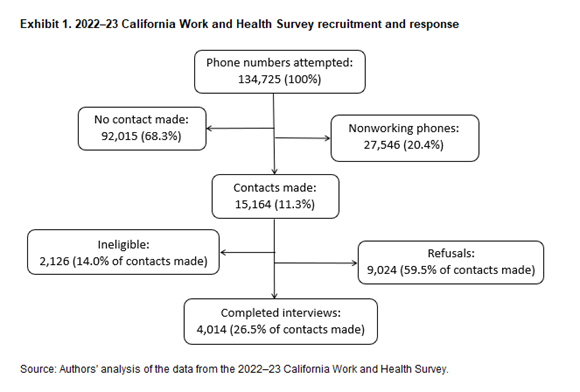
| Category | Number | Percentage |
|---|---|---|
Phone numbers attempted | 134,725 | 100.0 |
No contact made | 92,015 | 68.3 |
Nonworking phones | 27,546 | 20.4 |
Contacts made | 15,164 | 11.3 |
Ineligible | 2,126 | 14.0 |
Refusals | 9,024 | 59.5 |
Completed interviews | 4,014 | 26.5 |
Source: Authors' analysis of the data from the 2022–23 California Work and Health Survey. | ||
Following the development of an earlier survey of work and health, our goal for the CWHS was to create a survey instrument that would capture both traditional and emergent ways of working, in addition to health-status measures, and one that could be completed within a reasonable time allotment over the phone or on the internet.6 To do so, we engaged in a rigorous survey development process. Where possible, we relied on validated questions and scales from previously published studies. We solicited insights from numerous experts on changes in the nature of work and psychometrics through one-on-one conversations and in a group workshop setting. We then conducted key informant interviews with representatives of worker organizations most affected by nonstandard work arrangements, including rideshare drivers, restaurant employees, warehouse workers, and janitors. Participants articulated what they saw as key aspects of worker arrangements and provided input on terminology about nonstandard work arrangements in order to enhance the questionnaire’s comprehensibility.
We next selected 25 questions for a preliminary pilot test, including several generated from key informant input. During pilot testing, we administered these questions to 21 workers and evaluated their understanding of the questions by using cognitive interviews. We assessed the effectiveness of survey questions in categorizing and identifying both traditional and nonstandard forms of work, describing the relationships between workers and their organizations, and identifying worker misclassification. The pilot interviews led to the rewording of several questions, including extensive modifications of the section on potential misclassification (described below), and deletion of others, such as a question that attempted to detect employment by way of a Professional Employer Organization (PEO). Following these cognitive interviews, the survey went through several iterations to ensure wording clarity and to keep the average interview under 45 minutes.
In an effort to detect employees potentially misclassified as independent contractors, we worked from the set of legal criteria used by many states, including California, known as the “ABC test.”7 Under the ABC test, a worker is considered an independent contractor only when their work satisfies all three of the following conditions (criteria): (A) the worker is free from control and direction of the hiring entity in connection with the performance of the work, both under the contract for the performance of the work and in fact; (B) the worker performs work that is outside the usual course of the hiring entity’s business; and (C) the worker is customarily engaged in an independently established trade, occupation, or business of the same nature as that involved in the work performed.8 These criteria were not designed to be survey questions and required substantial modification to be comprehensible to respondents. The final question for criterion B departed most significantly from the original language of the legal test. Rather than ask the question directly, we simply asked the industry of the hiring entity and compared it with the industry reported earlier by the respondent in describing their own job. When these codes differed at the three-digit level of the North American Industry Classification System (NAICS), we considered the respondent to have met criterion B. We asked the ABC-based questions to respondents who indicated that they were self-employed or independent contractors, along with those who reported receiving a 1099 tax form for their work in the specific job about which they were being queried. Legally, only self-employed independent contractors are subject to potential misclassification. However, we asked the questions more broadly to allow for respondents’ potential misinterpretations of their actual hiring arrangements.
The CWHS survey instrument was composed of three major sections. The first and longest section focused on employment, including detailed questions about employment status and work arrangements, working conditions, and occupation and industry of working respondents’ jobs. To be sure that respondents reported on all current or recent work, we began the section with the following introduction: “We’re interested in all the work you did for pay or profit, whether in a formal job with definite work on a continuing basis, as a business owner or an independent contractor, or informal work or odd jobs you took on for pay.” Participants were asked about the main job they held in the past week (7 days), defined as the job with the most hours worked, as well as any second job worked in the past week or in the past month (30 days). Those not working in the past week were asked the same series of questions about the main job, if any, that they had held in the past month. Each respondent provided the total number of jobs held in the past month and reported on details of up to two jobs—referred to as a main job and a second job. We expanded to a 1-month timeframe because much nonstandard work is done episodically, so we chose this timeframe as a trade-off between episodic work patterns and the loss of reliability that would be caused by a longer recall period. Participants who were not currently employed were asked when they had last worked. Currently employed respondents were also asked about the nature of their longest job held.
The health section included questions about physical and mental health status, a checklist of common chronic illnesses, functional limitations, pain and other common symptoms, perceived stress, occupational injury, height, weight, health behaviors, and health insurance coverage. Many of these measures were from validated scales, including the PROMIS Global Health 1.2 measures, National Health Interview Survey, 4-item Perceived Stress Scale, and Behavioral Risk Factor Surveillance Survey.9 The final section includes basic demographic information, household composition, paid and unpaid caregiving for family members, household income and individual earnings, benefit recipiency, and financial strain.
Occupation and industry data were collected as text responses for each job reported. The NIOSH Occupational Computerized Coding System (NIOCCS) was used to apply Standard Occupational Classification (SOC) and NAICS codes to the responses.10 The NIOCCS industry and occupation machine-learning model determines industry code probabilities based on recognized words in the industry and the occupation narratives and provides a reliability score, along with each industry and occupation code it assigns.11 Any response with a reliability of less than 0.8 was manually coded by CWHS investigators, with a secondary review if questions still remained. The codes were applied at the most detailed level possible (up to six digits), but at times the responses could not be categorized beyond a two- or three-digit code.
Many of the questions used to categorize work arrangements in the CWHS were based on the questions in the BLS 2017 Current Population Survey Contingent Worker Supplement (CPS–CWS), which includes questions that allow for identification of workers in alternative or contingent employment arrangements.12 In the CWHS, the three types of nonstandard work arrangements are not mutually exclusive; respondents can have a single job that is contingent or alternative, and app-based work at the same time.
Alternative employment arrangements include independent contractors, temporary help agency workers, on-call workers, and contract-company workers. Independent contractors include workers who indicated they were independent contractors, independent consultants, or freelance workers. Independent contractors can identify as self-employed or not. The latter group, termed “wage and salary independent contractors” may work at a worksite for prolonged periods of time, often alongside employees of the firm.13 On-call workers are those who indicate that they are summoned to work only when they are needed. Contract-company workers are those who report that labor contract firms provide their services to other companies on a contract basis.
Contingent workers are those whose jobs have a predetermined end date, indicating their job is expected to last less than a year. BLS defines contingent work in three ways. The first and most narrow definition includes only wage and salary workers, excludes the self-employed and independent contractors, and is limited to jobs that began less than a year ago. In the second definition, contingent workers can include self-employed workers and any independent contractors. The third definition is further broadened by removing the criterion for job tenure of less than 1 year, but only for wage and salary workers. (The three definitions are referred to as definition 1, definition 2, and definition 3 throughout this article.)
App-based work was classified according to the BLS definition for electronically mediated employment: short jobs or tasks that workers find through websites or mobile apps that both connect them with customers and arrange payment for the tasks.14 We asked all respondents the following question: “Some workers find short, in-person jobs or tasks through companies that connect them directly with customers or jobs using a website or mobile app. These companies also coordinate payment for the service through the app. Have you earned money through companies like these?” Participants who answered affirmatively were asked to provide the names of the apps from a list of the 16 most common applications. Respondents could also provide the name or names of any apps not listed.
Complex work arrangements created challenges for respondents reporting contract-company work or app-based employment, leading to overestimates of both employment types. We undertook a data-cleaning process for these questions by editing responses that had a high probability of being false positives. For app-based employment, we reviewed text responses for occupation and industry for jobs in which individuals either did not share an app name or filled out the text “other” response. We excluded all sales applications, such as online auctions and marketplaces, as well as those in which the respondent uses an application as part of their job (as opposed to using a digital platform that engages workers in task-based work). Following a process similar to that used by BLS in cleaning the electronically mediated work responses to the CPS–CWS, we reviewed additional variables in deciding whether or not a job qualified as app-based employment: independent contractor status, on-call status, temporary-agency status, contract-company worker status, number of jobs, and hours worked in the past week.15 All decisions were made on a case-by-case basis by investigators.
For contract-company workers, we excluded anyone who was self-employed, an independent contractor, or an employee of a business they own. In addition, we reviewed text responses for occupation and industry to identify respondents who had confused “employer” with customer or client, or who worked in a specific occupation unlikely to involve contract-company workers.
We compared the prevalence of nonstandard work arrangements from the CWHS with that of the CPS–CWS, the most recent large-scale survey of these types of employment.16 Although the CWHS questions on nonstandard work arrangements are based on the CPS–CWS, there are important differences between the two surveys. The CPS–CWS was fielded nationally in 2017 to workers age 16 and over, while the CWHS was limited to California residents ages 18 to 70. CWHS respondents could self-complete the survey through a website, and a large majority chose to do so, while all CPS–CWS responses were collected by interviewers. All CWHS respondents report about themselves only, whereas the CPS–CWS allows for one household respondent to answer questions on behalf of one or more household members, a practice referred to as proxy reporting.17
As noted previously, the CWHS asks about work in the past 7 days as well as in the past 30 days, while the CPS–CWS focuses exclusively on the week that includes the 12th day of the month (often called the reference week). In the CWHS, the questions defining alternative work are asked of all employed respondents, while the CPS–CWS has a more complex approach to defining the universe of respondents eligible for each question. In the CPS–CWS, self-employed respondents are only eligible for one type of alternative work arrangement: independent contractors. For wage and salary workers in the CPS–CWS, the questions about alternative work are asked in a hierarchical fashion, beginning with temporary agency work, then on-call work, then contract-company work, and finally independent contracting. Those who respond positively to one question are not asked the subsequent questions.
In the CPS–CWS, some of the work arrangement series have follow-up questions further limiting the responses. For example, respondents are only considered to be contract-company workers if they work at the customer’s worksite and only had one customer. The CWHS asks the questions about work arrangements in a different order from that of the CPS–CWS and intersperses those questions with others about shift work, payment methods, and size of firm.
The CPS–CWS uses different question content, structure, and wording to identify contingent workers. For example, CPS–CWS has two questions to classify wage and salary workers as contingent workers, then uses follow-up questions to eliminate those jobs set to end for purely personal reasons; the CWHS does not include those follow-up questions, which would lead to a higher prevalence of contingent work. Also, CPS–CWS asks about job tenure—a component of the definition of contingency—only after it has been established whether a respondent is self-employed or an independent contractor. In contrast, the CWHS asks about job tenure before self-employment or independent-contractor status is established.18 (See appendix table A-1 for a summary of the major differences in the individual questions.)
To allow for generalizability of estimates from the CWHS to the California working-age population, we developed sample adjustment weights based on the population estimates from the Census Bureau’s 2021 American Community Survey for demographic characteristics, California regions, and socioeconomic status of the population of California adults ages 18 to 70.19 Using these weights, we described the sociodemographic characteristics of the population and compared employed and not-employed Californians using chi-square tests. We estimated the prevalence of nonstandard work among those employed in the past 7 days and in the past 30 days and compared the estimates with those from the 2017 CPS–CWS, as described above. When limiting the CPS–CWS to self-reporting respondents, we developed post-stratification weights to match the population demographics of the entire survey sample.20 Next, we compared the prevalence of each type of nonstandard work among sociodemographic groups, including sex/gender, age, race/ethnicity, and education, using chi-square tests. We estimated the proportion of respondents who met the three ABC criteria, either singly or together, and we used chi-square tests to compare self-employed workers with wage and salary independent contractors. For this comparison, we excluded state-licensed occupations and other occupations not subject to the ABC test.21 Lastly, we used a chi-square test to compare the percentages of workers meeting two or three ABC criteria by major industry category. All statistical tests used the proportional survey weights and were calculated in SAS 9.4.22
The subsections that follow provide detailed explanations of the results from the authors' analysis of the 2022–23 CWHS data.
A total of 4,014 interviews were completed, including 366 (9 percent) in Spanish. Approximately 26 percent were completed by phone; the remainder were self-completed using the web interface. Table 1 shows the estimated population, based on the survey weights, for all working-age Californians and the subsets who were working in the past 7 and past 30 days. Among 26.8 million Californians ages 18 to 70, 18.0 million (67.0 percent) had worked in the 7 days prior to interview, and 19.0 million (70.8 percent) had worked in the 30 days prior to the interview. Hispanic and White non-Hispanic individuals each made up about one-third of the population. Only 36 percent of this population had no education beyond high school, and about 20 percent lived in a household with five or more residents.
| Characteristic | Population | Percentage of total population | Percentage employed in past 30 days |
|---|---|---|---|
Total population (ages 18 to 70) | 26,831,016 | 100.0 | 70.8 |
Employed in past 30 days | 19,003,000 | 70.8 | 70.8 |
Employed in past 7 days | 17,983,000 | 67.0 | 94.6 |
Mean age | 42.5 | N/A | N/A |
Sex | |||
Women | 13,138,000 | 49.0 | 66.8 |
Men | 13,395,000 | 49.9 | 74.3 |
Language of interview | |||
English | 24,832,000 | 92.6 | 72.8 |
Spanish | 1,999,000 | 7.5 | 46.4 |
Race/ethnicity | |||
Asian or Pacific Islander | 3,035,000 | 11.3 | 77.6 |
Black of African American | 1,080,000 | 4.0 | 69.6 |
Hispanic or Latino | 8,663,000 | 32.3 | 66.8 |
White, non-Hispanic | 9,061,000 | 33.8 | 73.1 |
Other (multiracial or not reported) | 4,993,000 | 18.6 | 69.7 |
Region | |||
Los Angeles County | 6,945,000 | 25.9 | 72.4 |
Bay Area | 5,376,000 | 20.0 | 76.7 |
Central Valley | 4,691,000 | 17.5 | 66.9 |
South Coast (San Diego and Orange County) | 4,434,000 | 16.5 | 74.0 |
Inland Empire | 2,964,000 | 11.1 | 66.1 |
All other counties | 2,421,000 | 9.0 | 60.8 |
Education level | |||
High school diploma or less | 9,593,000 | 35.8 | 60.5 |
Some college | 7,924,000 | 29.5 | 70.1 |
4-year degree | 5,636,000 | 21.0 | 79.8 |
Graduate degree | 3,246,000 | 12.1 | 88.6 |
Not reported | 432,000 | 1.6 | 61.7 |
Household income less than 125 percent of Federal poverty level | 5,265,000 | 19.6 | 51.0 |
Marital status | |||
Married or cohabiting couple | 13,357,000 | 49.8 | 74.3 |
Widowed, divorced, or separated | 4,262,000 | 15.9 | 59.7 |
Never married | 8,476,000 | 31.6 | 70.7 |
Not reported | 735,000 | 2.7 | 73.2 |
Household size | |||
1 person | 3,720,000 | 13.9 | 64.6 |
2 people | 6,513,000 | 24.3 | 69.5 |
3 or 4 people | 9,903,000 | 36.9 | 74.3 |
5 or more people | 5,248,000 | 19.6 | 70.0 |
Not reported | 1,446,000 | 5.4 | 71.7 |
Note: Estimates are weighted to population. The total number of survey respondents was 4,014. Chi-square tests were used to estimate the percentages for employed and not employed. All differences are significant at p < 0.01. The mean age of 42.5 is plus or minus one standard deviation of 14.8 years. The percentages for women and men do not sum to 100 percent because a small number of survey respondents did not indicate their sex as female or male. N/A = not applicable. Source: Authors' analyses of the 2022–23 California Work and Health Survey. | |||
Unsurprisingly, employment rates differed greatly by sociodemographic characteristics. Men were more likely to be employed, as were Asian respondents. Those interviewed in Spanish and those with household incomes under 125 percent of the Federal Poverty Limit (FPL) were much less likely to be employed. Employment rates were also lower among residents of rural regions. Higher levels of education were associated with sequentially higher employment rates.
Increasing the timespan for consideration of employment status from 1 week (7 days) to 1 month (30 days) added approximately 1 million people to the ranks of the employed. People who were employed in the past month but not in the past week were, on average, younger, more likely to have household incomes under 125 percent FPL, and more likely to identify as Black or of Hispanic origin, compared with those who worked in the week preceding the interview.
The prevalence of nonstandard employment arrangements, including contingent work, alternative work arrangements, and app-based employment, is shown in table 2. The first set of columns describes only the main job held in the past 7 days, which is how labor market surveys generally collect employment data. The weighted population estimates show that the share of contingent jobs ranges from 4.0 percent to 9.7 percent of this population, depending on the definition used. The percentages for alternative arrangements range from 2.4 percent for temporary-agency work to 11.1 percent for self-employed independent contractors. App-based jobs are held by 5.7 percent of the California population in their main job in the past 7 days.
| Work arrangement | Main job: past 7 days | Main job: past 30 days | Second job: past 7 days | Second job: past 30 days | All employed: past 30 days1 | |||||
|---|---|---|---|---|---|---|---|---|---|---|
| Number | Percent | Number | Percent | Number | Percent | Number | Percent | Number | Percent | |
Total employed population | 17,671,629 | 100.0 | 1,019,427 | 100.0 | 2,419,846 | 100.0 | 1,388,609 | 100.0 | 18,691,056 | 100.0 |
Contingent work2 | ||||||||||
Definition 1 | 702,558 | 4.0 | 136,244 | 13.4 | 97,026 | 4.0 | 73,601 | 5.3 | 957,983 | 5.1 |
Definition 2 | 876,695 | 5.0 | 155,868 | 15.3 | 222,540 | 9.2 | 123,685 | 8.9 | 1,281,098 | 6.9 |
Definition 3 | 1,707,732 | 9.7 | 204,139 | 20.0 | 335,731 | 13.9 | 224,205 | 16.1 | 2,279,005 | 12.2 |
Not contingent (per definition 3) | 15,963,897 | 90.3 | 815,288 | 80.0 | 2,084,115 | 86.1 | 1,164,404 | 83.9 | 16,412,051 | 87.8 |
Alternative work | ||||||||||
Independent contractor | 2,952,661 | 16.7 | 156,304 | 15.3 | 1,155,059 | 47.7 | 568,717 | 41.0 | 3,988,782 | 21.3 |
Self-employed independent contractor | 1,968,368 | 11.1 | 78,856 | 7.7 | 827,060 | 34.2 | 473,932 | 34.1 | 2,871,625 | 15.4 |
Wage and salary independent contractor | 984,293 | 5.6 | 77,449 | 7.6 | 327,998 | 13.6 | 94,786 | 6.8 | 1,342,273 | 7.2 |
On-call worker | 1,093,432 | 6.2 | 98,873 | 9.7 | 297,808 | 12.3 | 96,456 | 6.9 | 1,452,640 | 7.8 |
Temporary agency | 423,780 | 2.4 | 99,205 | 9.7 | 66,588 | 2.8 | 30,975 | 2.2 | 578,929 | 3.1 |
Contract-company worker | 920,607 | 5.2 | 99,119 | 9.7 | 114,589 | 4.7 | 56,142 | 4.0 | 1,142,577 | 6.1 |
Any alternative arrangement | 4,770,489 | 27.0 | 335,111 | 32.9 | 1,435,101 | 59.3 | 691,588 | 49.8 | 6,164,652 | 33.0 |
Not alternative | 12,901,140 | 73.0 | 684,316 | 67.1 | 984,745 | 40.7 | 697,021 | 50.2 | 12,526,405 | 67.0 |
App-based employment | 1,005,524 | 5.7 | 125,466 | 12.3 | 286,131 | 11.8 | 186,781 | 13.5 | 1,398,558 | 7.5 |
1 The results for all employed in the past 30 days indicate at least one job held in a specified nonstandard arrangement. 2 The three definitions of contingent work are as follows: Definition 1 of contingent work includes only wage and salary workers, excludes the self-employed and independent contractors, and is limited to jobs that began less than a year before the survey. Definition 2 includes self-employed workers and independent contractors. Definition 3 broadens the scope by removing the criterion for job tenure of less than 1 year, but only for wage and salary workers. For more information on the three definitions of contingent work, see “Definitions of nonstandard work arrangements” in the methods section of this article; see also table A-1 in the appendix. Note: Estimates are weighted to population. The table omits 34 employed respondents for whom there were no data on on work arrangements. Contingent, alternative, and app-based employment are not mutually exclusive categories. Not contingent is when all of a person’s work is not contingent. Not alternative is when all of a person’s work is not alternative. The values of the subcategories of independent contractor sum to more than the total because of multiple jobholding. Source: Authors’ analyses of the 2022–23 California Work and Health Survey. | ||||||||||
The CWHS gathered data on a main job worked in the past 30 days (but not in the past 7 days), or a second job worked in either the past 7 days or in the past 30 days, as shown in the second, third, and fourth sets of columns of table 2. Although the number of individuals in these employment situations is much smaller than the number in a 7-day main job, it is apparent that nonstandard arrangements are more common. For the main job held in the past 30 days, contingent employment (definition 2) represents 15.3 percent of the population, and 12.3 percent have app-based employment. Among those with second jobs, over 40 percent are independent contractors in those jobs.
The final set of columns in table 2 shows the proportions of respondents in the CWHS for any job held in the past 30 days. Thus, for those reporting on two jobs, the figures in the last set of columns could reference either or both jobs. Comparing these estimates with those from the main 7-day job shows that expanding the universe to include jobs worked in the past 30 days or to include a second job substantially increased the proportion of all forms of nonstandard employment. Contingent employment, using the second definition, expanded from 5.0 percent to 6.9 percent of the employed population. Alternative employment increased from 27.0 percent to 33.0 percent of the employed population. App-based employment increased from 5.7 percent to 7.5 percent. Despite these large increases, however, over 80 percent of all jobs with any of the nonstandard work arrangements are the main job held by the worker.
Respondents with more than one job could report nonstandard work arrangements in only the main job, only the second job, or in both jobs. Table 3 shows this distribution for each of the major categories of nonstandard work arrangements: contingent work, independent contracting, other forms of alternative work arrangements, and app-based work. Among multiple jobholders, approximately half of contingent work, independent contracting, and other alternative work is done in the main job, while 60 percent of app-based work is in the main job.
| Job category | Contingent work | Independent contractor | Other alternative work arrangement | App-based work | ||||
|---|---|---|---|---|---|---|---|---|
| Number | Percent | Number | Percent | Number | Percent | Number | Percent | |
Total number with two jobs | 3,808,455 | 100.0 | 3,808,455 | 100.0 | 3,808,455 | 100.0 | 3,808,455 | 100.0 |
Neither job in specified arrangement | 3,339,422 | 87.7 | 1,818,980 | 47.8 | 3,172,021 | 83.3 | 3,130,521 | 82.2 |
Either job in specified arrangement | 469,033 | 12.3 | 1,989,475 | 52.2 | 636,434 | 16.7 | 677,934 | 17.8 |
Specified arrangement in main job | 220,499 | 47.0 | 1,109,658 | 55.8 | 344,249 | 54.1 | 410,366 | 60.5 |
Main job only | 122,808 | 26.2 | 265,699 | 13.4 | 233,521 | 36.7 | 205,022 | 30.2 |
Both jobs | 97,691 | 20.8 | 843,959 | 42.4 | 110,728 | 17.4 | 205,344 | 30.3 |
Second job only | 248,535 | 53.0 | 879,817 | 44.2 | 292,185 | 45.9 | 267,568 | 39.5 |
Note: Estimates are weighted to population. Denominators for percentages shown are the number of individuals with either job in a specified arrangement. Contingent, alternative, and app-based employment are not mutually exclusive categories. This table uses definition 2 for contingent work, which includes self-employed workers and independent contractors. Independent contractors can be self-employed or not. Other alternative work arrangement includes temporary-agency, on-call, and contract-company workers, and it excludes independent contractors. Source: Authors’ analyses of the 2022–23 California Work and Health Survey. | ||||||||
The CPS–CWS estimates for the California population ages 18 to 70 were compared with the 7-day job main job estimates for the CWHS. (See table 4). In all forms of nonstandard employment arrangements, the CWHS estimates were higher than the CPS–CWS estimates. The ratio of the prevalences between the CWHS and the CPS–CWS for the three definitions of contingent work ranged from 1.9 to 2.7. For alternative work arrangements, the ratios ranged from 1.5 for self-employed independent contractors to 10.7 for contract-company workers. For app-based employment, the ratio was 3.7.
| Work Arrangement | Main job in past 7 days (CWHS) | Main job in past 7 days (CPS–CWS) | Ratio of CWHS to CPS–CWS percentages (all data collected) | Ratio of CWHS to CPS-CWS percentages (tight comparison)1 | ||
|---|---|---|---|---|---|---|
| Number | Percent | Number | Percent | |||
Total employed population | 17,671,629 | 100.0 | 18,286,958 | 100.0 | N/A | N/A |
Contingent Work2 | ||||||
Definition 1 | 702,558 | 4.0 | 267,315 | 1.5 | 2.7 | 1.2 |
Definition 2 | 876,695 | 5.0 | 354,126 | 1.9 | 2.6 | 1.2 |
Definition 3 | 1,707,732 | 9.7 | 907,502 | 5.0 | 1.9 | 1.2 |
Not contingent (per definition 3) | 15,963,897 | 90.3 | 17,379,456 | 95.0 | 1.0 | 1.0 |
Alternative Work | ||||||
Independent contractor | 2,952,661 | 16.7 | 1,519,537 | 8.3 | 2.0 | 1.5 |
Self-employed | 1,968,368 | 11.1 | 1,345,295 | 7.4 | 1.5 | 1.2 |
Wage and salary | 984,293 | 5.6 | 174,242 | 1.0 | 5.8 | 3.5 |
On call worker | 1,093,432 | 6.2 | 267,644 | 1.5 | 4.2 | 2.5 |
Temporary agency | 423,780 | 2.4 | 161,152 | 0.9 | 2.7 | 2.8 |
Contract company worker | 920,607 | 5.2 | 88,833 | 0.5 | 10.7 | 2.4 |
Any alternative arrangement | 4,770,489 | 27.0 | 2,030,068 | 11.1 | 2.4 | 1.9 |
Not alternative | 12,901,140 | 73.0 | 16,256,890 | 88.9 | 0.8 | 0.9 |
App-based employment | 1,005,524 | 5.7 | 280,701 | 1.5 | 3.7 | 3.3 |
1 Tight comparison ratios between the CWHS and CPS–CWS estimates were calculated by excluding proxy responses from the CPS–CWS and by restricting the universe of contingent and alternative work arrangements in the CWHS to more closely match those of the CPS-CWS. (See appendix table A-1 for an item-by-item comparison of the two survey instruments.) 2 The three definitions of contingent work are as follows: Definition 1 includes only wage and salary workers, excludes the self-employed and independent contractors, and is limited to jobs that began less than a year before the survey. Definition 2 includes self-employed workers and independent contractors. Definition 3 broadens the scope by removing the criterion for job tenure of less than 1 year, but only for wage and salary workers. For more information on the three definitions of contingent work, see “Definitions of nonstandard work arrangements” in the methods section of this article; see also table A-1 in the appendix. Note: Estimates are weighted to population. Table omits 34 employed respondents without data on work arrangements. Contingent, alternative, and app-based employment are not mutually exclusive categories. CWHS = California Work and Health Survey. CPS–CWS = Current Population Survey Contingent Worker Supplement. N/A = Not applicable. Source: Authors’ analyses of the 2022–23 California Work and Health Survey. | ||||||
In an attempt to remove measurement-based variation that might account for the large differences in these results, we made modifications to the definitions for alternative workers in the CWHS, in order to match the way that the questions were structured in the CPS–CWS (described above). Further, because proxy respondents, who make up a large portion of the CPS–CWS, may not have accurate or complete information regarding these work arrangements, and the CWHS does not include proxy respondents, we made estimates of the CPS–CWS data that exclude proxy responses, re-estimating the sampling weights for the self-respondents to match the population demographics of the entire survey sample.23 As shown in the final column of table 4, these modifications moved the estimates from the two surveys closer together, particularly for the contingent worker categories. However, the CWHS remained substantially higher in alternative work arrangements and app-based employment.
Among the 1.4 million Californians estimated to be app-based workers in either a first or second job, most do rideshare or delivery work, with smaller proportions using other types of apps, including for odd jobs and entertainment work. (See table 5.) More than half of app-based workers report that they are independent contractors, most of whom report that they are self-employed. However, an additional 40 percent report that they are wage and salary employees. Notably, over 80 percent of app-based workers perform this work as their main job, rather than as secondary employment.
| Category | Number | Percent |
|---|---|---|
Total app-based employment | 1,398,558 | 100.0 |
Delivery | 817,430 | 58.4 |
Rideshare | 288,760 | 20.6 |
Personal care | 187,433 | 13.4 |
Odd jobs | 120,195 | 8.6 |
Entertainment or hospitality | 107,166 | 7.7 |
Assorted | 42,031 | 3.0 |
Self-employed independent contractor | 591,291 | 42.3 |
Wage-and-salary independent contractor | 153,348 | 11.0 |
Self-employed non-independent contractor | 100,398 | 7.2 |
Wage-and-salary non-independent contractor | 553,521 | 39.6 |
App-based employment in main job | 1,130,990 | 80.9 |
App-based employment in second job only | 267,568 | 19.1 |
Note: Estimates are weighted to population. Percentages may sum to more than 100 percent because respondents can report app-based employment in two jobs and can report more than one application per job. Source: Authors' analyses of the 2022–23 California Work and Health Survey. | ||
Women were more likely to have contingent employment and less likely to work in alternative arrangements other than in independent contracting (i.e., temporary agency, on-call or contract-company work), but they did not differ from men in the prevalence of independent contracting or app-based employment. (See table 6.) All forms of nonstandard employment varied by age, although the pattern was inconsistent. Both younger and older workers were more likely to have contingent employment. Independent contracting increased with age while other forms of alternative work decreased with age. The oldest age group was markedly less likely to report app-based employment. Independent contracting was less common among Asian and Hispanic workers than among White and Black workers, while White workers were less likely than all other racial and ethnic groups to work in other alternative arrangements. Those with lower education levels were more likely to have contingent employment, other alternative types of work, and app-based employment, but they did not differ from more educated workers in prevalence of independent contracting.
| Characteristic | Contingent employment | Independent contractor | Other alternative work arrangement | App-based employment | ||||||||
|---|---|---|---|---|---|---|---|---|---|---|---|---|
| Percentage employed | 95-percent confidence interval | Percentage employed | 95-percent confidence interval | Percentage employed | 95-percent confidence interval | Percentage employed | 95-percent confidence interval | |||||
| Lower bound | Upper bound | Lower bound | Upper bound | Lower bound | Upper bound | Lower bound | Upper bound | |||||
Among all employed in past 30 days | 6.9 | 6.0 | 7.7 | 21.3 | 19.9 | 22.8 | 11.6 | 10.5 | 12.8 | 7.5 | 6.6 | 8.4 |
Sex | ||||||||||||
p < 0.05 | Yes | N/A | N/A | No | N/A | N/A | Yes | N/A | N/A | No | N/A | N/A |
Women | 7.6 | 6.3 | 9.0 | 21.5 | 19.5 | 23.5 | 9.9 | 8.4 | 11.3 | 7.7 | 6.4 | 9.0 |
Men | 5.9 | 4.7 | 7.1 | 21.0 | 18.9 | 23.0 | 13.0 | 11.3 | 14.8 | 7.4 | 6.0 | 8.7 |
Age | ||||||||||||
p < 0.05 | Yes | N/A | N/A | Yes | N/A | N/A | Yes | N/A | N/A | Yes | N/A | N/A |
18 to 34 years | 11.0 | 8.9 | 13.1 | 17.4 | 14.9 | 19.9 | 15.2 | 12.8 | 17.6 | 9.7 | 7.7 | 11.7 |
35 to 54 years | 4.1 | 3.0 | 5.1 | 20.6 | 18.5 | 22.7 | 10.1 | 8.6 | 11.7 | 7.2 | 5.8 | 8.5 |
55 to 64 years | 3.6 | 2.1 | 5.1 | 27.8 | 24.2 | 31.4 | 8.1 | 5.9 | 10.3 | 5.0 | 3.3 | 6.8 |
65 to 70 years | 10.4 | 5.7 | 15.2 | 39.2 | 31.6 | 46.8 | 8.6 | 4.2 | 12.9 | 0.6 | 0.0 | 1.8 |
Race/ethnicity | ||||||||||||
p < 0.05 | No | N/A | N/A | Yes | N/A | N/A | Yes | N/A | N/A | No | N/A | N/A |
Asian or Pacific Islander | 8.6 | 5.1 | 12.2 | 14.6 | 10.1 | 19.1 | 13.1 | 8.8 | 17.4 | 7.4 | 4.0 | 10.7 |
Black | 8.6 | 3.9 | 13.3 | 24.2 | 17.1 | 31.4 | 10.5 | 5.4 | 15.5 | 9.5 | 4.6 | 14.4 |
Hispanic or Latino | 7.7 | 6.1 | 9.4 | 17.3 | 14.9 | 19.6 | 16.0 | 13.7 | 18.3 | 8.8 | 7.0 | 10.5 |
White, non-Hispanic | 4.9 | 3.7 | 6.1 | 23.9 | 21.5 | 26.3 | 7.5 | 6.0 | 8.9 | 6.0 | 4.7 | 7.4 |
Other, multiracial, or not reported | 7.5 | 5.1 | 9.9 | 27.1 | 23.0 | 31.2 | 11.6 | 8.7 | 14.6 | 7.8 | 5.3 | 10.3 |
Education level | ||||||||||||
p < 0.05 | Yes | N/A | N/A | No | N/A | N/A | Yes | N/A | N/A | Yes | N/A | N/A |
High school diploma or less | 8.5 | 6.2 | 10.7 | 21.8 | 18.4 | 25.2 | 16.9 | 13.9 | 20.0 | 9.2 | 6.8 | 11.6 |
Some college | 7.3 | 5.6 | 8.9 | 21.9 | 19.3 | 24.6 | 10.8 | 8.8 | 12.7 | 9.8 | 7.9 | 11.7 |
4-year degree | 6.7 | 5.0 | 8.3 | 20.5 | 17.8 | 23.2 | 8.9 | 7.0 | 10.8 | 5.4 | 3.9 | 6.9 |
Graduate degree | 3.6 | 2.2 | 5.1 | 19.7 | 16.6 | 22.8 | 7.6 | 5.5 | 9.6 | 2.3 | 1.1 | 3.5 |
Note: Estimates are weighted to population. The data in this table show percentages for all workers in the demographic category with the specified work arrangement. The table uses definition 2 for contingent work, which includes self-employed workers and independent contractors. Independent contractors can be self-employed or not. Other alternative work arrangements include temporary agency, on-call, and contract-company workers; independent contractors are excluded from this category. “Yes” indicates that the p-value for the chi-square tests of differences in employment is less than 0.05; “No” indicates that the p-value is greater than or equal to 0.05. N/A = Not applicable. Source: Authors' analyses of the 2022–23 California Work and Health Survey. | ||||||||||||
We analyzed the results of the ABC test for independent contractor (IC) misclassification as operationalized by the CWHS. (See table 7.) Criterion B, based on a comparison of NAICS codes for the respondent’s job and the industry of the business for which they work, was met by less than half of the respondents. Criteria A and C, which were asked more directly, were met by about two-thirds of respondents—69.3 percent for criterion A and 65.0 percent for criterion B. Taken together, less than 25 percent of respondents met all three criteria, and 32 percent met none or only one criterion.
| Category | All respondents | All independent contractors | Self-employed independent contractors | Wage-and-salary independent contractors | App-based workers | ||||||||||
|---|---|---|---|---|---|---|---|---|---|---|---|---|---|---|---|
| Percentage meeting criteria | 95-percent confidence interval | Percentage meeting criteria | 95-percent confidence interval | Percentage meeting criteria | 95-percent confidence interval | Percentage meeting criteria | 95-percent confidence interval | Percentage meeting criteria | 95-percent confidence interval | ||||||
| Lower bound | Upper bound | Lower bound | Upper bound | Lower bound | Upper bound | Lower bound | Upper bound | Lower bound | Upper bound | ||||||
Individual criteria | |||||||||||||||
Criterion A: Worker decides how the work is done1 | 69.3 | 66.2 | 72.4 | 70.7 | 66.5 | 75.0 | 83.8 | 79.4 | 88.1 | 46.8 | 39.1 | 54.5 | 58.0 | 50.4 | 65.5 |
Criterion B: Different industry from employer | 47.8 | 44.5 | 51.2 | 48.7 | 44.1 | 53.4 | 50.5 | 44.6 | 56.3 | 45.6 | 37.9 | 53.1 | 58.6 | 51.1 | 66.2 |
Criterion C: In business for themselves1 | 64.9 | 61.7 | 68.1 | 65.8 | 61.4 | 70.2 | 89.2 | 85.6 | 92.8 | 22.8 | 16.3 | 29.3 | 59.4 | 51.8 | 66.9 |
Number of criteria met1 | |||||||||||||||
None | 8.7 | 6.8 | 10.6 | 7.6 | 5.1 | 10.1 | 1.4 | 0.04 | 2.8 | 18.9 | 12.9 | 25.0 | 10.6 | 5.9 | 15.3 |
One | 23.4 | 20.6 | 26.3 | 24.1 | 20.1 | 28.1 | 10.0 | 6.5 | 13.5 | 50.0 | 42.3 | 57.7 | 25.3 | 18.6 | 31.9 |
Two | 45.0 | 41.6 | 48.3 | 43.7 | 39.1 | 48.4 | 52.3 | 46.4 | 58.2 | 28.0 | 21.1 | 34.9 | 41.7 | 34.2 | 49.3 |
All three | 22.9 | 20 | 25.7 | 24.6 | 20.6 | 28.6 | 36.3 | 30.6 | 41.9 | 3.1 | 0.4 | 5.7 | 22.4 | 16.0 | 28.8 |
1 p < 0.01 for difference between self-employed and wage-and-salary independent contractors. Note: The data in this table are based on 853 respondents; the data exclude 114 respondents with missing answers for one or more criteria. Estimates are weighted to population. Responses for those who answered ABC questions in both main and second job are reported for the main job answers only, to avoid double counting. The columns for independent-contractor status exclude 151 respondents with state-licensed occupations not subject to the ABC test. Source: Authors' analyses of the 2022–23 California Work and Health Survey. | |||||||||||||||
We compared results of the ABC test for self-employed independent contractors (ICs) and wage and salary employees who identified themselves as ICs (but who should be subject to the same rights and protections as any other employee under state and federal labor law, contractual limits notwithstanding). We expected a larger share of self-employed ICs to meet the ABC test criteria than those who identify as wage and salary ICs. Self-employed ICs were significantly more likely than wage and salary ICs to meet criterion A, reporting that they—rather than their client—decided how their work was done (83.7 percent versus 47.4 percent). Similarly, self-employed ICs were more than 3 times as likely as employee ICs to meet criterion C, reporting that they were in business for themselves (89.2 percent versus 23.1 percent). However, for criterion B, there was no significant difference by self-employment status (51.3 percent versus 46.2 percent), underscoring the challenges of implementing criterion B as a survey question. The two groups also sharply diverged in the number of criteria met: Self-employed ICs were significantly more likely than were wage and salary ICs to meet at least two of the ABC criteria (88.8 percent versus 31.5 percent). Nevertheless, the 11.2 percent of self-employed ICs who met none or only one of the three criteria in the ABC test suggests a high likelihood of misclassification.
App-based workers, who could report any self-employment and independent contractor status, fell somewhere in between the two groups of independent contractors in the proportions meeting a single criterion and in the overall count of criteria met. More than 35 percent of this group met none or only one of the ABC criteria.
The proportion of workers meeting at least two ABC criteria varied somewhat, but not significantly, across major industry groups (data not shown). Workers in the information industry were most likely to meet two or three criteria (78.6 percent), followed by leisure and hospitality (76.5 percent), finance (70.9 percent), trade, transit, and utilities (67.1 percent), extraction and construction (66.7 percent), professional and business services (66.7 percent), and education and healthcare (60.3 percent).
The CWHS was designed to capture the broadest possible view of current employment in California, focusing on characteristics of work that are most under scrutiny today, including nonstandard employment arrangements and independent contractor classification, as well as to link those characteristics to individual health and economic status. The results of the survey demonstrate success in some aspects of its mission, particularly highlighting the episodic nature of nonstandard arrangements and their greater prevalence in second jobs. They also point to the ongoing challenges of summarizing this very complex labor market through a self-reporting mechanism, especially for certain forms of nonstandard employment.
By expanding the timeframe under consideration from 1 week to 1 month, the CWHS extended its purview of the employed to cover an additional 1 million people with more episodic work. Excluding them would have resulted in a workforce that disproportionately omitted young, low-income, and Black and Hispanic individuals. Expanding the scope of the employment questions to include both the main job and a second job worked in the past 7 or 30 days also resulted in a clearer view of the variations in employment, as a higher proportion of second jobs were in nonstandard employment arrangements, even though the large majority of nonstandard employment arrangements are the main jobs held.
The prevalence of nonstandard employment has been and continues to be a concern in recent labor market research. The results from the CWHS indicate both the potential and challenges of correctly accounting for these types of employment. In the CWHS, contingent work in the past 30 days varied from 5.1 percent to 12.2 percent, depending on the definition used; workers with alternative work arrangements accounted for 33 percent of all workers. In comparison to the 2017 Current Population Survey Contingent Worker Supplement, the CWHS had a substantially higher prevalence of most types of nonstandard work, although these differences were reduced after aligning the individual survey questions and data collection methods as closely as possible. Some of the remaining differences are probably related to slight wording differences, the context of data collection (in-home versus by telephone or the internet), or the order of the questions in the survey, which cannot be accounted for in the present analysis. The time constraints on the CWHS were more severe, given the need to include health measures, and it was not always possible to add clarifications or follow-up questions. At the same time, the CWHS made fewer assumptions about the possibility of satisfying multiple forms of employment simultaneously, while the CPS–CWS used a fixed hierarchy of items, likely reducing the prevalence of some forms of employment. For example, all respondents in the CWHS could answer each question about alternative work arrangements, while the CPS–CWS restricted the universe of one question based on the responses to prior questions. Without a clear gold standard for these definitions, it is possible that the CPS–CWS is somewhat underestimating the true prevalence, just as the CWHS may be overestimating it.
Another potential explanation for at least some of the difference is that the prevalence of nonstandard work, particularly alternative arrangements and app-based jobs, did in fact increase over the intervening years since the CPS–CWS was fielded. Unfortunately, it is not possible to precisely determine the relative influence of the potential underestimates, overestimates, and increases over time on the true prevalence of nonstandard work in California.
The prevalence of the newest feature of nonstandard work, app-based employment, was estimated at 1.4 million in California, or 7.5 percent of the workforce. Over 80 percent of these jobs were reported to be the main (or only) job held by the respondents. Although this figure differs from similar figures reported elsewhere, especially by the companies who run the applications, the difference is indicative of a gap in how individual workers report their jobs. In the CWHS, a respondent’s main job was determined by the one at which the respondent worked the most hours, which may be a different metric than that used in other surveys and reporting on this issue.
A novel aspect of the CWHS is the inclusion of questions designed to identify independent contractor (IC) misclassification by operationalizing the ABC test for use in a survey questionnaire. We were motivated to attempt this challenge by two factors. One is the widespread adoption of the ABC test, a stronger and simpler standard for determining IC misclassification than the common-law standard that used to prevail. The second is intensifying policy debate about IC status versus employee status in the context of this legal development and the increasing trend toward alternative employment. This is exemplified by seesawing regulations in California, where the large app-based service providers funded a ballot initiative that exempted rideshare drivers from the newly enacted ABC test, and by the U.S. Department of Labor loosening its IC guidance in 2021 and retightening it in 2024.24 These developments are consequential because employee status confers upon workers a wide array of rights and benefits: minimum wage and overtime laws, workplace safety regulations, health and retirement benefits, unemployment benefits, state disability insurance, workers’ compensation insurance, and employer contributions to Social Security and Medicare.25 Thus, workers misclassified as independent contractors are deprived of these rights and subject to significant economic costs and risks. Misclassification rates have been shown to be higher in low-earning occupations.26
The results of the CWHS translation of the ABC test demonstrate the challenges in implementing the ABC test in survey form, apart from the nuances of any legal test. Workers do not have a reliable off-hand knowledge of all three criteria. While they appeared to have first-hand experience with who controls their work (criterion A) and whether or not they run their own business (criterion C), many respondents did not seem to clearly differentiate occupation from industry or to understand the distinction between their own work and the main business of their employer (the key element of criterion B). This issue was compounded by the limitations of the survey format, including the inability to probe for more detailed responses, which resulted in a lack of specificity in the industry responses and required a comparison at the three-digit NAICS level. This likely resulted in an underestimate of the share of ICs whose work is substantially different from the main business of their employer or client, because many of the three-digit NAICS codes encompass industries that are clearly distinct for the purposes of criterion B.
Although the survey implementation of the ABC test did not prove useful for determining the share of self-employed ICs meeting all three tests as per the legal standard, meeting none or only one of the ABC criteria would indicate a high likelihood of misclassification and might reasonably be used in future population surveys. Among the self-employed, arguably the only respondents at risk for misclassification, over 11 percent of respondents were in this category.
In addition to the challenges described above, there are several limitations in this survey, due to the sample size and the nature of self-reported data. The sample size limited our ability to examine nonstandard work patterns across detailed occupation and industry groups. Respondents may not have been able to correctly report all aspects of their employment, such as which type of tax forms they received or under what terms they were hired, which may have limited the accuracy of findings related to misclassification. Professional Employer Organizations (PEOs) were identified in earlier research as particularly problematic for workers to report accurately, and our pilot testing confirmed this: even after probing for named entities on workers’ paychecks, they could not reliably discern joint employment with a PEO.27
Despite these challenges, the results from the CWHS provide a picture of the complexity and diversity of the contemporary California workforce and show potential for advancing cross-sectoral data linkages to understand the impacts of nonstandard work arrangements. In future research that makes use of the follow-up survey data, the CWHS will allow for in-depth explorations of how these arrangements and contemporary working conditions are linked to the health and economic well-being of the population.
Table A-1 provides a detailed comparison of the 2017 CPS Contingent Worker Supplement and 2022–23 California Work and Health Survey.
Alternative work arrangements | ||||
|---|---|---|---|---|
Concept | CPS–CWS survey question text | CPS–CWS universe | CWHS survey question text | CWHS universe |
Self-employed independent contractor | Are you self-employed as an independent contractor, independent consultant, free-lance worker, or something else? | Self-employed | Are you self-employed as an independent contractor, independent consultant or freelance worker or something else (such as a business or shop owner)? | Self-employed |
Wage and salary independent contractor | Last week, were you working as an independent contractor, an independent consultant, or a free-lance worker? (That is, someone who obtains customers on their own to provide a product or service.) | Wage and salary workers, not employed by a temporary help agency, not on-call, not contract-company workers | Do you work as an independent contractor, independent consultant or freelance worker on this job? | Wage and salary workers |
Temporary agency employee | Are you paid by a temporary help agency on your job? | Wage and salary workers, nonindependent contractors, and job is temporary | At this job, are you paid by a temporary employment agency? | All employed |
On-call worker | Some people are in a pool of workers who are only called to work as needed, although they can be scheduled to work for several days or weeks in a row—for example, substitute teachers and construction workers supplied by a union hiring hall).These people are sometimes referred to as "on-call" workers. Were you an on-call worker on your job last week? (That is, someone who obtains customers on their own to provide a product or service.) | Wage and salary workers, nonindependent contractors, and not employed by a temporary help agency | On-call workers are called into work only when they are needed. Were you an on-call worker at this job last week? | All employed |
Contract company worker | Some companies provide employees or their services to others under contract. A few examples of services that can be contracted out include security, landscaping, or computer programming. Did you work for a company that contracts out you or your services last week? | Wage and salary workers, nonindependent contractors, not employed by a temporary help agency | Some companies provide employees or employee services to others under contract. At this job do you work for a company that contracts your services out? | Wage and salary workers, nonindependent contractors (includes temporary help agency workers) |
Contingent workers | ||||
Definition 1: Excludes all self-employed and all independent contractors and workers with job tenure greater than 12 months. | ||||
Basic questions | Provided the economy does not change and your job performance is adequate, can you continue to work for your current employer as long as you wish? If not, then the following: How much longer do you expect to work in your current job? (If necessary, do you think it will be more than a year?) | Wage and salary workers, excluding independent contractors | Provided the economy does not change and your job performance is adequate, can you continue to work for your current employer as long as you wish? (If not): Do you expect this job to end in the next 12 months? | Wage and salary workers, excluding independent contractors |
Job tenure | Job tenure varies by job classification. Not alternative: How long have you worked for your current employer? Temporary agency: How long have you been accepting assignments from this temporary help agency? On-call: How long have you been an on-call worker? Contract-company worker: How long have you worked for the company that contracts out your services? | Wage and salary workers, excluding independent contractors | How long have you worked for this specific company or organization? How many years? | Wage and salary workers, excluding independent contractors |
Definition 2: Includes self-employed and independent contractors. | ||||
Basic questions | Same as Definition 1, plus the following: How much longer do you expect to be an independent contractor or self-employed? | All employed | Same as Definition 1 | All employed |
Job tenure | Same as above, plus the following: How long have you been an independent contractor or self-employed? | All employed | Same as Definition 1 | All employed |
Definition 3: Eliminates job tenure requirement for wage and salary nonindependent contractor employees. | ||||
Note: For more information on the Current Population Survey Contingent Worker Supplement, see “Current Population Survey, May 2017: Contingent Work Technical Documentation“ (U.S. Census Bureau, 2017), https://www2.census.gov/programs-surveys/cps/techdocs/cpsmay17.pdf. For more information on the 2022–23 CWHS, see "California Work and Health Survey 2022: Technical documentation" (California Labor Laboratory, September 12, 2023), https://calaborlab.ucsf.edu/technical-documentation. CPS–CWS = Current Population Survey Contingent Workers Supplement. CWHS = California Work and Health Survey. Source: Authors' comparisons of the survey instruments for the May 2017 Current Population Survey Contingent Worker Supplement and the 2022–23 California Work and Health Survey. | ||||
Acknowledgment: The authors gratefully acknowledge the following individuals who lent their expertise in the development of the CWHS survey instrument: Paul Blanc, Carisa Harris, and Patti Katz (University of California, San Francisco); Ken Jacobs and Annette Burnhardt (University of California, Berkeley Institute for Research on Labor and Employment); Mark DiCamillo (University of California, Berkeley Institute of Governmental Studies).
Laura Trupin, Alicia LaFrance, Nari Rhee, Trisha Iley, Ima Varghese Mac, and Edward Yelin, "Exploring the complexities of nonstandard employment: the 2022–23 California Work and Health Survey," Monthly Labor Review, U.S. Bureau of Labor Statistics, March 2026, https://doi.org/10.21916/mlr.2026.5
1 For more information on app-based employment, see "Appendix A. Guidelines for recording," in Current Population Survey staff, “Electronically mediated work: new questions in the Contingent Worker Supplement,” Monthly Labor Review, September 2018, https://www.bls.gov/opub/mlr/2018/article/electronically-mediated-work-new-questions-in-the-contingent-worker-supplement.htm.
2 The Current Population Survey (CPS) is a monthly survey of U.S. households conducted by the U.S. Census Bureau for the Bureau of Labor Statistics. The CPS provides information on the nation's labor force, including data on the employed, unemployed, and those not in the labor force. The CPS Contingent Worker Supplement (CPS–CWS) was a special supplemental survey added to the May 2017 CPS. For more information on the CPS–CWS, see “Current Population Survey, May 2017: Contingent Work Technical Documentation“ (U.S. Census Bureau, 2017), https://www2.census.gov/programs-surveys/cps/techdocs/cpsmay17.pdf.
3 Toni Alterman, Sara E. Luckhaupt, James M. Dahlhamer, Brian W. Ward, and Geoffrey M. Calvert, “Prevalence rates of work organization characteristics among workers in the U.S.: Data from the 2010 National Health Interview Survey,” American Journal of Industrial Medicine, vol. 56, no. 6 (June 2013), pp. 647–59, https://doi.org/10.1002/ajim.22108; Contingent Workforce: Size, Characteristics, Earnings, and Benefits (U.S. Government Accountability Office, April 20, 2015), https://www.gao.gov/products/gao-15-168r; Katharine G. Abraham and Susan N. Houseman, Contingent and Alternative Employment: Lessons From the Contingent Worker Supplement, 1995–2017, report prepared for the U.S. Department of Labor (W.E. Upjohn Institute for Employment Research, 2020), https://research.upjohn.org/reports/270/; Measuring Alternative Work Arrangements for Research and Policy (Washington, DC: The National Academies Press, 2020), https://doi.org/10.17226/25822.; and Katharine G. Abraham, John C. Haltiwanger, Claire Hou, Kristin Sandusky, and James R. Spletzer, “Reconciling survey and administrative measures of self-employment,” Journal of Labor Economics, vol. 39, no. 4 (October 2021), https://doi.org/10.1086/712187.
4 Annette Bernhardt, Christopher Campos, Allen Prohofsky, Aparna Ramesh, and Jesse Rothstein, “Independent contracting, self-employment, and gig work: evidence from California tax data,” ILR Review, vol. 76, no. 2 (March 2023), pp. 357–386, https://doi.org/10.1177/00197939221130322.
5 For more information on the California Labor Laboratory, see https://calaborlab.ucsf.edu/. The California Labor Laboratory is a National Institute for Occupational Safety and Health (NIOSH) Center of Excellence for Total Worker Health. For more information on the NIOSH designation, see “NIOSH Extramural Research and Training: Centers of Excellence for Total Worker Health” (NIOSH Public Health, November 5, 2024), https://www.cdc.gov/niosh/extramural-programs/php/about/twh_centers.html.
6 For more information on the first iteration of the California Work and Health Survey (CWHS), conducted from 1998 to 2000, see Edward Yelin and Laura Trupin, “Disability and the characteristics of employment,” Monthly Labor Review, May 2003, https://www.bls.gov/opub/mlr/2003/05/art3full.pdf.
7 See Lynn Rhinehart, Celine McNicholas, Margaret Poydock, and Ihna Mangundayao, Misclassification, the ABC test, and employee status: the California experience and its relevance to current policy debates (Economic Policy Institute, June 16, 2021), https://www.epi.org/publication/misclassification-the-abc-test-and-employee-status-the-california-experience-and-its-relevance-to-current-policy-debates/. See also Yelin and Trupin, “Disability and the characteristics of employment.”
8 See “ABC test,” California Labor and Workforce Development Agency (Official website of the State of California 2025), https://www.labor.ca.gov/employmentstatus/abctest/.
9 For more information, see Ron D. Hays, Benjamin D. Schalet, Karen L. Spritzer, and David Cella, “Two-item PROMIS® global physical and mental health scales,” Journal of Patient-Reported Outcomes, vol. 1, no. 2 (September 2017), https://doi.org/10.1186/s41687-017-0003-8; Steven L. Botman, T. F. Moore, and Christopher L. Moriarity, Design and estimation for the National Health Interview Survey, 1995–2004, Vital and health statistics series 2, no. 130 (Centers for Disease Control and Prevention, June 2000), https://stacks.cdc.gov/view/cdc/6518; Sheldon Cohen, Tom Kamarck, and Robin Mermelstein, “A global measure of perceived stress,” Journal of Health and Social Behavior, vol. 24, no. 4 (December 1983), pp. 385–396, https://doi.org/10.2307/2136404; and “Behavioral Risk Factor Surveillance System Survey Questionnaire” (Centers for Disease Control and Prevention, last modified September 4, 2024), https://www.cdc.gov/brfss/questionnaires/index.htm.
10 See NIOSH Industry and Occupation Computerized Coding System (Centers for Disease Control and Prevention, National Institute for Occupational Safety and Health, last modified December 13, 2022), https://csams.cdc.gov/nioccs/.
11 See “About NIOCCS” (Centers for Disease Control and Prevention, National Institute for Occupational Safety and Health), last modified December 13, 2022, https://csams.cdc.gov/nioccs/About.aspx.
12 See “Current Population Survey, May 2017: Contingent Work Supplement Technical Documentation.”
13 See Abraham and Houseman, Contingent and Alternative Employment: Lessons from the Contingent Worker Supplement, 1995–2017.
14 See “Electronically mediated work: new questions in the Contingent Worker Supplement.”
15 See appendix A in “Electronically mediated work: new questions in the Contingent Worker Supplement.”
16 See "Current Population Survey, May 2017: Contingent Work Supplement Technical Documentation." See also "Current Population Survey, May 2017: Contingent Worker Supplement” (National Archive of Data on Arts and Culture, April 29, 2021), https://doi.org/10.3886/ICPSR37191.v2.
17 See Design and Methodology: Current Population Survey—America’s Source for Labor Force Data, Technical Paper 77 (U.S. Census Bureau, October 2019), https://www2.census.gov/programs-surveys/cps/methodology/CPS-Tech-Paper-77.pdf.
18 For more information about the CWHS survey design and content, including the survey instrument, see “California Work and Health Survey Technical Documentation,” California Labor Laboratory, University of California, San Francisco, September 12, 2023, https://calaborlab.ucsf.edu/technical-documentation.
19 See American Community Survey, Public Use Microdata Sample (U.S. Census Bureau, last modified October 28, 2024), https://www.census.gov/programs-surveys/acs/microdata.html. See also Devin Caughey, Adam J. Berinsky, Sara Chatfield, Erin Hartman, Eric Schickler, and Jasjeet S. Sekhon, Target Estimation and Adjustment Weighting for Survey Nonresponse and Sampling Bias (New York: Cambridge University Press, September 29, 2020), https://doi.org/10.1017/9781108879217.
20 See Kenneth D. Royal, “A guide for creating post-stratification weights to correct for sample bias,” Education in the Health Professions, vol. 2, no. 1 (January–June 2019), pp. 48–50, https://doi.org/10.4103/EHP.EHP_8_19.
21 Ken Jacobs, Enrique Lopezlira, and Vivian Vàzquez, "The vast majority of California’s independent contractors are still covered by the ABC test," UC Berkeley Center for Labor Research and Education, June 2023, https://laborcenter.berkeley.edu/ab2257-employment-status/.
22 Programming documentation for SAS® 9.4 and SAS® Viya® 3.5, SAS Help Center, https://documentation.sas.com/doc/en/pgmsascdc/9.4_3.5/pgmsaswlcm/home.htm.
23 See “Electronically mediated work: new questions in the Contingent Worker Supplement.”
24 “Dynamex Operations West, Inc. v. Superior Court of Los Angeles County” (California Supreme Court decision issued April 30, 2018), https://law.justia.com/cases/california/supreme-court/2018/s222732.html; “California Assembly Bill No. 5 Worker status: employees and independent contractors” (California Assembly Regular Session, effective January 1, 2020), https://leginfo.legislature.ca.gov/faces/billTextClient.xhtml?bill_id=201920200AB5; “California Proposition 22, Exempts App-Based Transportation and Delivery Companies from Providing Employee Benefits to Certain Drivers” (passed November 2020), https://lao.ca.gov/BallotAnalysis/Proposition?number=22&year=2020; and “US Department of Labor Announces Final Rule on Classifying Workers as Employees or Independent Contractors Under the Fair Labor Standards Act: Rescinds 2021 independent contractor rule; replaces it with analysis consistent with caselaw,” (U.S. Department of Labor, January 9, 2024), https://www.dol.gov/newsroom/releases/whd/whd20240109-1; and “Employee or Independent Contractor Classification Under the Fair Labor Standards Act” (U.S. Department of Labor, effective March 11, 2024), https://www.federalregister.gov/documents/2024/01/10/2024-00067/employee-or-independent-contractor-classification-under-the-fair-labor-standards-act.
25 Kristin Cummings and Kathleen Kreiss, “Contingent workers and contingent health: risks of a modern economy,” Journal of the American Medical Association, vol. 299, no. 4 (published online January 30, 2008), pp. 448–450, https://doi.org/10.1001/jama.299.4.448
26 Corey Husak, “How U.S. companies harm workers by making them independent contractors,” Washington Center for Equitable Growth, July 2019, https://equitablegrowth.org/wp-content/uploads/2019/09/IB-Independent-Contracting.pdf.
27 Katharine G. Abraham, John C. Haltiwanger, Kristin Sandusky, and James R. Spletzer, “Measuring the gig economy: current knowledge and open issues," Working Paper 24950 (Cambridge, MA: National Bureau of Economic Research, August 2018), https://www.nber.org/papers/w24950.