An official website of the United States government
 United States Department of Labor
An official website of the United States government
United States Department of Labor

The .gov means it's official.
Federal government websites often end in .gov or .mil. Before sharing sensitive information,
make sure you're on a federal government site.

The site is secure.
The
https:// ensures that you are connecting to the official website and that any
information you provide is encrypted and transmitted securely.
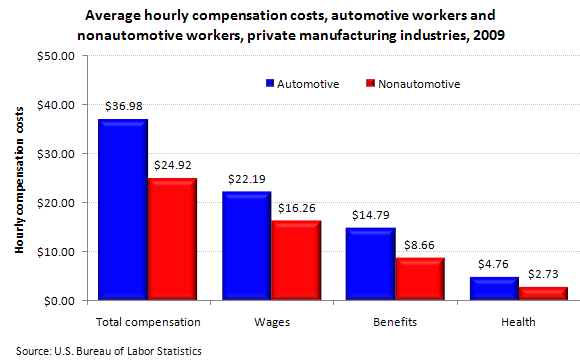
Compensation costs for blue-collar workers in the automobile industry exceed those of many blue-collar workers in other manufacturing industries.
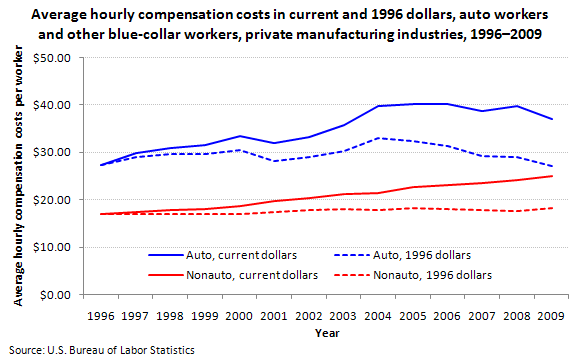
Compensation costs for auto workers were among the highest of any manufacturing industry in 2009, despite the trends of recent years in which nominal auto industry compensation costs have held steady or declined (except from 2007 to 2008), while compensation costs in other manufacturing industries have continued to climb. In real terms, private auto industry compensation costs have been falling since 2004.
Compensation costs can be broken into two categories: wages and benefits. In the auto industry, upward pressure on wage costs has been offset by downward pressure on benefit costs. In both real and nominal terms, benefit costs have been falling for auto manufacturers in recent years (except from 2007 to 2008), while benefit costs have been steady for other private industry manufacturers.
These data are from the Compensation Cost Trends program. To learn more, see "Auto Industry Labor Costs in Perspective" in the April 2011 issue of Compensation and Working Conditions Online. In the source article, “blue-collar workers” include the following occupations: protective service occupations; food preparation and serving related occupations; building and grounds cleaning and maintenance occupations; personal care and service occupations; farming, fishing, and forestry occupations; construction and extraction occupations; installation, maintenance, and repair occupations; production occupations; transportation and material moving occupations.
Bureau of Labor Statistics, U.S. Department of Labor, The Economics Daily, Labor costs in the auto industry at https://www.bls.gov/opub/ted/2011/ted_20110427.htm (visited October 17, 2026).