
An official website of the United States government
 United States Department of Labor
An official website of the United States government
United States Department of Labor

The .gov means it's official.
Federal government websites often end in .gov or .mil. Before sharing sensitive information,
make sure you're on a federal government site.

The site is secure.
The
https:// ensures that you are connecting to the official website and that any
information you provide is encrypted and transmitted securely.


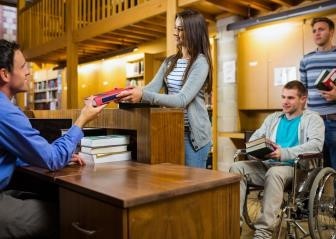 Administer and maintain libraries or collections of information, for public or private access through reference or borrowing. Work in a variety of settings, such as educational institutions, museums, and corporations, and with various types of informational materials, such as books, periodicals, recordings, films, and databases. Tasks may include acquiring, cataloging, and circulating library materials, and user services such as locating and organizing information, providing instruction on how to access information, and setting up and operating a library's media equipment.
For terms and definitions in this profile, see definitions of major terms.
The qualifications that workers need to use judgment, make decisions, interact with others, and adapt to changes in jobs.
In 2025, internal verbal interactions were required constantly (every few minutes) for 5.3 percent of librarians and media collections specialists. Internal verbal interactions were required more than once per hour (but not constantly) for 77.1 percent.
| Requirement | Yes | No |
|---|---|---|
|
Work schedule varies |
21.3 | 78.7 |
|
Working around crowds |
<0.5 | >99.5 |
|
Telework routinely allowed |
7.6 | 92.4 |
|
Supervisor present in immediate work area |
54.7 | 45.3 |
|
Source: U.S. Bureau of Labor Statistics, Occupational Requirements Survey |
||
The minimum level of formal education required, credentials necessary, on-the-job training, and prior work experience necessary for average performance in jobs. The time associated with these requirements is combined to calculate the specific vocational preparation level needed for the job.
In 2025, prior work experience was required for 55.8 percent of librarians and media collections specialists and on-the-job training was required for 61.8 percent.
A master's degree was required for 71.8 percent of librarians and media collections specialists.
The various hazards or difficulties that are in the area where workers perform their critical tasks.
In 2025, a quiet noise exposure was present for 76.5 percent of librarians and media collections specialists. Another 23.5 percent were exposed to moderate noise, less than 0.5 percent were exposed to loud noise, and less than 0.5 percent to very loud noise. Personal protective equipment (PPE) was used by less than 0.5 percent of workers to mitigate noise exposure and was not used by greater than 99.5 percent.
The physical activities required to perform tasks in jobs. The presence and, in some cases, duration of these activities are published.
In 2025, speaking was required for greater than 99.5 percent of librarians and media collections specialists and was not required for less than 0.5 percent. For less than 0.5 percent of workers, speaking was seldom required, for 41.0 percent speaking was occasionally required, for 59.0 percent speaking was frequently required, and for less than 0.5 percent speaking was required constantly.
Performing work in low postures was required for 41.9 percent of librarians and media collections specialists and was not required for 58.1 percent.
On average, librarians and media collections specialists spent 63.8 percent of the workday sitting and 36.2 percent of the workday standing.
| Requirement | Yes | No |
|---|---|---|
|
Driving |
7.3 | 92.7 |
|
Climbing structure-related ramps or stairs |
4.0 | 96.0 |
|
Source: U.S. Bureau of Labor Statistics, Occupational Requirements Survey |
||