
An official website of the United States government
 United States Department of Labor
An official website of the United States government
United States Department of Labor

The .gov means it's official.
Federal government websites often end in .gov or .mil. Before sharing sensitive information,
make sure you're on a federal government site.

The site is secure.
The
https:// ensures that you are connecting to the official website and that any
information you provide is encrypted and transmitted securely.


Apply plasterboard or other wallboard to ceilings or interior walls of buildings. Apply or mount acoustical tiles or blocks, strips, or sheets of shock-absorbing materials to ceilings and walls of buildings to reduce or reflect sound. Materials may be of decorative quality. Includes lathers who fasten wooden, metal, or rockboard lath to walls, ceilings or partitions of buildings to provide support base for plaster, fire-proofing, or acoustical material. Excludes "Carpet Installers" (47-2041), "Carpenters" (47-2031), and "Tile and Marble Setters" (47-2044).
Employment estimate and mean wage estimates for this occupation:
| Employment (1) | Employment RSE (3) |
Mean hourly wage |
Mean annual wage (2) |
Wage RSE (3) |
|---|---|---|---|---|
| 101,900 | 2.3 % | $23.64 | $49,170 | 1.2 % |
Percentile wage estimates for this occupation:
| Percentile | 10% | 25% | 50% (Median) |
75% | 90% |
|---|---|---|---|---|---|
| Hourly Wage | $13.22 | $16.62 | $21.03 | $28.05 | $39.91 |
| Annual Wage (2) | $27,490 | $34,580 | $43,730 | $58,350 | $83,010 |
Industries with the highest published employment and wages for this occupation are provided. For a list of all industries with employment in this occupation, see the Create Customized Tables function.
Industries with the highest levels of employment in this occupation:
| Industry | Employment (1) | Percent of industry employment | Hourly mean wage | Annual mean wage (2) |
|---|---|---|---|---|
| Building Finishing Contractors | 82,240 | 10.10 | $23.58 | $49,050 |
| Nonresidential Building Construction | 6,310 | 0.78 | $26.02 | $54,120 |
| Residential Building Construction | 6,280 | 0.81 | $20.79 | $43,240 |
| Foundation, Structure, and Building Exterior Contractors | 3,250 | 0.36 | $25.16 | $52,320 |
| Other Specialty Trade Contractors | 1,090 | 0.16 | $32.37 | $67,320 |
Industries with the highest concentration of employment in this occupation:
| Industry | Employment (1) | Percent of industry employment | Hourly mean wage | Annual mean wage (2) |
|---|---|---|---|---|
| Building Finishing Contractors | 82,240 | 10.10 | $23.58 | $49,050 |
| Residential Building Construction | 6,280 | 0.81 | $20.79 | $43,240 |
| Nonresidential Building Construction | 6,310 | 0.78 | $26.02 | $54,120 |
| Foundation, Structure, and Building Exterior Contractors | 3,250 | 0.36 | $25.16 | $52,320 |
| Other Wood Product Manufacturing | 560 | 0.24 | $17.33 | $36,050 |
Top paying industries for this occupation:
| Industry | Employment (1) | Percent of industry employment | Hourly mean wage | Annual mean wage (2) |
|---|---|---|---|---|
| Other Specialty Trade Contractors | 1,090 | 0.16 | $32.37 | $67,320 |
| Nonresidential Building Construction | 6,310 | 0.78 | $26.02 | $54,120 |
| Building Equipment Contractors | 330 | 0.02 | $25.89 | $53,860 |
| Foundation, Structure, and Building Exterior Contractors | 3,250 | 0.36 | $25.16 | $52,320 |
| Building Finishing Contractors | 82,240 | 10.10 | $23.58 | $49,050 |
States and areas with the highest published employment, location quotients, and wages for this occupation are provided. For a list of all areas with employment in this occupation, see the Create Customized Tables function.

States with the highest employment level in this occupation:
| State | Employment (1) | Employment per thousand jobs | Location quotient (9) | Hourly mean wage | Annual mean wage (2) |
|---|---|---|---|---|---|
| California | 29,190 | 1.72 | 2.44 | $29.72 | $61,820 |
| Texas | 8,410 | 0.69 | 0.99 | $18.21 | $37,870 |
| New York | 5,490 | 0.58 | 0.83 | $23.84 | $49,600 |
| Florida | 4,980 | 0.58 | 0.82 | $16.94 | $35,240 |
| Washington | 4,790 | 1.47 | 2.09 | $28.84 | $59,990 |

States with the highest concentration of jobs and location quotients in this occupation:
| State | Employment (1) | Employment per thousand jobs | Location quotient (9) | Hourly mean wage | Annual mean wage (2) |
|---|---|---|---|---|---|
| Utah | 3,650 | 2.50 | 3.56 | $19.00 | $39,530 |
| Nevada | 2,790 | 2.07 | 2.94 | $18.24 | $37,930 |
| California | 29,190 | 1.72 | 2.44 | $29.72 | $61,820 |
| Idaho | 1,160 | 1.65 | 2.34 | $17.21 | $35,800 |
| Washington | 4,790 | 1.47 | 2.09 | $28.84 | $59,990 |
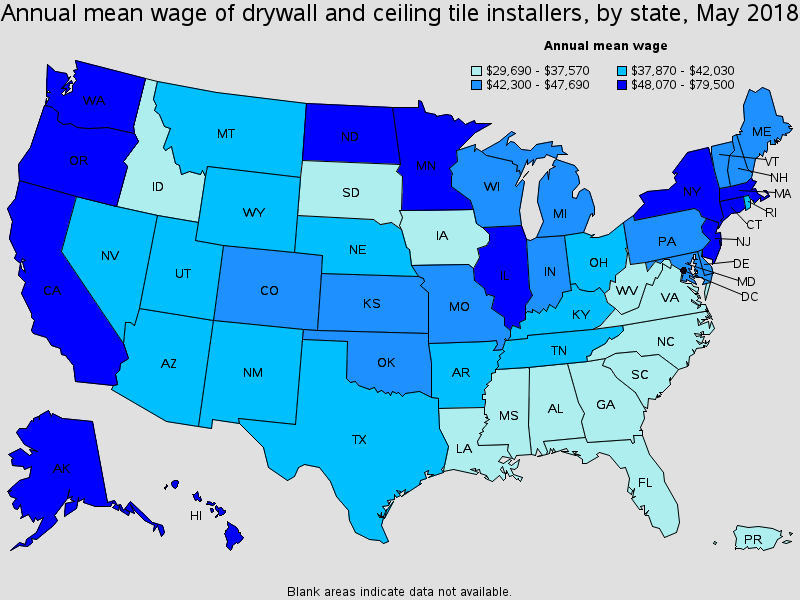
Top paying States for this occupation:
| State | Employment (1) | Employment per thousand jobs | Location quotient (9) | Hourly mean wage | Annual mean wage (2) |
|---|---|---|---|---|---|
| Hawaii | 710 | 1.11 | 1.57 | $38.22 | $79,500 |
| California | 29,190 | 1.72 | 2.44 | $29.72 | $61,820 |
| Washington | 4,790 | 1.47 | 2.09 | $28.84 | $59,990 |
| Oregon | 1,410 | 0.75 | 1.06 | $28.47 | $59,230 |
| Minnesota | 1,000 | 0.35 | 0.50 | $28.14 | $58,530 |

Metropolitan areas with the highest employment level in this occupation:
| Metropolitan area | Employment (1) | Employment per thousand jobs | Location quotient (9) | Hourly mean wage | Annual mean wage (2) |
|---|---|---|---|---|---|
| Los Angeles-Long Beach-Anaheim, CA | 9,260 | 1.51 | 2.15 | $28.09 | $58,430 |
| New York-Newark-Jersey City, NY-NJ-PA | 6,150 | 0.65 | 0.92 | $24.46 | $50,870 |
| Riverside-San Bernardino-Ontario, CA | 3,940 | 2.64 | 3.75 | $25.48 | $52,990 |
| Seattle-Tacoma-Bellevue, WA | 3,530 | 1.78 | 2.53 | $29.85 | $62,080 |
| San Francisco-Oakland-Hayward, CA | 3,300 | 1.37 | 1.94 | $38.45 | $79,970 |
| Phoenix-Mesa-Scottsdale, AZ | 3,250 | 1.58 | 2.25 | $20.31 | $42,240 |
| Dallas-Fort Worth-Arlington, TX | 3,140 | 0.88 | 1.25 | $17.05 | $35,460 |
| San Diego-Carlsbad, CA | 3,080 | 2.10 | 2.99 | $29.84 | $62,070 |
| San Jose-Sunnyvale-Santa Clara, CA | 2,760 | 2.47 | 3.51 | $32.80 | $68,220 |
| Washington-Arlington-Alexandria, DC-VA-MD-WV | 2,250 | 0.72 | 1.02 | $19.64 | $40,850 |

Metropolitan areas with the highest concentration of jobs and location quotients in this occupation:
| Metropolitan area | Employment (1) | Employment per thousand jobs | Location quotient (9) | Hourly mean wage | Annual mean wage (2) |
|---|---|---|---|---|---|
| St. George, UT | 290 | 4.50 | 6.39 | $19.72 | $41,020 |
| Logan, UT-ID | 180 | 3.13 | 4.45 | $19.92 | $41,430 |
| Provo-Orem, UT | 700 | 2.86 | 4.07 | $17.93 | $37,300 |
| Lake Havasu City-Kingman, AZ | 140 | 2.86 | 4.06 | $18.80 | $39,100 |
| Santa Rosa, CA | 580 | 2.83 | 4.02 | $36.67 | $76,270 |
| Salt Lake City, UT | 1,930 | 2.71 | 3.84 | $19.17 | $39,860 |
| Riverside-San Bernardino-Ontario, CA | 3,940 | 2.64 | 3.75 | $25.48 | $52,990 |
| Reno, NV | 580 | 2.50 | 3.55 | $17.36 | $36,110 |
| San Jose-Sunnyvale-Santa Clara, CA | 2,760 | 2.47 | 3.51 | $32.80 | $68,220 |
| Boise City, ID | 790 | 2.46 | 3.49 | $16.92 | $35,190 |

Top paying metropolitan areas for this occupation:
| Metropolitan area | Employment (1) | Employment per thousand jobs | Location quotient (9) | Hourly mean wage | Annual mean wage (2) |
|---|---|---|---|---|---|
| Urban Honolulu, HI | 560 | 1.21 | 1.72 | $39.14 | $81,410 |
| San Francisco-Oakland-Hayward, CA | 3,300 | 1.37 | 1.94 | $38.45 | $79,970 |
| Santa Rosa, CA | 580 | 2.83 | 4.02 | $36.67 | $76,270 |
| Fresno, CA | 920 | 2.45 | 3.47 | $34.33 | $71,410 |
| San Jose-Sunnyvale-Santa Clara, CA | 2,760 | 2.47 | 3.51 | $32.80 | $68,220 |
| San Luis Obispo-Paso Robles-Arroyo Grande, CA | (8) | (8) | (8) | $32.07 | $66,700 |
| Merced, CA | 80 | 1.14 | 1.62 | $31.59 | $65,700 |
| Bremerton-Silverdale, WA | 90 | 1.01 | 1.43 | $31.57 | $65,660 |
| Modesto, CA | 340 | 1.82 | 2.59 | $31.44 | $65,390 |
| Minneapolis-St. Paul-Bloomington, MN-WI | 580 | 0.30 | 0.42 | $31.39 | $65,280 |
Nonmetropolitan areas with the highest employment in this occupation:
| Nonmetropolitan area | Employment (1) | Employment per thousand jobs | Location quotient (9) | Hourly mean wage | Annual mean wage (2) |
|---|---|---|---|---|---|
| Southwest Maine nonmetropolitan area | 210 | 1.09 | 1.55 | $18.89 | $39,300 |
| Northwest Colorado nonmetropolitan area | 190 | 1.60 | 2.27 | $20.51 | $42,670 |
| Central East New York nonmetropolitan area | 110 | 0.66 | 0.93 | $18.27 | $38,000 |
| Western Washington nonmetropolitan area | 100 | 0.86 | 1.22 | $31.30 | $65,090 |
| South Central Wisconsin nonmetropolitan area | 100 | 0.48 | 0.68 | $18.45 | $38,370 |
Nonmetropolitan areas with the highest concentration of jobs and location quotients in this occupation:
| Nonmetropolitan area | Employment (1) | Employment per thousand jobs | Location quotient (9) | Hourly mean wage | Annual mean wage (2) |
|---|---|---|---|---|---|
| Northwest Colorado nonmetropolitan area | 190 | 1.60 | 2.27 | $20.51 | $42,670 |
| Central Utah nonmetropolitan area | 70 | 1.50 | 2.13 | $15.99 | $33,270 |
| Northwestern Idaho nonmetropolitan area | 90 | 1.28 | 1.81 | $17.46 | $36,310 |
| Northwest Alabama nonmetropolitan area | 80 | 1.20 | 1.70 | $15.93 | $33,140 |
| Southwest Maine nonmetropolitan area | 210 | 1.09 | 1.55 | $18.89 | $39,300 |
Top paying nonmetropolitan areas for this occupation:
| Nonmetropolitan area | Employment (1) | Employment per thousand jobs | Location quotient (9) | Hourly mean wage | Annual mean wage (2) |
|---|---|---|---|---|---|
| Hawaii / Kauai nonmetropolitan area | 70 | 0.71 | 1.01 | $33.36 | $69,400 |
| North Coast Region of California nonmetropolitan area | 50 | 0.43 | 0.62 | $31.94 | $66,440 |
| Western Washington nonmetropolitan area | 100 | 0.86 | 1.22 | $31.30 | $65,090 |
| North Valley-Northern Mountains Region of California nonmetropolitan area | 100 | 0.99 | 1.40 | $29.32 | $60,990 |
| Coast Oregon nonmetropolitan area | 50 | 0.42 | 0.60 | $24.92 | $51,840 |
These estimates are calculated with data collected from employers in all industry sectors, all metropolitan and nonmetropolitan areas, and all states and the District of Columbia. The top employment and wage figures are provided above. The complete list is available in the downloadable XLS files.
The percentile wage estimate is the value of a wage below which a certain percent of workers fall. The median wage is the 50th percentile wage estimate--50 percent of workers earn less than the median and 50 percent of workers earn more than the median. More about percentile wages.
(1) Estimates for detailed occupations do not sum to the totals because the totals include occupations not shown separately. Estimates do not include self-employed workers.
(2) Annual wages have been calculated by multiplying the hourly mean wage by a "year-round, full-time" hours figure of 2,080 hours; for those occupations where there is not an hourly wage published, the annual wage has been directly calculated from the reported survey data.
(3) The relative standard error (RSE) is a measure of the reliability of a survey statistic. The smaller the relative standard error, the more precise the estimate.
(8) Estimate not released.
(9) The location quotient is the ratio of the area concentration of occupational employment to the national average concentration. A location quotient greater than one indicates the occupation has a higher share of employment than average, and a location quotient less than one indicates the occupation is less prevalent in the area than average.
Other OES estimates and related information:
May 2018 National Occupational Employment and Wage Estimates
May 2018 State Occupational Employment and Wage Estimates
May 2018 Metropolitan and Nonmetropolitan Area Occupational Employment and Wage Estimates
May 2018 National Industry-Specific Occupational Employment and Wage Estimates
Last Modified Date: March 29, 2019