
An official website of the United States government
 United States Department of Labor
An official website of the United States government
United States Department of Labor

The .gov means it's official.
Federal government websites often end in .gov or .mil. Before sharing sensitive information,
make sure you're on a federal government site.

The site is secure.
The
https:// ensures that you are connecting to the official website and that any
information you provide is encrypted and transmitted securely.

More BLS articles and information related to public assistance are available online at the following:
Government means-tested assistance programs, such as Medicaid and Supplemental Security Income (SSI), provide cash and noncash benefits to many low-income families. In 2009, 19.0 percent of U.S. families, on average, participated in at least one major means-tested program per month. Participation rates were highest for one-parent families headed by women, 46.3 percent, compared with 26.5 percent for one-parent families headed by men and 12.3 percent for married-couple families.1
This article uses data from the 2011 Consumer Expenditure Interview Survey to examine the spending patterns of families receiving benefits from one or more government means-tested assistance programs.2 Families with children under 18 are the focus of this research, because the poverty rate for children under 18 was highest for this group, at 21.9 percent in 2011, compared with 13.7 percent for people age 18 to 64 and 8.7 percent for people age 65 and older.3
Findings show that:
Average total expenditures of families receiving means-tested assistance were less than half those of families not receiving assistance.
For families receiving assistance, food, housing, and transportation accounted for 77.0 percent of the family budget, compared with 65.5 percent of the budget of families not receiving assistance.
Among one-parent families receiving assistance, 36.8 percent did not own a car, compared with 3.0 percent of families not receiving assistance and 9.7 percent of two-parent families receiving assistance.
The sample used in this analysis consisted of families with at least one child under 18.4 Families receiving assistance were compared with families not receiving assistance; demographic characteristics, as well as spending patterns, were examined.
Additional analysis of families receiving assistance was made by comparing single-parent and dual-parent families.
The benefit programs in which sample families participated include housing assistance (provision of public housing and housing subsidy payments); Medicaid, the joint federal-state program that pays for medical care for low-income persons; and public assistance (cash assistance from state and local government welfare programs, such as Temporary Assistance for Needy Families (TANF), and short-term emergency help). Also included are the Supplemental Nutrition Assistance Program (SNAP) and the SSI program that provides monthly benefits to disabled adults and children, and to those 65 and older who have limited income and assets but are not disabled. Participation in any of these programs is determined by information provided by survey respondents.
Findings
Unless otherwise indicated, all findings are statistically significant.
Consumer Expenditure Survey (CE) data show that in 2011,5 there were 27.1 million families in the United States with at least one child under 18 years old.6 About 24 percent of families with children under 18 received government means-tested assistance benefits. Among families receiving assistance, 51.6 percent were one-parent families, and 48.4 percent were two-parent families. Average family size was the same (3.7 persons), whether or not a family received assistance. Among families receiving assistance, however, one-parent families averaged 3.1 persons, compared with 4.4 for two-parent families. (See table 1.)
| Item | All | Families receiving | Type of family receiving assistance | ||
|---|---|---|---|---|---|
| No assistance | Assistance | One-parent | Two-parent | ||
| Number of families (in thousands) | 27,100 | 20,500 | 6,600 | 3,200 | 3,400 |
|
| |||||
| Family characteristics | |||||
| Income before taxes | $77,372 | $93,665 | $26,852 | $17,452 | $36,856 |
| Age of reference person | 38.2 | 39.3 | 34.7 | 34.7 | 35.0 |
| Average number in family: | |||||
| Persons | 3.7 | 3.7 | 3.7 | 3.1 | 4.4 |
| Children under 18 | 1.9 | 1.9 | 2.2 | 1.9 | 2.4 |
| Persons 65 and older | 0.0 | 0.0 | 0.0 | 0.0 | 0.0 |
| Earners | 1.5 | 1.7 | 1.1 | 0.8 | 1.4 |
| Vehicles | 2.0 | 2.3 | 1.2 | 0.8 | 1.8 |
|
| |||||
| Percent distribution | |||||
| Gender (reference person): | |||||
| Male | 42.4 | 47.9 | 25.2 | 6.8 | 44.9 |
| Female | 57.6 | 52.1 | 74.8 | 93.2 | 55.1 |
| Race (reference person): | |||||
| Black or African-American | 13.7 | 9.2 | 27.6 | 44.2 | 9.9 |
| White, Asian, and all other races | 86.4 | 90.8 | 72.5 | 55.8 | 90.2 |
| Hispanic or Latino origin (reference person): | |||||
| Hispanic or Latino | 16.8 | 12.9 | 28.8 | 17.8 | 40.5 |
| Not Hispanic or Latino | 83.2 | 87.1 | 71.2 | 82.2 | 59.5 |
| Education (reference person): | |||||
| Less than high school | 11.2 | 6.1 | 27.0 | 22.5 | 31.9 |
| High school graduate | 21.5 | 17.8 | 32.8 | 33.3 | 32.3 |
| Some college or associate's degree | 32.3 | 32.7 | 31.0 | 36.8 | 24.8 |
| Bachelor's degree or higher | 35.1 | 43.4 | 9.2 | 7.4 | 11.1 |
| Housing tenure: | |||||
| Homeowner | 64.0 | 76.1 | 26.5 | 17.1 | 36.5 |
| With mortgage | 53.9 | 65.6 | 17.6 | 9.6 | 26.1 |
| Without mortgage | 10.1 | 10.5 | 8.9 | 7.5 | 10.4 |
| Renter | 36.0 | 23.9 | 73.5 | 82.9 | 63.5 |
| Number of earners: | |||||
| None | 6.1 | 1.6 | 20.0 | 32.4 | 6.8 |
| One | 41.5 | 36.5 | 57.1 | 61.2 | 52.7 |
| Two | 48.1 | 56.8 | 21.0 | 5.6 | 37.5 |
| Three or more | 4.3 | 5.1 | 1.9 | 0.9 | 3.0 |
| Number of vehicles owned or leased: | |||||
| None | 8.0 | 3.0 | 23.7 | 36.8 | 9.7 |
| One or more | 92.0 | 97.0 | 76.3 | 63.2 | 90.3 |
| Source: U.S. Bureau of Labor Statistics, Consumer Expenditure Interview Survey. | |||||
Families not receiving assistance averaged 1.7 earners per household, compared with 0.8 for one-parent families receiving assistance and 1.4 for two-parent families receiving assistance.
More than 86 percent of the sampled families had a reference person who was White, Asian, or all other (than Black or African-American, in this case) races. This proportion ranged from 55.8 percent of one-parent families receiving assistance to 90.8 percent of families not receiving assistance. Nearly 14 percent of all families had a reference person who was Black or African-American. This proportion ranged from 9.2 percent of families not receiving assistance to 44.2 percent of one-parent families receiving assistance. (See table 1 and chart 1.)
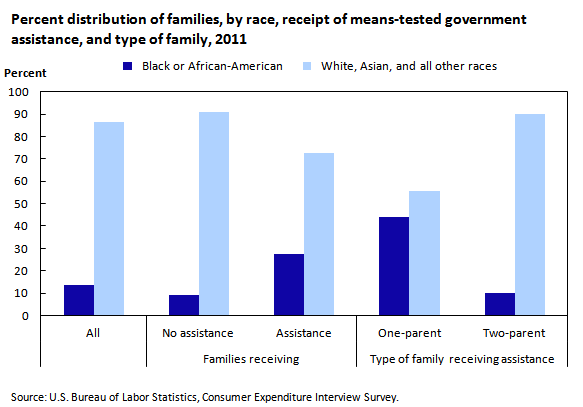
| Race | All | Families receiving | Type of family receiving assistance | ||
|---|---|---|---|---|---|
| No assistance | Assistance | One-parent | Two-parent | ||
Black or African-American | 13.7 | 9.2 | 27.6 | 44.2 | 9.9 |
White, Asian, and all other races | 86.4 | 90.8 | 72.5 | 55.8 | 90.2 |
The reference person was Hispanic or Latino in 16.8 percent of families with children under 18, with a range of 12.9 percent of families not receiving assistance to 40.5 percent of two-parent families receiving assistance. (See table 1 and chart 2.) Among one-parent families receiving assistance, female household heads predominated (93.2 percent, compared with 6.8 percent headed by men).7
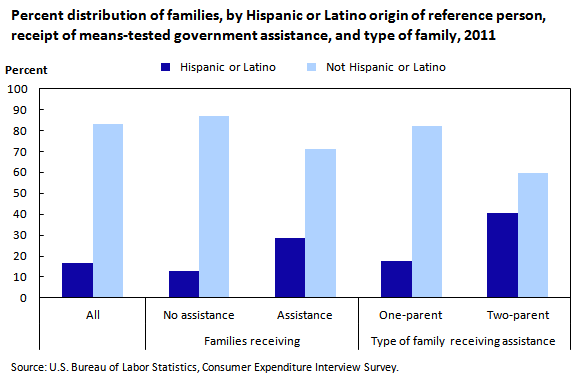
| Ethnicity | All | Families receiving | Type of family receiving assistance | ||
|---|---|---|---|---|---|
| No assistance | Assistance | One-parent | Two-parent | ||
Hispanic or Latino | 16.8 | 12.9 | 28.8 | 17.8 | 40.5 |
Not Hispanic or Latino | 83.2 | 87.1 | 71.2 | 82.2 | 59.5 |
In all families with children under 18, 11.2 percent had a reference person with less than a high school education. This proportion ranged from 6.1 percent of families not receiving assistance to 31.9 percent of two-parent families receiving assistance. In families not receiving assistance, 43.4 percent had a reference person with a bachelor’s degree or higher, compared with 7.4 percent of one-parent families and 11.1 percent of two-parent families receiving assistance. (See table 1 and chart 3.)
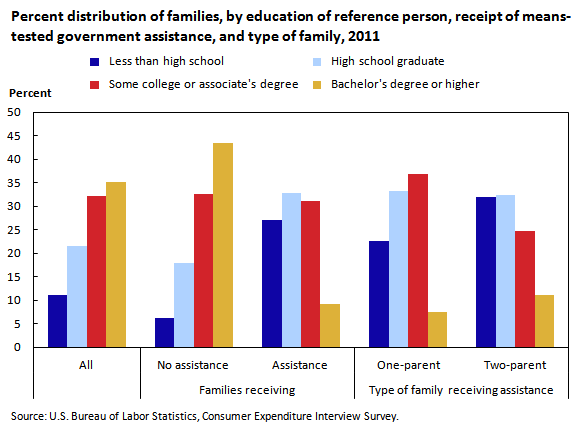
| Education level | All | Families receiving | Type of family receiving assistance | ||
|---|---|---|---|---|---|
| No assistance | Assistance | One-parent | Two-parent | ||
Less than high school | 11.2 | 6.1 | 27.0 | 22.5 | 31.9 |
High school graduate | 21.5 | 17.8 | 32.8 | 33.3 | 32.3 |
Some college or associate's degree | 32.3 | 32.7 | 31.0 | 36.8 | 24.8 |
Bachelor's degree or higher | 35.1 | 43.4 | 9.2 | 7.4 | 11.1 |
About 76 percent of families not receiving assistance were homeowners, compared with 24 percent of such families who were renters. The situation was reversed among families receiving assistance, with 26.5 percent homeowners and 73.5 percent renters. Two-parent families receiving assistance were more likely (36.5 percent) to be homeowners than one-parent families (17.1 percent).
Among families receiving government means-tested assistance, Medicaid was the program with the highest participation rate (69.7 percent). (See table 2.)8
| Program | Percent of families participating in program | Average annual amount received by participating families | ||||
|---|---|---|---|---|---|---|
| All | One-parent | Two-parent | All | One-parent | Two-parent | |
| Housing assistance | 25.9 | 41.1 | 9.6 | NA | NA | NA |
| Medicaid | 69.7 | 68.2 | 71.3 | NA | NA | NA |
| Public assistance | 10.7 | 15.7 | 5.1 | 2,713 | 2,666 | 2,867 |
| Supplemental Nutrition Assistance Program (SNAP) | 60.9 | 72.2 | 48.9 | 2,702 | 2,758 | 2,615 |
| Supplemental Security Income (SSI) | 12.5 | 14.2 | 10.7 | 6,994 | 5,998 | 8,402 |
| NOTE: ""NA"" stands for not available. Source: U.S. Bureau of Labor Statistics, Consumer Expenditure Interview Survey. | ||||||
SNAP benefits were reported by 60.9 percent of families receiving assistance. A greater proportion of one-parent families received SNAP benefits (72.2 percent, compared with 48.9 percent of two-parent families). For families with SNAP benefits, the average amount received was $2,702; one-parent families received an average of $2,758, not statistically different from the $2,615 received by two-parent families.9
Nearly 26 percent of families received housing assistance; one-parent families had a participation rate of 41 percent, compared with almost 10 percent for two-parent families.10
A small proportion (12.5 percent) of families received SSI benefits. One-parent families received SSI benefits averaging $5,998, not statistically different from the $8,402 received by two-parent families.11
Public Assistance had the lowest participation rate (10.7 percent), and the average benefit received was $2,713. Participation, however, was 15.7 percent for one-parent families, compared with 5.1 percent for two-parent families. Benefits averaged $2,666 for one-parent families and $2,867 for two-parent families, but these differences were not statistically significant.12
In 2011, total expenditures were more than twice as high for families not receiving assistance, $66,525, compared with $30,582 for families receiving assistance. Total expenditures for one-parent families receiving assistance were $24,780, roughly two-thirds of the $36,756 spent by two-parent families receiving assistance. Food, housing, and transportation accounted for the greatest proportion of the budget of all families. These three categories made up 65.5 percent of the total budget of families not receiving assistance, compared with 79.7 percent for one-parent and 75 percent for two-parent families receiving assistance. (See table 3.)
| Item | All | Families receiving | Type of family receiving assistance | |||||||
|---|---|---|---|---|---|---|---|---|---|---|
| No assistance | Assistance | One-parent | Two-parent | |||||||
| Dollars | Percent | Dollars | Percent | Dollars | Percent | Dollars | Percent | Dollars | Percent | |
| Total expenditures | $57,760 | 100.0 | $66,525 | 100.0 | $30,582 | 100.0 | $24,780 | 100.0 | $36,756 | 100.0 |
| Food | 8,788 | 15.2 | 9,539 | 14.3 | 6,460 | 21.1 | 5,709 | 23.0 | 7,259 | 19.7 |
| Food at home | 6,183 | 10.7 | 6,470 | 9.7 | 5,293 | 17.3 | 4,810 | 19.4 | 5,806 | 15.8 |
| Food away from home | 2,605 | 4.5 | 3,069 | 4.6 | 1,167 | 3.8 | 899 | 3.6 | 1,453 | 4.0 |
| Housing | 20,151 | 34.9 | 22,833 | 34.3 | 11,835 | 38.7 | 10,343 | 41.7 | 13,423 | 36.5 |
| Apparel and services | 1,505 | 2.6 | 1,628 | 2.4 | 1,123 | 3.7 | 1,009 | 4.1 | 1,245 | 3.4 |
| Transportation | 9,791 | 17.0 | 11,249 | 16.9 | 5,271 | 17.2 | 3,734 | 15.1 | 6,906 | 18.8 |
| Healthcare | 3,001 | 5.2 | 3,687 | 5.5 | 876 | 2.9 | 487 | 2.0 | 1,290 | 3.5 |
| Entertainment | 2,917 | 5.1 | 3,423 | 5.1 | 1,347 | 4.4 | 1,108 | 4.5 | 1,601 | 4.4 |
| Personal insurance and pensions | 7,354 | 12.7 | 9,116 | 13.7 | 1,890 | 6.2 | 1,011 | 4.1 | 2,826 | 7.7 |
| Other | 4,251 | 7.4 | 5,048 | 7.6 | 1,780 | 5.8 | 1,378 | 5.6 | 2,207 | 6.0 |
Housing expenditures were almost twice as high among families not receiving assistance ($22,833, compared with $11,835 for families receiving assistance). One factor affecting the difference in expenditures is the higher homeownership rate among families not receiving assistance. Another factor is the provision of public housing or housing subsidy payments for 26 percent of families receiving assistance. Although greater in dollar amount, housing expenditures represented a smaller share of total expenditures among families not receiving assistance (34.3 percent, compared with 38.7 percent for families receiving assistance).
Food expenditures were higher among families not receiving assistance, but accounted for a lower share of total expenditures than among families receiving assistance. A different pattern emerges when separately examining food at home and food away from home, the two components of food spending. Food away from home spending was higher in both dollar amount and percent of total spending among families not receiving assistance. One explanation is the prevalence of SNAP benefits, which can only be used for food at home, among families receiving assistance.13
Transportation expenses, both in dollars ($3,734) and as a percentage of the family budget (15.1 percent) were lowest among one-parent families receiving assistance. A major factor is the lower rate of automobile ownership among one-parent families. Almost 37 percent did not own a car, compared with almost 10 percent of two-parent families receiving assistance and 3 percent of families not receiving assistance. Transportation expenses were $11,249 for families not receiving assistance, but represented a smaller share of the family budget (16.9 percent) than the $6,906 spent by two-parent families, which accounted for 18.8 percent of the family budget.
Although clothing is a basic necessity, it claimed a relatively small proportion of the family budget of all families, ranging from 2.4 percent for families not receiving assistance to 4 percent for one-parent families receiving assistance.14
Healthcare was greatest in dollar amount ($3,728) and as a proportion (5.5 percent) of the budget of families not receiving assistance. Among families receiving assistance, healthcare spending averaged $487 (2.0 percent of the family budget) for one-parent and $1,290 (3.5 percent of the family budget) for two-parent families. One explanation is the fact that 70 percent of these families had Medicaid coverage for healthcare expenses. The data, however, do not indicate whether, all factors being equal, families with Medicaid benefits received the same services and quality of care as either families receiving no assistance or families receiving assistance other than Medicaid.
Personal insurance and pensions accounted for 13.7 percent of the budget of families not receiving assistance, compared with 6.2 percent for families receiving assistance. Families receiving assistance had fewer earners and so would be less likely to make pension contributions than families without assistance who had more earners.
Entertainment expenses were 5.1 percent ($3,423) of the budget of families not receiving assistance, compared with 4.4 percent ($1,347) of families receiving assistance. Other expenses15 claimed 7.6 percent of the budget of families not receiving assistance and 5.8 percent of the budget of those receiving assistance.
Although average family size was the same, average annual expenditures of families receiving assistance were less than half the amount spent by families not receiving assistance.
Food, housing, and transportation took up the greatest share of the family budget, regardless of whether any assistance was received. Families not receiving assistance spent more on food and on housing than families receiving assistance, but expenditures represented smaller proportions of the family budget, compared with families receiving assistance.
Healthcare spending was highest in dollar amount and as a percentage of the family budget among families receiving no assistance. One reason is that 70 percent of families receiving assistance had Medicaid coverage.
This Beyond the Numbers article was prepared by Ann C. Foster and William R. Hawk, economists in the Office of Prices and Living Conditions, Bureau of Labor Statistics. Email: foster.ann@bls.gov, telephone: (202) 691-5174, or hawk.william@bls.gov, telephone: (202) 691-5131.
Ann C. Foster and William R. Hawk, “Spending patterns of families receiving means-tested government assistance ,” Beyond the Numbers: Prices & Spending, vol. 2 / no. 26 (U.S. Bureau of Labor Statistics, December 2013), https://www.bls.gov/opub/btn/volume-2/spending-patterns-of-families-receiving-means-tested-government-assistance.htm
1 Means-tested programs are those that require an individual or family’s income and/or assets fall below specified thresholds to qualify for benefits.
The 2009 data are from the Survey of Income and Program Participation (SIPP), which examined participation in the following major means-tested programs: Temporary Assistance for Needy Families (TANF), General Assistance (GA), Supplemental Nutrition Assistance Program (SNAP), Supplemental Security Income (SSI), Medicaid, and housing assistance. For more information, see Jeongsoo Kim, Shelley K. Irving, and Tracy A. Loveless, “Dynamics of Economic Well-Being: Participation in Government Programs, 2004 to 2007 and 2009: Who Gets Assistance?” Current Population Reports, P70-130 (U.S. Census Bureau, July 2012), www.census.gov/prod/2012pubs/p70-130.pdf.
4 In the Consumer Expenditure Survey (CE), the consumer unit is the entity for which expenditure reports are collected. Consumer units include families, single persons living alone or sharing a household with others but who are financially independent, and two or more persons living together, who share expenses. For more information, see BLS Handbook of Methods, Chapter 16,”Consumer Expenditures and Income,” Bureau of Labor Statistics, www.bls.gov/opub/hom/cex/home.htm.
This analysis is limited to families with own children under 18, who currently live with the reference person. “Own children” in a family are sons and daughters, including stepchildren and adopted children, of the reference person.
13 Although SNAP benefits are not included in computing poverty statistics, the value of SNAP benefits is included as income in the CE. When requesting information on food purchases, the CE does not ask whether these purchases were made with cash or SNAP benefits.
Monthly income is the most important determinant of a family’s or household’s eligibility for SNAP benefits. A detailed process is involved in computing the net income used to determine eligibility, with standards varying somewhat by state. For more information, see “Characteristics of Supplemental Nutrition Assistance Program Households: Fiscal Year 2011” (U.S. Department of Agriculture, Food and Nutrition Service, November 2012), www.fns.usda.gov/sites/default/files/2011Characteristics.pdf.
Publish Date: Monday, December 16, 2013