
An official website of the United States government
 United States Department of Labor
An official website of the United States government
United States Department of Labor

The .gov means it's official.
Federal government websites often end in .gov or .mil. Before sharing sensitive information,
make sure you're on a federal government site.

The site is secure.
The
https:// ensures that you are connecting to the official website and that any
information you provide is encrypted and transmitted securely.
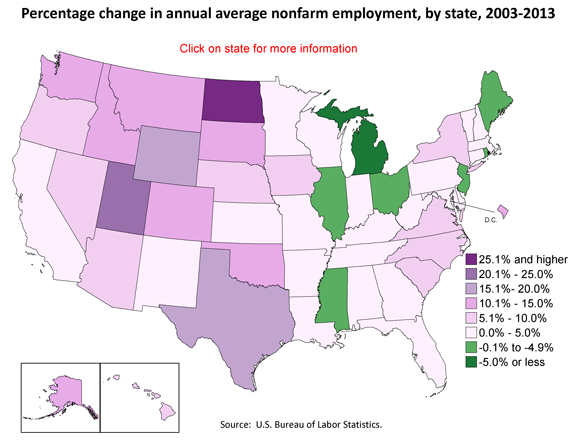
From 2003 to 2013, annual average nonfarm payroll employment increased in 43 states and the District of Columbia, and decreased in 7 states. The largest percentage increases in employment occurred in North Dakota (+33.6 percent), followed by Utah (+20.1 percent), Texas (+19.5 percent), and Wyoming (+16.2 percent).
State | 2003 employment | 2013 employment | Percent change |
|---|---|---|---|
Alabama | 1,875,600 | 1,903,400 | 1.5 |
Alaska | 298,200 | 335,800 | 12.6 |
Arizona | 2,299,200 | 2,515,200 | 9.4 |
Arkansas | 1,145,100 | 1,177,400 | 2.8 |
California | 14,557,800 | 15,147,400 | 4.1 |
Colorado | 2,152,800 | 2,381,100 | 10.6 |
Connecticut | 1,644,500 | 1,654,700 | 0.6 |
Delaware | 415,700 | 427,400 | 2.8 |
District of Columbia | 665,500 | 745,200 | 12.0 |
Florida | 7,232,600 | 7,579,200 | 4.8 |
Georgia | 3,870,300 | 4,033,400 | 4.2 |
Hawaii | 567,600 | 617,600 | 8.8 |
Idaho | 572,000 | 638,300 | 11.6 |
Illinois | 5,810,800 | 5,796,900 | -0.2 |
Indiana | 2,902,200 | 2,933,300 | 1.1 |
Iowa | 1,440,400 | 1,529,600 | 6.2 |
Kansas | 1,313,200 | 1,372,900 | 4.5 |
Kentucky | 1,783,300 | 1,835,000 | 2.9 |
Louisiana | 1,905,500 | 1,951,000 | 2.4 |
Maine | 606,800 | 601,700 | -0.8 |
Maryland | 2,486,500 | 2,596,100 | 4.4 |
Massachusetts | 3,209,200 | 3,356,000 | 4.6 |
Michigan | 4,415,900 | 4,104,500 | -7.1 |
Minnesota | 2,660,300 | 2,777,200 | 4.4 |
Mississippi | 1,116,400 | 1,111,900 | -0.4 |
Missouri | 2,681,700 | 2,729,800 | 1.8 |
Montana | 400,300 | 448,800 | 12.1 |
Nebraska | 913,700 | 978,300 | 7.1 |
Nevada | 1,088,300 | 1,175,700 | 8.0 |
New Hampshire | 617,700 | 640,100 | 3.6 |
New Jersey | 3,977,100 | 3,934,800 | -1.1 |
New Mexico | 775,600 | 811,300 | 4.6 |
New York | 8,399,400 | 8,908,500 | 6.1 |
North Carolina | 3,786,900 | 4,056,900 | 7.1 |
North Dakota | 332,600 | 444,300 | 33.6 |
Ohio | 5,397,700 | 5,252,400 | -2.7 |
Oklahoma | 1,471,000 | 1,633,100 | 11.0 |
Oregon | 1,574,100 | 1,673,700 | 6.3 |
Pennsylvania | 5,614,000 | 5,742,500 | 2.3 |
Rhode Island | 484,300 | 470,800 | -2.8 |
South Carolina | 1,804,200 | 1,896,600 | 5.1 |
South Dakota | 378,400 | 417,100 | 10.2 |
Tennessee | 2,662,700 | 2,749,700 | 3.3 |
Texas | 9,366,900 | 11,190,200 | 19.5 |
Utah | 1,074,100 | 1,289,900 | 20.1 |
Vermont | 299,200 | 306,000 | 2.3 |
Virginia | 3,504,000 | 3,763,900 | 7.4 |
Washington | 2,700,500 | 2,987,000 | 10.6 |
West Virginia | 726,900 | 763,100 | 5.0 |
Wisconsin | 2,773,800 | 2,818,100 | 1.6 |
Wyoming | 250,000 | 290,500 | 16.2 |
The largest percentage decreases in payroll employment from 2003 to 2013 were recorded by Michigan (−7.1 percent), Rhode Island (−2.8 percent), and Ohio (−2.7 percent).
From March 2013 to March 2014, nonfarm employment increased in 45 states and the District of Columbia and decreased in 5 states. The largest over-the-year percentage increase occurred in North Dakota (+4.5 percent), followed by Nevada (+3.8 percent) and Florida (+3.0 percent). The largest over-the-year percentage decreases in employment occurred in Alaska, Kentucky, and New Mexico (-0.2 percent each).
These data are from the Current Employment Statistics (State and Metro Area) program. Data for the most recent month are preliminary and subject to revision. To learn more, see "Regional and State Employment and Unemployment — March 2014" (HTML) (PDF), news release USDL-14-0606.
Bureau of Labor Statistics, U.S. Department of Labor, The Economics Daily, North Dakota has largest percentage increase in employment from 2003 to 2013 at https://www.bls.gov/opub/ted/2014/ted_20140424.htm (visited October 11, 2026).


