
An official website of the United States government
 United States Department of Labor
An official website of the United States government
United States Department of Labor

The .gov means it's official.
Federal government websites often end in .gov or .mil. Before sharing sensitive information,
make sure you're on a federal government site.

The site is secure.
The
https:// ensures that you are connecting to the official website and that any
information you provide is encrypted and transmitted securely.


Artificial Intelligence (AI) has captured the interest of economists, policy makers, workers, and the public. How can we track the development of AI and its effect on workers and the economy? One metric to investigate is productivity. BLS productivity measures are useful for tracking changes in efficiency—the quantity of output produced for each unit of input. Changes in technology are one reason why productivity might increase over time.
BLS produces productivity and related measures for the economy as a whole as well as for sectors and industries. This includes data on the inputs to production: labor, capital, energy, materials, and services.
BLS implicitly captures AI use through its capital measure of software used in production. Software is a part of the asset category Intellectual property products (IPP).
As with any technological advancement there is a lot that goes into the production process. With AI, different industries will adopt the advancement in different stages. A lot of this process can be tracked using the industry data available on the BLS productivity tables page.
Exploring and measuring how AI is changing the economy ensures relevance in describing the dynamic U.S. economy and respond to evolving needs.
Artificial intelligence is an emerging technological innovation in many aspects of production and across many industries. The U.S. Bureau of Labor Statistics (BLS) implicitly captures AI use through its capital measure of software used in production. A May 2026 article, "AI and the rise of software investment," uses data from the BLS productivity program to break down recent investment growth by asset category and, more specifically, to examine recent investment in the software category.
New research on "AI exposure and industry productivity growth" presented at the National Academies AI Day for the Federal Statistics looks at the question "Do industries with greater AI exposure experience faster productivity growth?" and finds industry exposure is strongly positively related to labor productivity. This research also looks at how industry AI exposure is related to various capital measures and finds that highly exposed industries are becoming more capital intensive.
In addition, the following graphic shows how AI is moving through the economy, with each stop along the road associated with a chart below the graphic using productivity data.
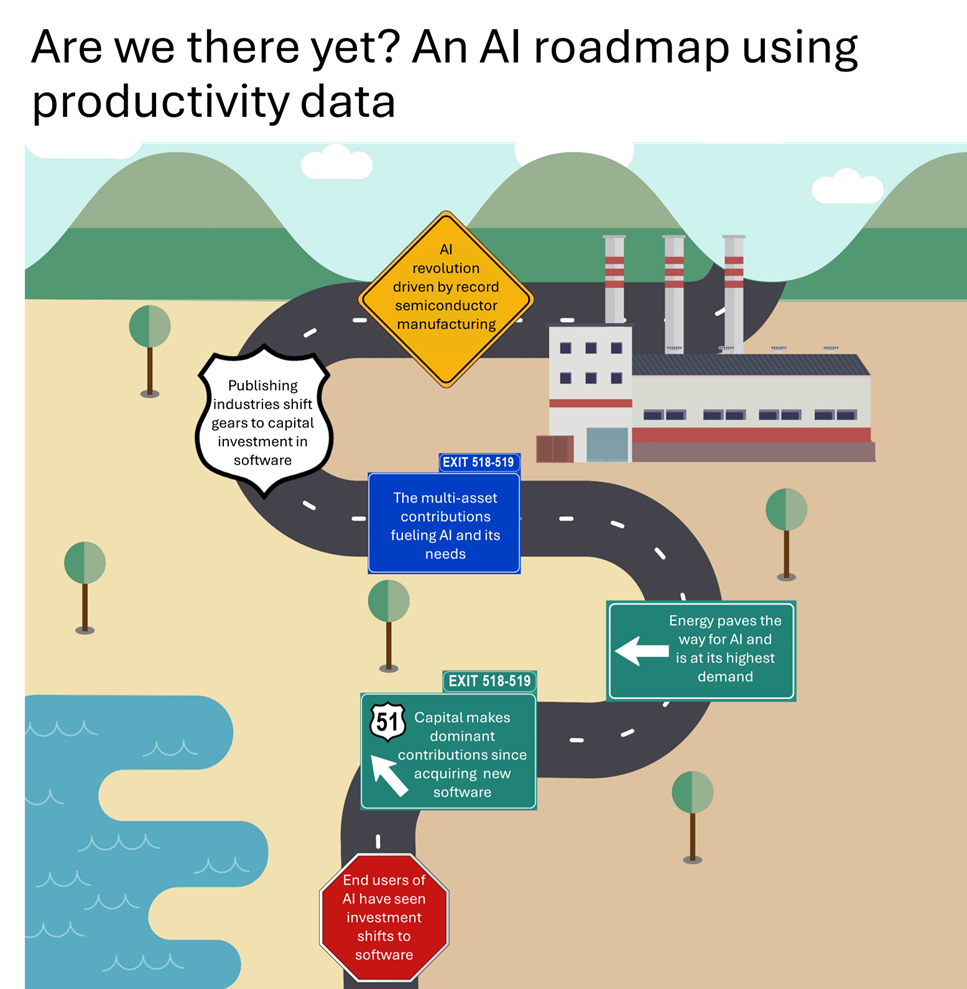
See the AI and productivity data presented in the AI Roadmap graphic and charts.
Last modified date: June 8, 2026