An official website of the United States government
 United States Department of Labor
An official website of the United States government
United States Department of Labor

The .gov means it's official.
Federal government websites often end in .gov or .mil. Before sharing sensitive information,
make sure you're on a federal government site.

The site is secure.
The
https:// ensures that you are connecting to the official website and that any
information you provide is encrypted and transmitted securely.

| November 2026
The aviation industry plays a significant role in our economy, enabling the transportation of goods and people throughout the country and the world. This industry encompasses a range of activities, such as airport and ground operations, aircraft maintenance and repair, and air traffic management. These areas employ a large variety of air transportation workers, who collectively ensure that people and cargo are transported safely.
Keep reading to learn more about some of these occupations, including what they do, how to prepare to enter them, what their wages were in 2025, what their employment prospects look like, and the factors expected to drive demand for their services.
Workers in the following occupations are involved in various aspects of air transportation, including flight operations, ground support, airport operations, and aircraft repair and maintenance.
Airline pilots, copilots, and flight engineers pilot and navigate the flight of fixed-wing aircraft, usually on scheduled air carrier routes, for the transport of passengers and cargo.
Commercial pilots fly and navigate fixed-wing aircraft on nonscheduled air carrier routes (such as for charter flights or aerial applications in agriculture and other industries) or fly and navigate helicopters.
Flight attendants monitor safety of the aircraft cabin, provide routine services to airline passengers, and respond to emergency incidents.
Airfield operations specialists ensure the safe takeoff and landing of commercial and military aircraft.
Aircraft service attendants service aircraft with fuel. They may also de-ice aircraft, empty sewage tanks, service air and oxygen systems, refill water or cooling agents, or clean and polish the exterior.
Reservation and transportation ticket agents and travel clerks take and confirm passengers’ bookings, answer questions, check bags, and issue boarding passes.
Air traffic controllers coordinate the movement of aircraft to maintain safe distances between them.
Aircraft mechanics and service technicians perform scheduled maintenance, make repairs, and complete inspections of aircraft systems and equipment.
Avionics technicians install, inspect, test, adjust, or repair avionics equipment in aircraft or space vehicles.
There are widespread employment opportunities for workers in these selected occupations. Most of these occupations are projected to see employment grow faster than the all-occupation average, which is projected to grow 3.5 percent from 2025 to 2035. Similarly, regarding pay, most of the selected air transportation occupations earned an annual wage that exceeded the median annual of $50,980 for all workers in 2025.
Demand for employment for selected air transportation occupations is expected to be strong. As chart 1 shows, nearly all selected aviation occupations are projected to see above-average job growth from 2025 to 2035. For example, employment of flight attendants is expected to grow 8.8 percent over the projections decade, more than twice as fast as the 3.5-percent average for all occupations. In addition to having the second-fastest employment growth of all selected occupations, flight attendants is projected to add the most jobs (11,800) of these nine occupations.
The main factor that underpins demand for air transportation workers is aviation activity, which itself is driven by demand for air travel and air cargo. Demand for air travel, particularly leisure travel, is expected to increase as the economy continues to grow and disposable incomes rise. At the same time, a growing digital economy and evolving consumer shopping habits should continue to fuel e-commerce growth and thus air freight activity. As a result, aviation activity is expected to increase over the decade, fueling demand for these workers.
As with flight attendants, airline pilots is projected to see much faster than average job growth (+8.3 percent) from 2025 to 2035. Both of these occupations are expected to be needed to operate and service an increasing number of flights that will result from more demand for air travel. Demand for commercial pilots should likewise increase (+5.2 percent) from 2025 to 2035, as a growing number of individuals and firms opt to fly private.
The growth in air traffic will likely also lead to an increase in operations and support services at airports. These increased labor demands are expected to drive job growth for the workers who provide these services, namely reservation and transportation ticket agents and travel clerks, aircraft service attendants, and airfield operations specialists. In addition, greater aviation activity and the resulting maintenance requirements are expected to lead to employment growth of aircraft mechanics and service technicians and avionics technicians, with the latter projected to grow the fastest (+9.4 percent) of all selected occupations from 2025 to 2035. Meanwhile, the deployment of various technologies that make air traffic management more efficient is expected to limit expected job gains for air traffic controllers, resulting in slower projected employment growth (+1.7 percent) than the all-occupation average over the 2025–35 period.
In addition to favorable employment prospects, careers in aviation typically pay well. (See chart 2.) Seven of the nine selected occupations had median annual wages that were higher than the median wage for all occupations in 2025 ($50,980). Airline pilots, copilots, and flight engineers was the highest paid aviation occupation ($232,140), and also ranked among the top 25 highest paid occupations in 2025. Aircraft service attendants ($40,450) and reservation and transportation ticket agents and travel clerks ($44,390) had the lowest wages of the selected aviation occupations.
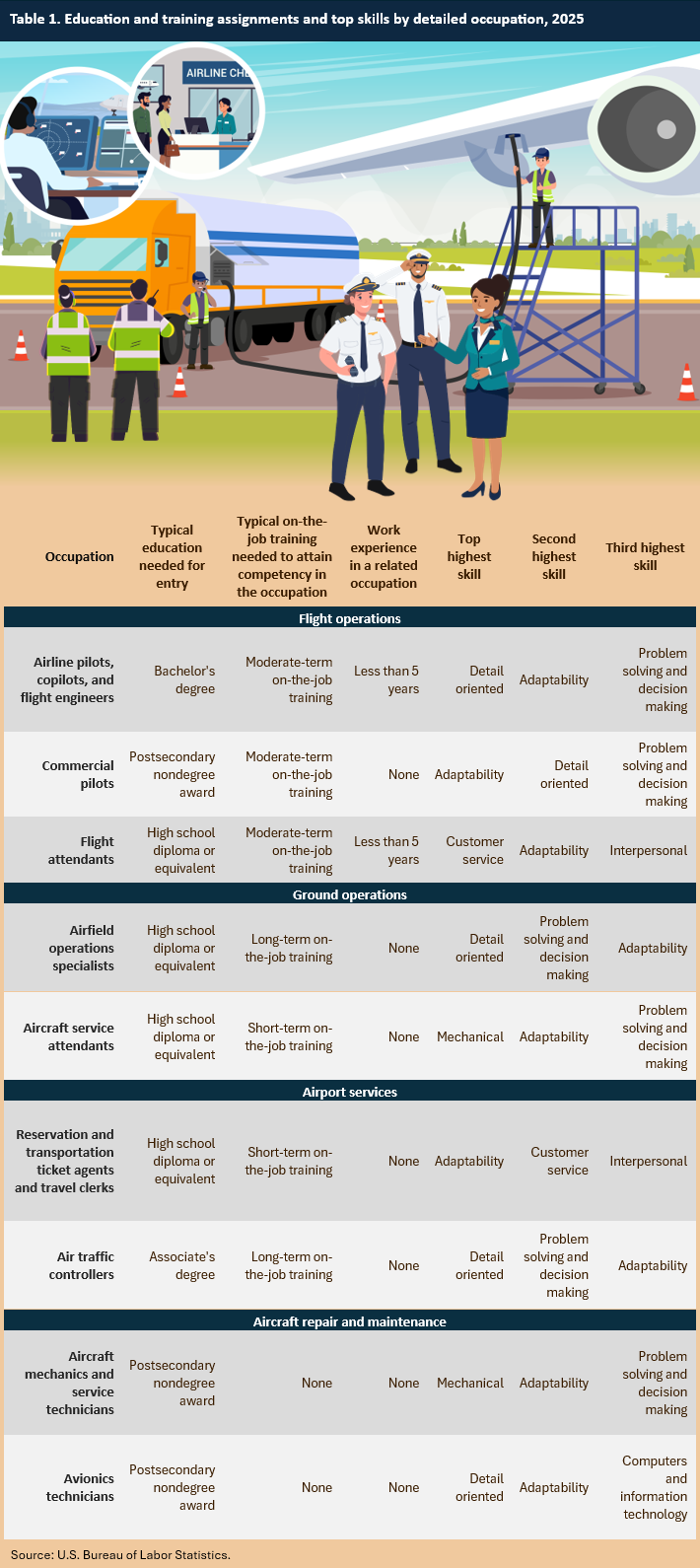
Most of the selected aviation occupations typically require a high school diploma or equivalent or a postsecondary nondegree award for entry as well as on-the-job training for competency. Being adaptable, good at problem solving and decision making, and detail oriented are important skills for most of these occupations, but customer service, mechanical, or computer and IT skills may also be needed depending on the job. See table 1 for typical education needed for entry, training, and work experience information for these selected occupations as well as their top three skills.
Several aviation occupations (for example, airfield operations specialists and flight attendants) typically require a high school diploma or equivalent for entry. (See table 1.) Due to federal regulations in air transportation, some occupations, such as aircraft mechanics and service technicians, require specialized postsecondary education recognized by the Federal Aviation Administration (FAA).
Two of the nine selected occupations typically require a college degree for entry. Airline pilots typically need a bachelor’s degree. Air traffic controllers typically need an associate’s degree, which must be completed at an FAA-approved Air Traffic-Collegiate Training Initiative (AT-CTI) program.
As table 1 shows, most air transportation occupations typically require some form of on-the-job training. Airline and commercial pilots undergo on-the-job training in accordance with federal regulations. This training usually includes several weeks of ground school and flight training, which can be completed with independent FAA-certified flight instructors or at schools that offer flight training. Airline and commercial pilots must have specific certificates and ratings from the FAA, which usually include completing flight hour requirements. To get a job with a major or regional airline, pilots also need extensive flight experience, such as operating charter jets or military aircraft.
For flight attendants, airlines provide initial training that typically lasts for several weeks or a few months. This training usually takes place at the airline’s flight training center and is required for FAA certification. Flight attendants typically also need 1 or 2 years of prior work experience in a service occupation, such as working in retail or food and beverage service, before getting their first job as a flight attendant.
Most newly hired air traffic controllers are trained at the FAA Academy in Oklahoma City, with the length of training varying with the candidate’s background.
Aircraft service attendants and reservation and transportation ticket agents and travel clerks typically need short-term on-the-job training, usually lasting a few weeks.
Workers who learn these skills and perform similar jobs in the military usually qualify for related civilian jobs, such as military pilots and military air traffic controllers.
The U.S. Bureau of Labor Statistics (BLS) provides information about the importance of skills for occupations. Table 1 shows that being adaptable is an important skill for aviation occupations. For instance, airline pilots, copilots, and flight engineers; commercial pilots; and flight attendants must all be able to act decisively, especially in emergencies, while air traffic controllers must be able to adapt to changes in weather, route schedules, and other variables while monitoring multiple aircraft’s locations.
The ability to use proper judgment to solve problems and make decisions is highly important for most of these occupations as well. For example, airline and commercial pilots must be able to identify complex problems and figure out appropriate solutions, while airfield operations specialists may encounter a range of problems in their work coordinating the safe takeoff and landing of aircraft, such as dealing with adverse weather conditions or managing the presence of wildlife on airport grounds.
Being detail oriented is also important for more than half of these occupations. For instance, avionics technicians must know how to adjust aircraft parts and avionics equipment precisely and to observe gauges and flight data to diagnose problems.
The occupations highlighted in this article are not the only ones that may work in air transportation. For example, transportation security screeners screen passengers and baggage in airport security and hand laborers and material movers load and unload passenger baggage and cargo onto planes.
Explore the Occupational Outlook Handbook (OOH) for detailed information about job duties, typical training requirements, wages, and more for the occupations highlighted in this article—and for hundreds of others. Visit the BLS skills data page for information about which skills are most relevant for more than 800 occupations.
Projections data are available from the BLS Employment Projections program. Wage data are from the BLS Occupational Employment and Wage Statistics (OEWS) program.
Javier Colato and Lindsey Ice, "Piloting your career: Jobs in aviation," Career Outlook, U.S. Bureau of Labor Statistics, November 2026.