
An official website of the United States government
 United States Department of Labor
An official website of the United States government
United States Department of Labor

The .gov means it's official.
Federal government websites often end in .gov or .mil. Before sharing sensitive information,
make sure you're on a federal government site.

The site is secure.
The
https:// ensures that you are connecting to the official website and that any
information you provide is encrypted and transmitted securely.


The IIF program produces a wide range of statistics on workplace fatal and nonfatal injuries and illnesses by industry and worker characteristics. More information about our program and the statistics we produce can be found here.
The Survey of Occupational Injuries and Illnesses (SOII) reports estimates of nonfatal injuries and illnesses for private industry, state and local governments. Current exceptions include workers on farms with 10 or fewer employees, private household workers, volunteers, and federal government workers. For more information, see our Handbook of Methods.
The Census of Fatal Occupational Injuries (CFOI) is a comprehensive national measure of all fatal workplace injuries. For more information, see our Handbook of Methods.
The most recently published nonfatal incidence rates by industry can be found here.
No. BLS does not provide estimates for costs associated with workplace injuries.
BLS has funded multiple research projects that examined the completeness and quality of the occupational injury and illness data collected by the SOII. These studies found that the SOII did not capture some cases that appeared to be within its scope; however, the estimated magnitude of the undercount varied depending on the methodology employed by the researchers.
For additional background information on the completeness of the SOII injury and illness counts and an update on current research see the SOII data quality research page.
The variation in estimates is measured by the percent relative standard error (RSE), which is used to calculate confidence intervals around sample estimates and test comparative statements. The IIF program publishes RSEs on its website to one decimal place for ease of display but may calculate confidence intervals and conduct significance tests using RSEs at higher levels of precision. As a result, public users who conduct their own significance tests from published RSEs may, from time to time, get slightly different results than BLS. Additional information on the reliability of IIF estimates and the calculation of confidence intervals can be found at https://www.bls.gov/iif/additional-resources/reliability-of-estimates.htm.
Differences between BLS published estimates for the rail transportation industry and data published by the FRA are mainly due to differences in the scope of the published data. To best align with scope of SOII collection, BLS includes injuries and illnesses that are excluded from published FRA data. Particularly, BLS may include injuries and illnesses to employees not on duty, contractors, volunteers, and workers injured off railroad property. FRA-published data include only injury or illness cases for on-duty railroad employees. In addition to differences in scope, SOII estimation methodologies may also introduce some small differences between results published by both agencies. BLS will implement changes that will mitigate these small methodological differences; however, differences in scops will remain.
You can assess your establishment's safety record by comparing your incidence rate relative to the national rates for similar establishments.
Industry (nonfatal) injury and illness rates from the most recent published data can be found here.
Information on calculating your firm's incidence rate can be found here.
For information on how to complete the survey, see our Survey Respondents page.
Data provided to the Bureau of Labor Statistics by respondents is strictly confidential. BLS does not share this information.
For more information, see the Data Integrity Guidelines and Confidentiality Pledge and Laws. For information on establishments that may have been cited for workplace violations or for other regulatory guidelines, contact the Occupational Safety and Health Administration (OSHA).
There are multiple ways to access IIF data.
Often, depending on the level of information sought, the information may be found in our resource tables.
Nonfatal data — Injury and illness data by industry. These data are released annually.
Nonfatal data (case circumstances and worker demographics) — Details on the injured or ill worker and case circumstances including the event, source, nature, and part of body involved in the injury or illness are available for cases involving days away from work, job transfer, or restriction. These data are released every other year (biennially).
Fatal data — Total counts of fatal workplace injuries, including details on the injured worker, event leading to injury, and source of injury.
For a more customized browsing experience, we recommend using the Data Profiles tool.
Yes. BLS allows eligible researchers the opportunity to gain access to restricted data files for select statistical research projects. Access to microdata for the Survey of Occupational Injuries and Illnesses (SOII) and Census of Fatal Occupational Injuries (CFOI) programs are available in one of our Federal Statistical Research Data Centers (FSRDCs) throughout the country and onsite at BLS in Washington, D.C. More information can be found here. Access to a research file requires a well-defined research question that must go through an approval process that takes approximately 6 months.
The CFOI micro fatality research file is also available to access through the BLS Virtual Data Enclave (VDE). Access to the CFOI research file through the VDE requires the same application and approval process as onsite access.
For more information, the IIF program can be reached at (202) 691-6170 or by e-mailing IIF Staff.
The ".txt" files in each section explains the data available for that series. You can use the ".txt" file to extract data from the other files in the directory.
Note that our coding systems that are the foundation of the data have changed over the years so use caution when comparing data across series breaks.
Each flat file has a data point associated with a unique Series ID. More information on Series ID formats and downloading data prior to 2003 is here.
BLS can provide data in addition to what is available online. If you have a specific data request, contact us to see if this is something we can provide.
If there is specific information that you would like to request, the IIF program can be reached at (202) 691-6170 or by submitting a data request online.
Starting with the reference year 2019, CFOI modernized its disclosure methodology further strengthening its protection of confidential data. As a result of these necessary protections there are fewer publishable counts in CFOI. Disclosure protection is always an ongoing balance between protecting confidential data from disclosure and providing useful data to users.
Individually identifiable data collected by the CFOI are used exclusively for statistical purposes and are protected under the Confidential Information Protection and Statistical Efficiency Act of 2002 (CIPSEA). These data are collected under a pledge of confidentiality and therefore require BLS to prevent disclosure of identifying information of decedents.
If fatal injury counts at an individual ownership level (i.e., private, federal, state, local) are not available, you may find more data at the “All ownership” level. You can get these data by running an Industry Profile for “All ownerships” in the Profiles Tool. In the Profiles Tool, select “Fatal Injuries Numbers,” then follow these steps:
This will generate either an Excel or HTML table.
Occupational injuries and illnesses collected in the 2020 and 2021 SOII include cases of COVID-19 when a worker was infected as a result of performing their work-related duties and met other recordkeeping criteria. COVID-19 is considered a respiratory illness under criteria established by the Occupational Safety and Health Administration (OSHA). The SOII collects detailed case information, including nature, for incidences requiring at least one day away from work and codes these cases using the Occupational Injury and Illness Classification System (OIICS). While OIICS does not include a code specifically for COVID-19, applicable days away from work cases were included in the Nature code 3299 – “Other diseases due to viruses, not elsewhere classified.” Additionally, these cases were coded under the following categories based on the Occupational Injuries and Illnesses Classification System, version 2.01:
For more information on the impact of the coronavirus (COVID-19) pandemic on SOII and CFOI, see: https://www.bls.gov/covid19/effects-of-covid-19-on-workplace-injuries-and-illnesses-compensation-and-occupational-requirements.htm.
Selected data for Nature code 3299 and additional discussion of how COVID-19 is reflected in the SOII can be found at https://www.bls.gov/iif/factsheets/how-covid-19-is-reflected-in-the-soii-data.htm.
In 2022, the Injuries, Illnesses, and Fatalities (IIF) website was redesigned to improve navigation and organization. As part of that, some webpage addresses and data table file names were changed.
If you’re looking for a page or data table that existed before the redesign, use the IIF website redesign crosswalk (XLSX) to find the current webpage or filename.
If you still can’t locate the information you’re looking for, please contact the IIF program for assistance: IIFStaff@bls.gov.
BLS recently redesigned the IIF website to improve navigation and include more dynamic pages. As part of the redesign, many of the historical data tables were removed from the website but are available upon request. These data also remain available through our databases and through the Profiles Tool.
No. OSHA's Injury Tracking Application (ITA)is an electronic reporting requirement for establishments developed and maintained by OSHA. The SOII is a survey of establishments administered by BLS for statistical purposes. Some employers may be required to report to OSHA and may also be sampled for participation in the SOII.
More information on OSHA electronic reporting requirements can be found here.
In some instances, yes. Some respondents will be able to provide their OSHA identification number (OSHA ID) to import to BLS the data that they have submitted to the OSHA ITA in that same year. If BLS can successfully match establishment information with information reported to OSHA, data that have been reported to the OSHA ITA will be automatically imported into the SOII Internet Data Collection Facility (IDCF). Imported data are taken from the OSHA 300A form, “Summary of Work-Related Injuries and Illnesses.” Additional information may need to be entered manually to complete the SOII.
BLS has implemented several matching criteria in addition to the OSHA ID to ensure the confidentiality and security of SOII respondents, and to ensure that the establishment matches the location(s) sampled by the SOII.
The OSHA ID number is sent to a respondent by OSHA once they enter their information into the OSHA ITA system. The OSHA ID would appear in a confirmation email sent by OSHA from DoNotReply@osha.gov with the subject “OSHA Injury and Illness Report: Successful Submission(s).”
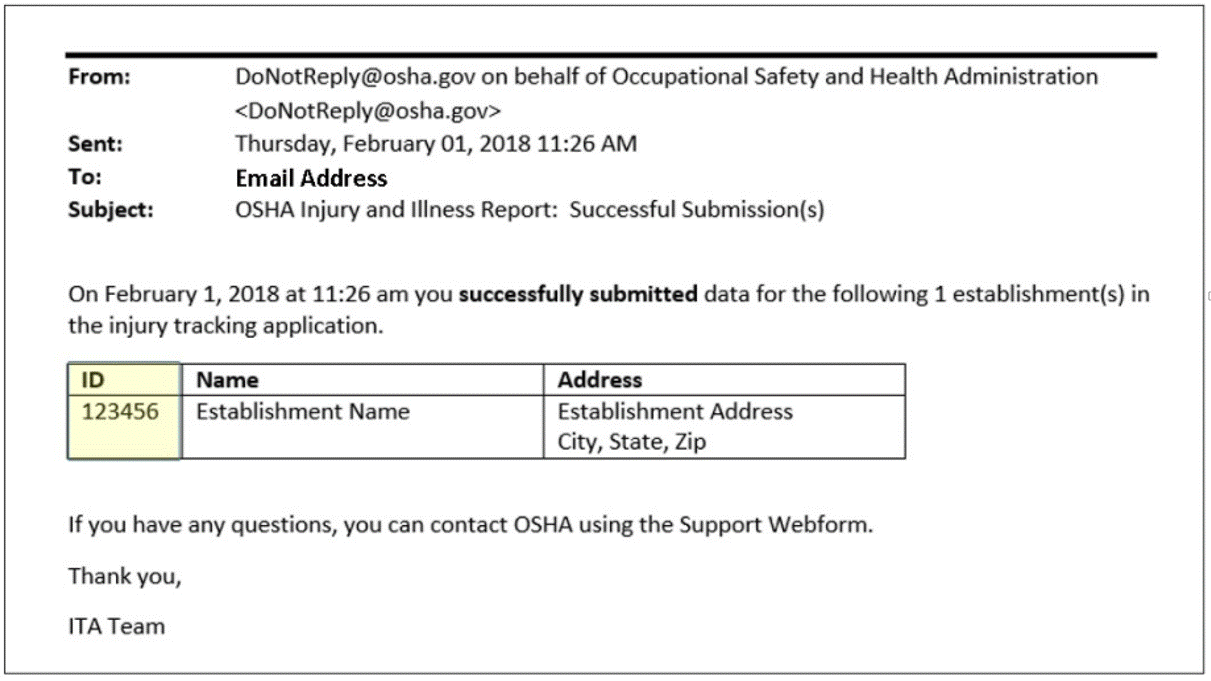
No. If you receive a mandatory survey from BLS and are required also to provide information to OSHA, you must submit it to both agencies.
Yes. Case and demographic estimates for Days Away from Work (DAFW) and for Days of Job Transfer or Restriction (DJTR) cases are produced biennially (every 2 years), starting with combined data from reference years 2021 and 2022 that were published in November 2023. The final single year DAFW estimates were for reference year 2020 that was published in November 2021.
A series of studies, in select industries, conducted by BLS to collect data for occupational injuries and illnesses that resulted in days of job transfer or restriction (DJTR) for reference years 2011 through 2019 provided important insights into workplace safety and health data that were previously unavailable. Analysis of DJTR data showed that their inclusion provides a more complete understanding of the circumstances leading to occupational injuries and illnesses than DAFW cases alone.
For more information, see information on the DJTR pilot study page: https://www.bls.gov/iif/nonfatal-injuries-and-illnesses-tables/soii-case-and-demographic-characteristics-historical-data/days-of-job-transfer-or-restriction.htm
Yes. The biennial publication of estimates for case circumstances and worker demographics beginning with reference years 2021-2022 is intended to provide the same level of detail among DJTR and DAFW cases as was previously available only for DAFW cases.
BLS changed the case and demographic estimates to a biennial publication cycle to be able to collect nationwide all-industry case details for DJTR cases without additional agency resources or respondent burden. After the BLS DJTR pilot concluded, it was determined that a biennial publication would support the dissemination of these new important estimates which would otherwise not be available.
Last Modified Date: August 04, 2026