
An official website of the United States government
 United States Department of Labor
An official website of the United States government
United States Department of Labor

The .gov means it's official.
Federal government websites often end in .gov or .mil. Before sharing sensitive information,
make sure you're on a federal government site.

The site is secure.
The
https:// ensures that you are connecting to the official website and that any
information you provide is encrypted and transmitted securely.


Occupational openings provide an estimate of opportunities for new workers to enter an occupation. Estimates of occupational openings are used for career information and workforce development purposes to give a more complete picture of the demand for workers.
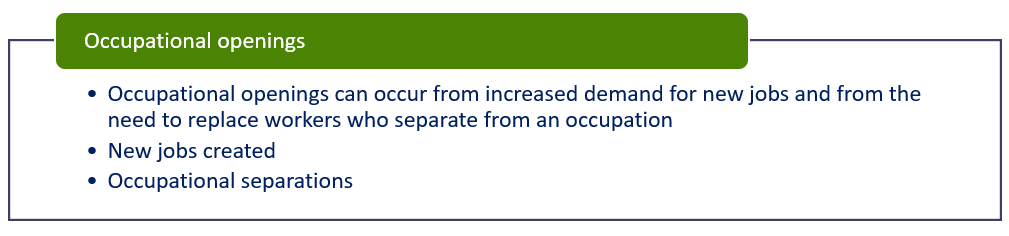
Occupational openings are defined as the sum of net occupational employment change (new jobs) and occupational separations. Occupational openings indicate that opportunities often exist in occupations with flat or declining employment where the incumbent worker has left the occupation.
To project occupational openings, the U.S. Bureau of Labor Statistics (BLS) calculates an estimate of separations caused by workers exiting the labor force (labor force exits) [1] due to retirement or other reasons, and separations caused by workers transferring to different occupations (occupational transfers). Workers who change jobs within an occupation do not generate openings since there is no net change in openings from this movement.
In most occupations, openings due to separations of existing workers provide many more opportunities than employment growth does.

More information about occupational separations, including a list of frequently asked questions, are available online.
The Employment Projections (EP) program has more details on methodology and concepts throughout the BLS Handbook of Methods. For additional information about the EP program, please contact us at (202) 691-5700 or ep-info@bls.gov.
[1] This isn't it's own category; rather, it's a description of the aforementioned "workers exiting the labor force".
Last modified date: August 27, 2026